E-Paper



Complexity of pursuing 'swadeshi' in present era | Number Theory
.

 Prefer HTon Google


Prime Minister Narendra Modi made two back-to-back appeals for buying “Swadeshi” or Make in India while touring his home state of Gujarat last week. While he called on shops to display Swadeshi boards outside their shops on Monday, he had a more nuanced definition of Swadeshi on Tuesday while speaking at the Maruti Suzuki electric vehicle factory. “My definition of swadeshi is simple. I do not have any concern about whose money it is—whether it is dollars or pounds, or whether it comes from white or black [people]. What matters is that the sweat and the hard work should be Indian,” Modi said at the inauguration. The Prime Minister’s comment merits a detailed examination of India’s trade patterns which reveal pursuing “Swadeshi” in whichever form is not a simple thing in today’s day and age.
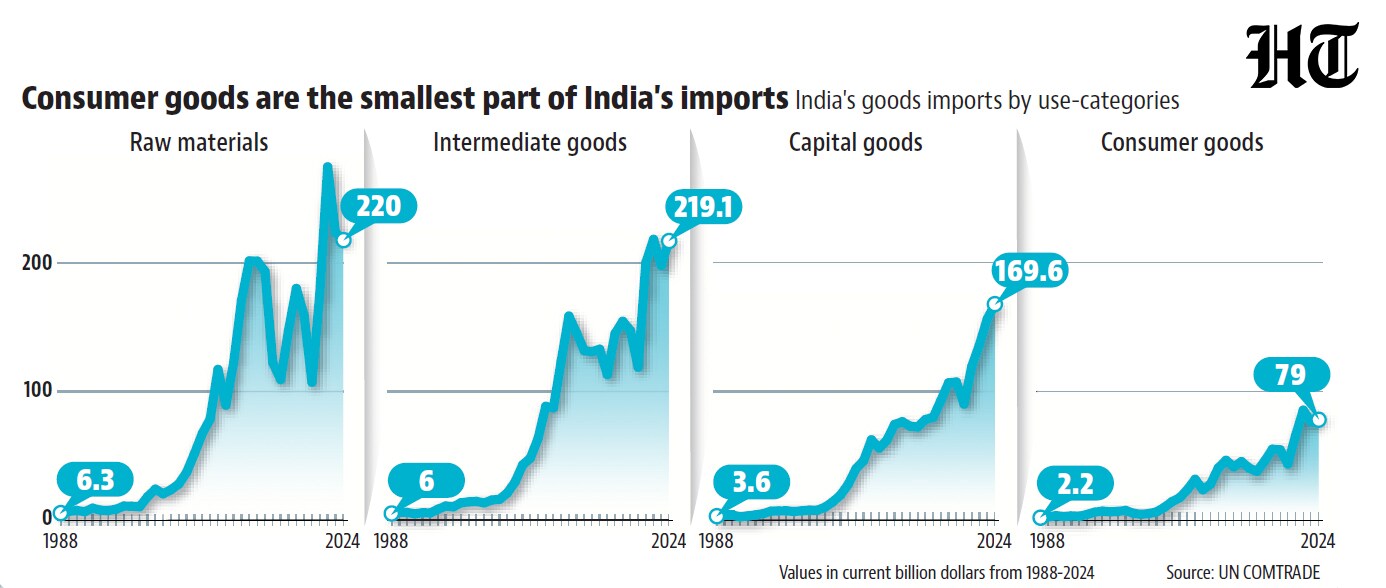
 Buying 'Swadeshi' from shops will only have a small impact on India’s importsThe UN COMTARDE database classifies goods imports and exports for countries by four broad categories: raw materials, intermediate goods, consumer goods and capital goods. A nudge to shopkeepers or consumers to buy swadeshi would be primarily directed at the consumer goods category. Consumer goods, however, were just about one-tenth of India’s total merchandise imports in 2024. In fact, a comparison of absolute value and import share of this category shows that its relative importance in imports has fallen from a peak of around 20% in the mid-1990s to just above 10% in the recent period. While the absolute value of consumer goods imports continues to increase, the other three sub-categories, especially raw materials and intermediate goods, have seen a faster increase in imports.
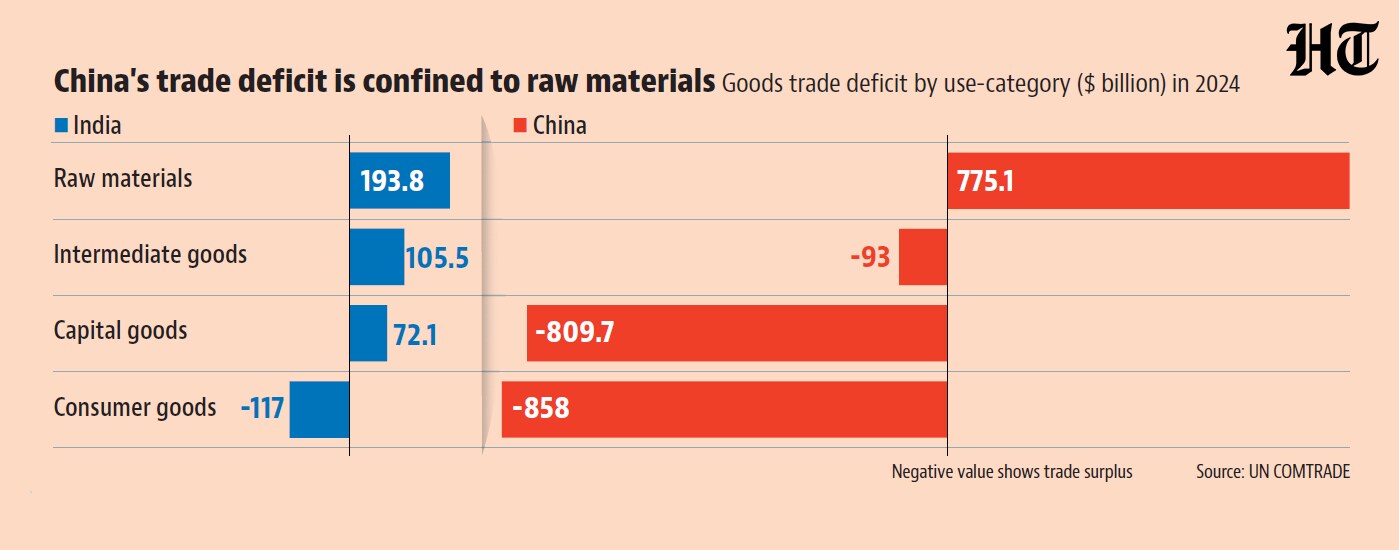
- What's needed is a boost to value additionChinese goods imports in 2024 were worth $2.453 trillion, almost four times Indian imports of $687 billion. However, China exported goods worth $3.4 trillion against India’s $433 billion worth of exports. Clearly, what China does much better than India is value addition in its economy. This can be seen clearly in a use-category wise classification of merchandise trade balance for India and China. While India’s trade surplus is confined to just consumer goods, China has a trade surplus, much bigger than India, in every category except raw materials.
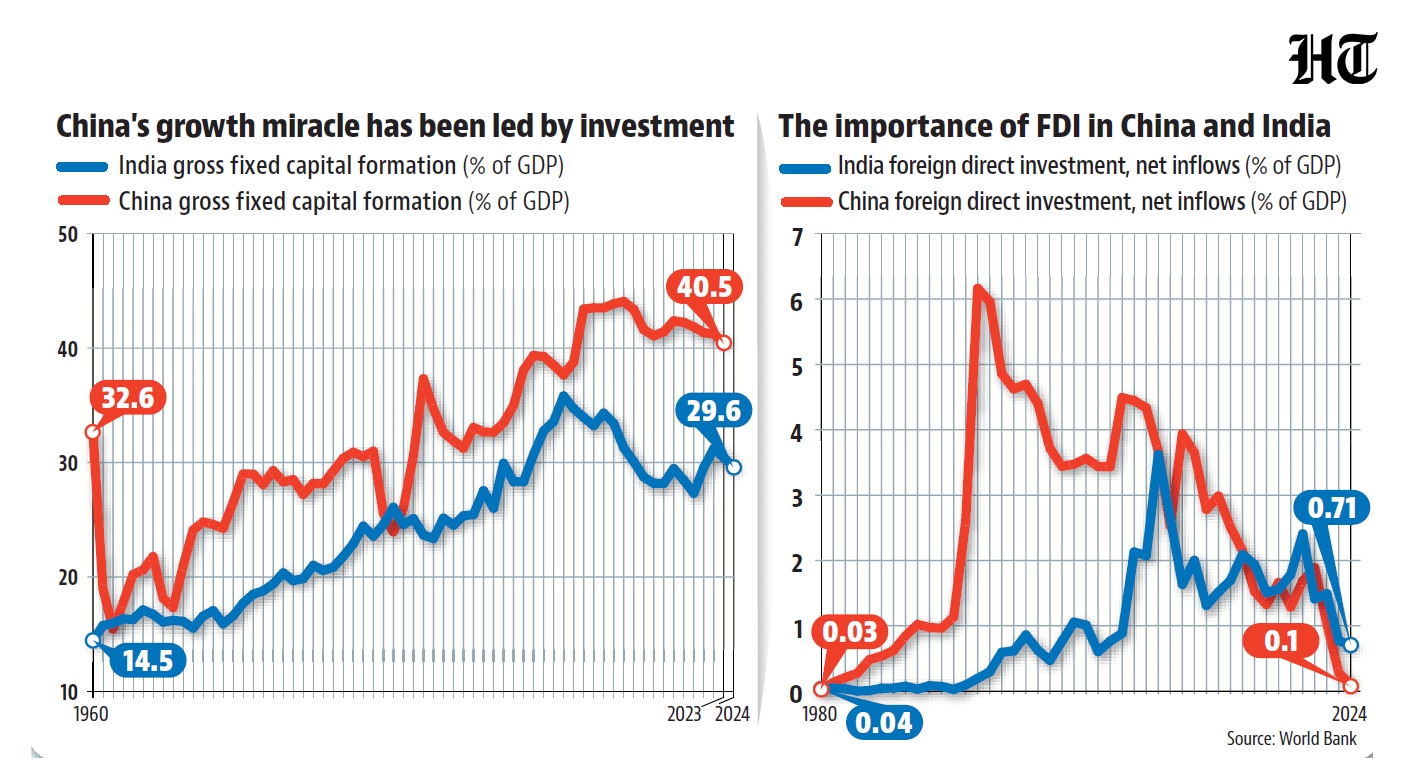
- The real challenge is to boost investmentWhether or not a country can import raw materials and then process them and sell them as exports, depends on its manufacturing capacity. Expanding manufacturing capacity requires investment, which can come from inside the economy or in the form of foreign direct investment. The best way to understand China’s lead over India in terms of manufacturing is to look at its consistent lead over India in terms of investment as a share of GDP, which is measured by share of gross fixed capital formation in GDP. Given the fact that China’s GDP itself is much larger – nearly five times in nominal dollar terms in 2024 than India’s – means that the physical investment gap is even bigger. How important is the role of foreign direct investment (FDI) in boosting Chinese investment? The gap between China and India, in terms of net FDI inflows as a share of GDP, was much larger in the 1990s than in the latter period. In fact, net FDI inflows in China are almost negligible now. While this has often been flagged as the possibility of China+1 moment in geo-economics where foreign capital pivots from China to other emerging markets, India’s net FDI inflow as share of GDP has not seen much of an increase.
- What can India do to boost investment in its economy?The Chinese investment surge was driven by export opportunities in a big way. This is a runway which has likely been shut by the rising surge of protectionism in the advanced economies. Import substitution, which is perhaps what Modi has been hinting at, is a limited but still significant avenue to pursue this goal. But herein lies another big challenge. Any aggressive import substitution strategy will involve a large reduction in Chinese imports to India. Whether the Chinese will play ball to such efforts is a big question. China, for example, has been putting various spanners in India’s manufacturing engine by actions such as preventing its engineers from working in Indian manufacturing projects or holding back critical raw materials. To surmise, boosting Swadeshi requires deft policy than the kind of mass movement which the termbecame associated with in Gandhiji’s time.