E-Paper



Number Theory: Donald Trump's rational politics and irrational economics
.

 Prefer HTon Google


Donald Trump assumed his second presidency as the darling of corporate America. Even before he was elected, some of the biggest names on Wall Street and in corporate America backed Trump. Much of that bonhomie has disappeared after his imposition of reciprocal tariffs which, unless rolled back, is bound to give a body blow to the global trading order. Stocks markets are having a meltdown, not just in the US but almost the entire world. Why is Trump refusing to walk back on his policies?
This two-part series will try and answer this question by looking at seemingly disparate but connected issues. The analysis leads to the conclusion that while Trump might be right in ignoring the outrage over the ongoing carnage in the stock markets, he might not achieve his desired objectives. The first part of this series will explain some larger realities about the US economy, especially manufacturing. The second part will take the example of Vietnam – it has been slapped with one of the highest tariffs – to show why the tariffs might not help the US.
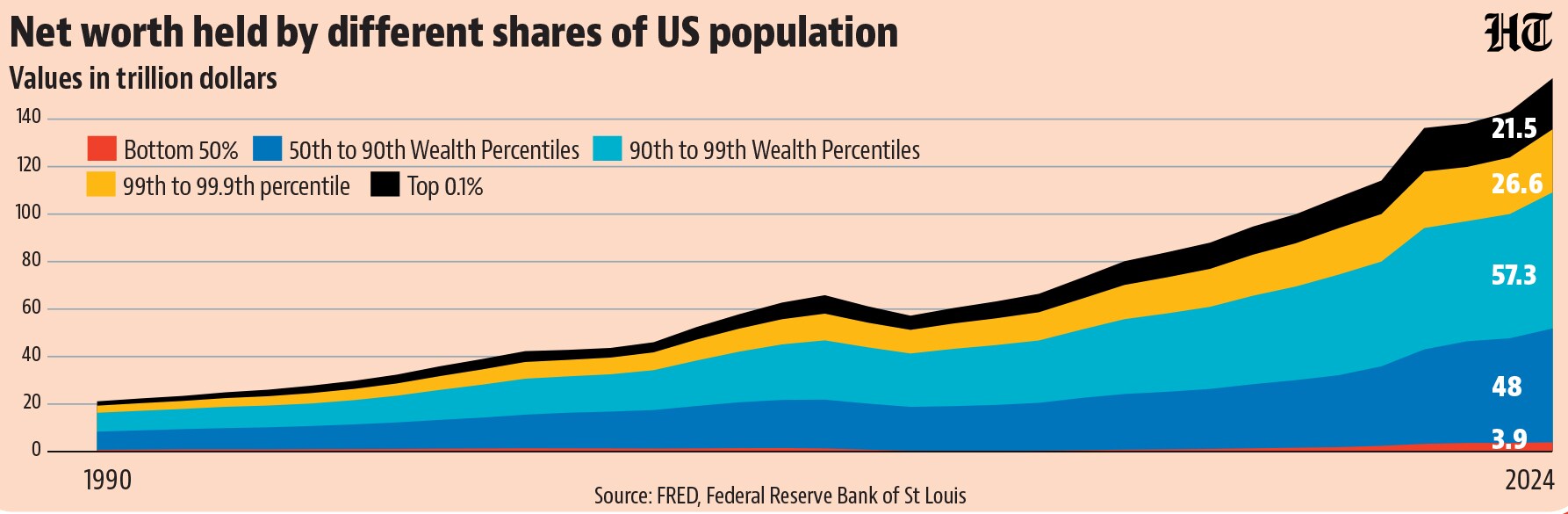
 The majority stands to lose much less than the super-rich in the ongoing turmoilData on net worth of different percentiles of the US population shows that the gap between the bottom half of the population and the super-rich in America has increased significantly in the last three and a half decades. The net worth of top 0.1% of the population in US was $21.5 trillion in 2024, more than five times the net worth of the bottom 50% of the population which was just $3.9 trillion. The top 10%, put together, had a net worth which was more than 27 times the net worth of the bottom 50%. Even the top half of the population excluding the top ten percent has seen its net worth increase compared to the bottom 50% of America. A stock market meltdown, therefore is bound to be much bigger concern in the top half of the population than its bottom half. It is in the latter that Trump’s core electoral support lies and it might well believe Trump’s claim that the short-term pain of tariffs will rejuvenate American manufacturing.
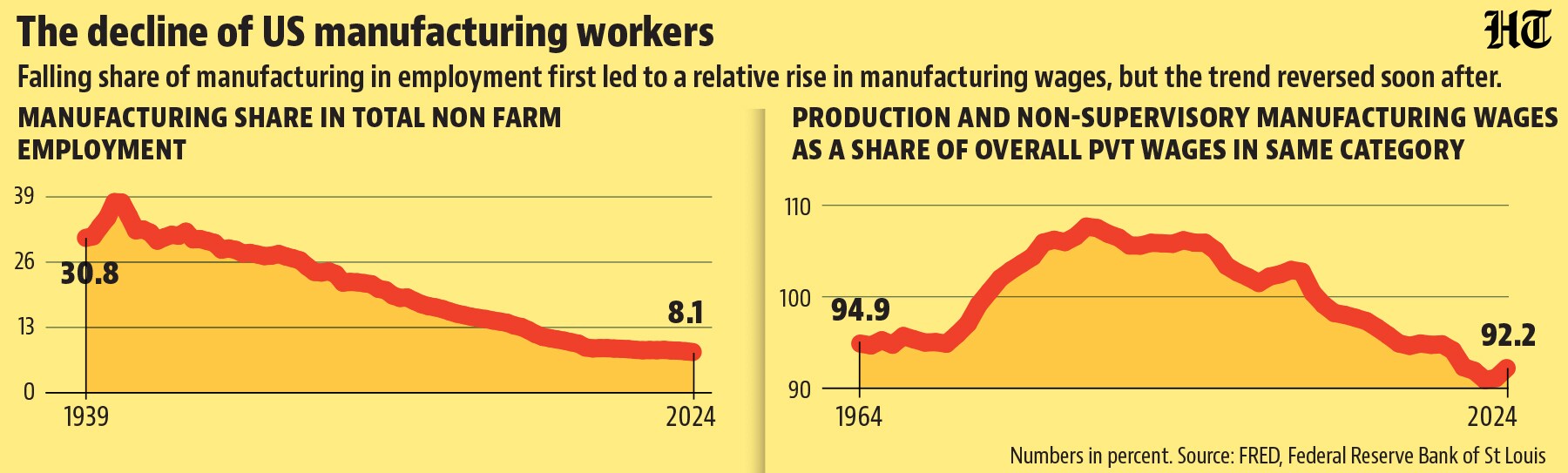
- But manufacturing’s decline and its impact on the underclass in the US is a complicated storyLong-term data shows that US has witnessed a fall in manufacturing’s share of employment since the 1940s. This is something even Trump flagged in his executive order announcing tariffs. As is to be expected, the fall in employment share of manufacturing gathered pace from the 1970s when Japan emerged as the first serious challenger to the US’s manufacturing prowess. This was followed by the rise of China and other Asian countries. As far as wages of blue-collar manufacturing workers were concerned, they were rising relative to other blue-collar workers until America took a turn towards neoliberalism under Ronald Reagan in the 1980s. The rate of fall only increased with the rise of China from the late 1990s and seems to have bottomed out just around the pandemic. A significant rejuvenation of American manufacturing will have to necessarily entail a rise in relative wages for manufacturing as well, failing which it will not find the required workforce for it. Given America’s demographic stage this will also put pressure on other blue-collar wages and could trigger either wage-driven inflation or demand for more immigrant labour. It is perhaps this prospect which is worrying American capital the most. The latter is something the American working class is always worked up about.
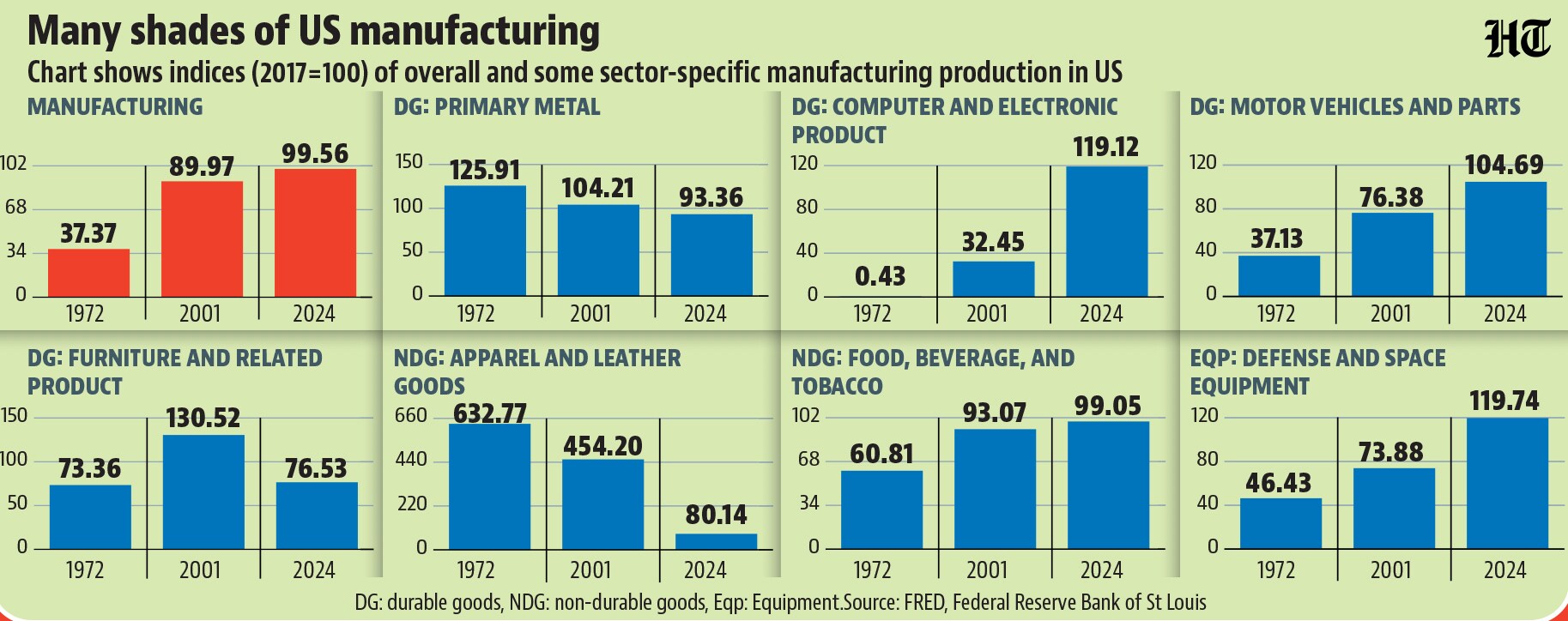
- There is manufacturing, and there is manufacturingWhat exactly does Trump want from his tariffs? Does he want America to make more fighter jets or T-shirts or passenger cars? Answering this question is important because the trajectory of American manufacturing between 1970 and now is very diverse across different kind of commodities. While manufacturing production has collapsed in the US for labour intensive goods such as textile and leather products, it has increased for things such as defence equipment, even motor vehicles. How exactly will the current tariffs affect different sectors of US manufacturing? Will tariffs on auto components etc. erode the competitive advantage of the US car industry? Will tariffs on textiles be enough to make domestic production of these commodities competitive in the US? Because Trump’s tariffs have taken into account country-wise trade deficits rather than a thorough input output analysis, the impacts (they are more likely to be bad than good) will only be felt post-facto.
- What's next?To be sure, even in commodities where US manufacturing has done well, bringing down the trade deficit might not be an easy thing to do. This is what the second part of the series will discuss.