
 E-Paper



Economy's good, bad and ugly as MPC would have viewed it | Number Theory
An HT analysis of the data points released alongside Wednesday’s MPC shows diverse messages regarding the state of the Indian economy
Updated on: Oct 8, 2026, 06:51:12 IST

 Prefer HTon Google
Share via


Copy link

The Monetary Policy Committee (MPC) of RBI announced a 25-basis point – one basis point is one hundredth of a percentage point – hike in the policy rate on Wednesday. The decision was widely expected. MPC has also changed its policy stance to calibrated tightening which has been described as ruling out rate cuts and either a pause or a hike going forward. The key decisions aside, the MPC meeting is also a keenly followed event in India’s economic policy calendar because of its commentary on the state of the economy. An HT analysis of the data points released alongside Wednesday’s MPC shows diverse messages regarding the state of the Indian economy.

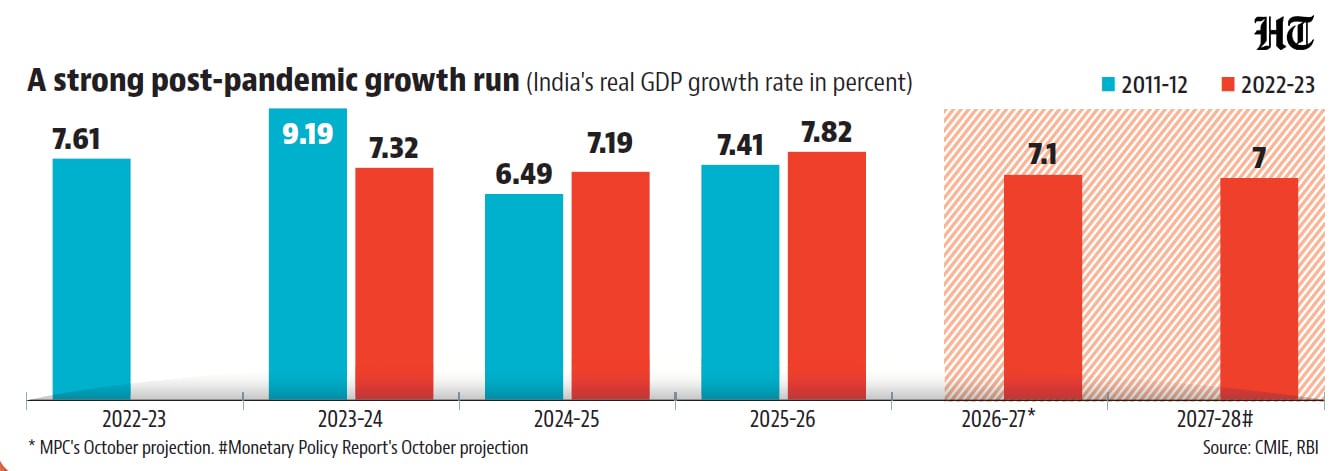
 Good: Growth will continue to show resilienceGrowth forecast for 2026-27 has been revised upwards to 7.1% from the 6.7% projection by the August 2026 MPC. The biannual Monetary Policy Report released along with the MPC resolution believes that GDP growth will be 7% in 2027-28 unless there is a subnormal monsoon or a major exogenous/policy shock. While these projections indicate that growth momentum will slow going forward, India has had an extraordinary run of high growth in the post-pandemic period. This number has been above 7% in each of the three years up to 2025-26 for which we have data in the 2022-23 GDP series. If one were to take the 2011-12 GDP series, growth has been higher than 7% in all years except 2024-25 since 2022-23. This is indeed good news.
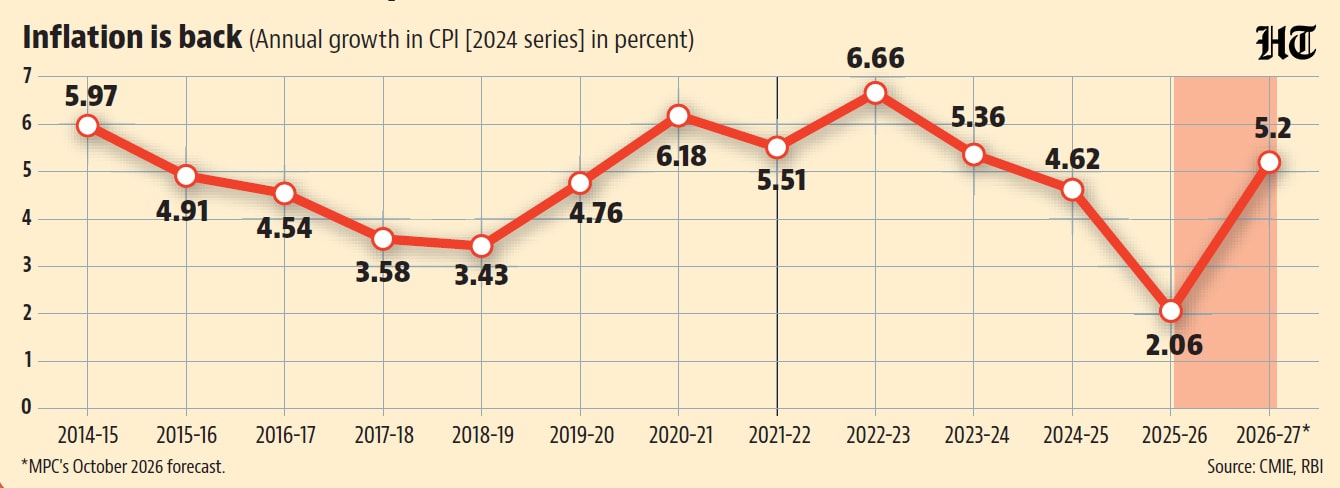
- Bad: End of “benign” inflation“It is clear that inflation and its outlook are not benign as they were last year”, RBI Governor Sanjay Malhotra said in his post-MPC statement. Inflation projections and expectations data released on Wednesday capture the changed reality. Benchmark inflation, as measured by the Consumer Price Index (CPI) is expected to be 5.2% for 2026-27, 20 basis points higher than what this number was in the August MPC resolution. Headline inflation was just 2.1% in 2025-26 and 4.6% in 2024-25. Even core inflation – the non-food non-fuel component of the CPI basket – is expected to be 4.4%, higher than its 3.6% value in 2025-26. Three-month ahead inflation expectation of households came in at 9.9% in the September survey compared to 9.2% in the July round. This number was 7.9% in January 2026. Crude oil price, as per the Monetary Policy Review, is expected to be $95/barrel for the second half (October 2025-March 2026) of the current fiscal year and $85 per barrel in 2027-28, an upward revision of $10 each compared to what was believed in April. The only upshot to this inflationary tailwind might be a firming up of the GDP deflator – the wholesale price index is growing at close to double digit levels right now – which could boost nominal GDP growth and provide some cushion to revenues which are a fraction of nominal GDP.
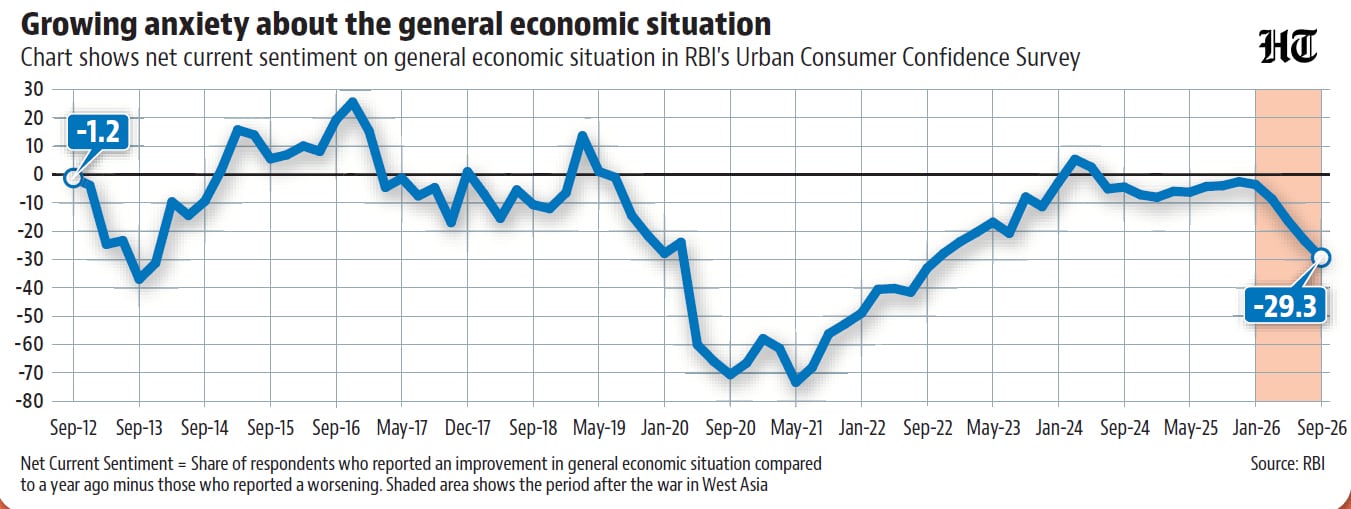
- Ugly: Consumer sentiment on the economic situation is among the worst ever barring the pandemicIt is one thing for the MPC wonks to believe that the economic situation, notwithstanding strong domestic growth momentum, is extremely turbulent. They are following global commodity, equity and bond markets which are all flashing red signs right now. However, at least one piece of data released by RBI on Wednesday shows that economic anxiety is not confined to the data nerds alone. The current sentiment on General Economic Situation, as captured in RBI’s Urban Consumer Confidence Survey (UCCS) is among the lowest ever if one were to exclude the periods in the aftermath of the Covid-19 pandemic’s disruption on the Indian economy. Net current sentiment on the general economic situation – it captures the difference in share of respondents who believe that the situation has improved or worsened compared to a year ago – came in at -29.3 in the September round of the UCCS. This number was -3.5 in the January 2026 round, the last survey before the war in West Asia started. The latest net sentiment value is the 18th lowest in the UCCS which has had 77 rounds so far. However, 15 out of the 17 rounds when this value was lower than the latest reading happened between 2020 and 2022 when the pandemic had severely dented the economy and a recovery was still underway. The only two non-pandemic rounds when the net current sentiment was lower than September 2026 round were September and December 2013 which followed the taper tantrum.


Unlock a world of Benefits with HT! From insightful newsletters to real-time news alerts and a personalized news feed – it's all here, just a click away! -Login Now!


