
 E-Paper



Reserve Bank raises rates by 25 basis points; signals more tightening ahead
The increase will make corporate and retail loans, including mortgages, more expensive amid geopolitical uncertainty.

 Prefer HTon Google


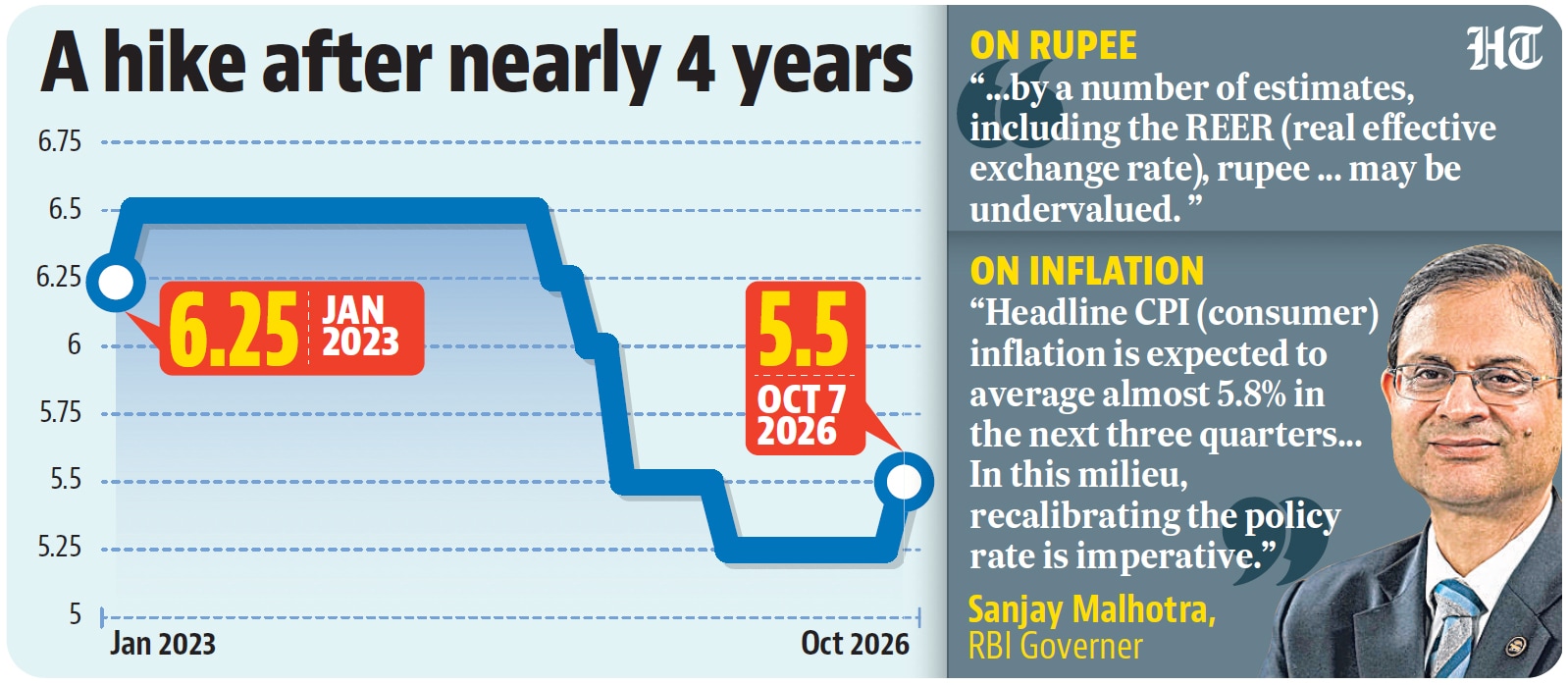
The Monetary Policy Committee (MPC) of the Reserve Bank of India increased the policy rate by 25 basis points – one basis point is one hundredth of a percentage point – taking it to 5.5% on Wednesday. The decision was widely expected and marks the beginning of a new cycle of monetary tightening amidst extremely turbulent conditions in international commodity and capital markets.
India’s growth story, notwithstanding these challenges, is expected to remain strong going forward and better than what was expected earlier.
The increase will make corporate and retail loans, including mortgages, more expensive. Most experts and analysts expect a further rate tightening in coming months.
Deep Dive

Also Read I What is repo rate? Key things to know after RBI’s first hike in four years
With the rate increase, MPC has signalled its intent to moderate the tension between the external turbulence and domestic resilience going froward. This is best described in the policy stance being changed to calibrated tightening from neutral, which has been defined as rates being either held constant or hiked but definitely not being reduced.
This is in keeping with RBI’s policy to “strive for price and financial stability as both are essential for sustainable growth in the long run”.
The summary projections describe the current economic situation well.
Faster growth, higher inflation
GDP growth for 2026-27 is now projected at 7.1%, 40 basis points higher than August forecast. The biannual Monetary Policy Report believes that GDP growth for 2027-28 will be 7% under assumptions of a normal monsoon and no major exogenous or policy shock.
Benchmark inflation, as measured by Consumer Price Index (CPI) is seen at 5.2% for the full fiscal year, higher than the 5% projection in August. Core inflation, which excludes the food and fuel components of the CPI basket is seen growing at 4.4% in the current fiscal year. “It is clear that inflation and its outlook are not benign as they were last year,” Governor Sanjay Malhotra said in his statement.
Quarterly growth projections stand at 7.2%, 6.9%, 6.8% and 7.1% for the quarters ending September 2026, December 2026, March 2027 and June 2027. The respective inflation numbers are 4.9%, 6%, 5.7% and 5.6%.
“The near-term outlook on inflation points towards continued pressures from supply side on account of the deficient monsoon, ongoing El Niño conditions and high energy and other commodity prices, the pass through of which is still continuing”, the latest MPC resolution says. This paints a different and more adverse picture from what the MPC said in August when it believed that “the higher inflation is mostly on account of fuel and food with little signs of generalisation of price pressures so far”.
Global turbulence
That MPC would hike rates, and along with its growth and inflation forecasts was widely believed. What was being awaited was RBI’s reading of the larger economic situation given the worsening of the geopolitical situation in West Asia, surge in advanced economy bond yields including 10-year US treasuries which serve as a global bellwether for interest rates, the US Federal reserve raising interest rates and the continuing rally in AI-linked equity prices.
Governor Malhotra’s post-MPC statement clearly acknowledges the external economic challenges. “The West Asia conflict, tariff related uncertainties, elevated bond yields and risks of an unwieldy correction in valuation of AI stocks are keeping global economic sentiments edgy with risk-off sentiments on EMEs (emerging market economies)”, it says attributing some of the ongoing headwinds in equity markets etc. and the consequent pressure on the capital account to such pressures.
Also Read I RBI raises repo rate by 25 points in first hike in four years, loan EMIs may rise
On the exchange rate question, RBI stuck to its stated position of “ensuring orderly adjustments to the exchange rate that are in sync with the underlying macroeconomic fundamentals and curbing excessive volatility”. A Reuters copy also quoted the Governor as saying that markets were perhaps not realising that “by a number of estimates, including the REER (real effective exchange rate), ”rupee ... may be undervalued.” The rupee closed at 96.78 against the dollar on Wednesday.
More hikes incoming
“All said, we believe the policy meeting was responsible, as RBI, which is also the risk manager of the economy, has started to work with a scenario in which the external environment can be uneasy for longer. For now, we stick to our view that this will be a 50bp rate hiking cycle, of which 25bp was delivered today. Yes, there is risk of another, especially if growth remains resilient despite a strengthening El Niño. But for now, we don’t see this as a deep rate hiking cycle”, HSBC Chief India Economist Pranjul Bhandari said in a research note issued after the meeting.
“We were expecting 50-75bps of rate hikes in this cycle. With the stance change to calibrated tightening, the conviction on a 75bps rate hike cycle has increased. If RBI pushes the repo rate to 6% by the February 2027 policy meeting, then in April 2027, the real policy rate based on forward looking inflation (Citi forecast) could be in the 150-200bps range. This could provide MPC the space to pause and reflect on the need for further tightening, especially if there is some moderation in growth”, Citibank Chief India Economist Samiran Chakraborty said in a note.
The budget backdrop
MPC’s decision has, in a way, also painted the larger backdrop for the next year’s budget which will reflect the fiscal costs of reining in inflation this year and will inherit a larger consolidation challenge in the next fiscal year. Crude oil prices, according to the Monetary Policy Report, are expected to stay at $95 per barrel for the second half of the current fiscal year and $85 per barrel in the 2027-28. Both these numbers are an upward revision of $10 per barrel from the April report.
The situation right now is very different from what existed before the 2026-27 Budget was prepared. “According to the World Bank’s Commodity Prices Outlook, October 2025, global commodity prices are expected to decline by approximately 7 per cent in FY27, primarily driven by subdued crude oil prices amid oversupply”, the 2025-26 Economic Survey had said. To give credit where it is due, the Survey did note that “Geopolitics may come in the way of this prediction”. Next year’s Union Budget will have to factor in for the adverse geopolitical situation.


