
 E-Paper



For South Korea's new president, winning was the first hurdle | Number Theory
.
Updated on: Jun 6, 2025, 09:06:04 IST

 Prefer HTon Google
Share via


Copy link

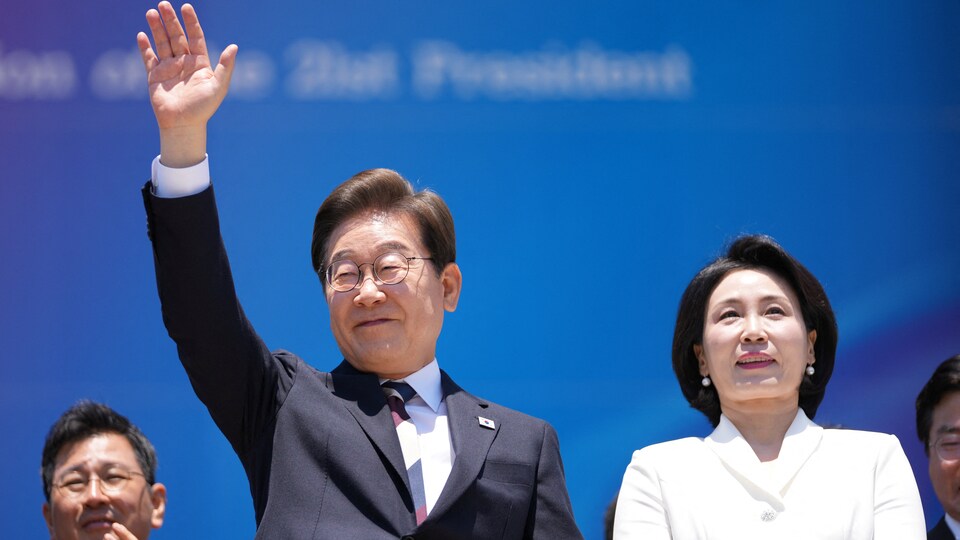
Lee Jae-myung of the Democratic Party of Korea has secured a decisive win in South Korea’s 21st presidential election, claiming 49.42% of the vote. While his victory was widely expected, given the outrage after his predecessor Yoon Suk Yeol’s attempt to impose martial law in December 2024, things are going to be far from easy for the new government in South Korea which is in the middle of a trade war and faces structural challenges which have been in the making for a long time.
For South Korea's new president, winning was the first hurdle
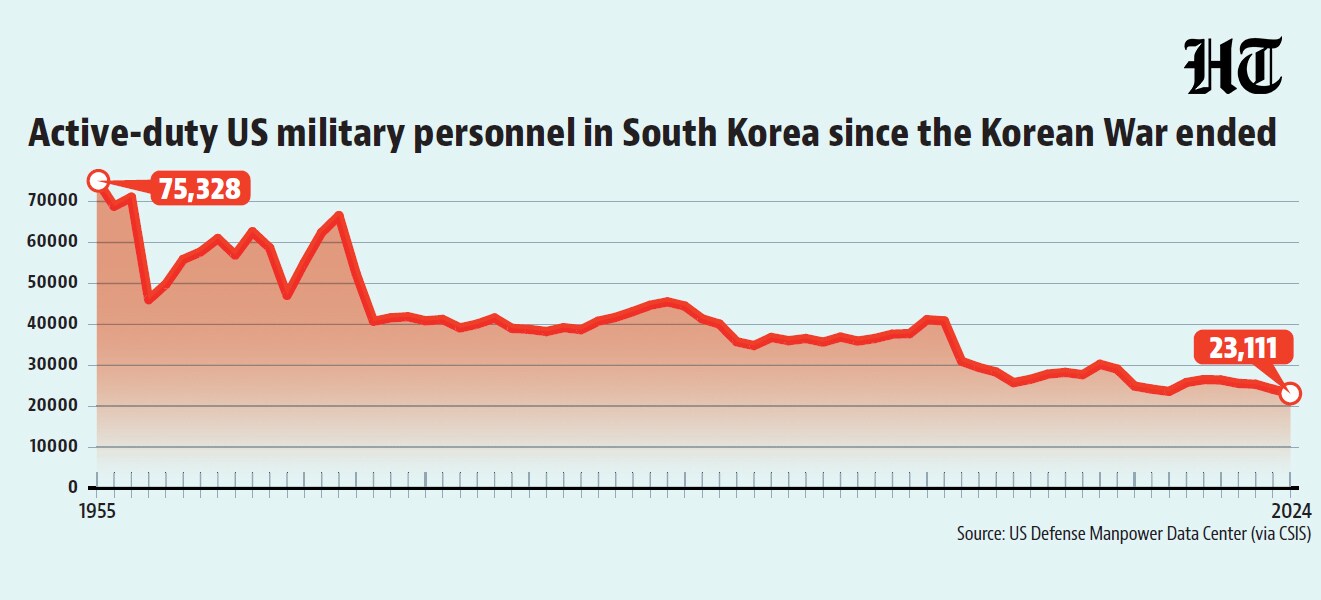
 South Korea will need to protect its exports to the US without jeopardising the latter’s security umbrellaDonald Trump slapped a 25% reciprocal tariff on South Korea in his Liberation Day announcement on April 2. Nearly 19% of South Korea’s exports are to the US. The political turmoil in Korea, thanks to the attempt to impose martial law by Yoon meant that there was an interim government in place when these tariffs were announced and Lee will have very little time to negotiate with the US before Trump’s 90-day suspension of tariffs ends on July 8. Since March, heightened geopolitical tensions have begun to take a toll on major industries. Data from May shows that steel exports fell by 12.4%, automobile shipments were down 4.4%, and auto-parts exports dropped 9.4% during the month. Meanwhile, a steep decline in global oil prices—now at their lowest point in four years—pushed down exports of petroleum products by 20.9% and petrochemicals by 20.8%. Lee’s ability to negotiate trade with the US will also face an additional constraint. South Korea has to ensure that security arrangements between the US and South Korea stay intact. The Trump administration has been advancing with policies that could significantly impact South Korea—most notably strategic flexibility and the possible withdrawal of a brigade from the peninsula. This strain was underlined by Defence Secretary Pete Hegseth’s decision to bypass Seoul on both of his regional trips, and by Secretary of State and interim National Security Adviser Marco Rubio, who has yet to visit the area. To be sure, the number of active-duty US military troops in South Korea was already at the lowest levels since the Korean war by the end of 2024.
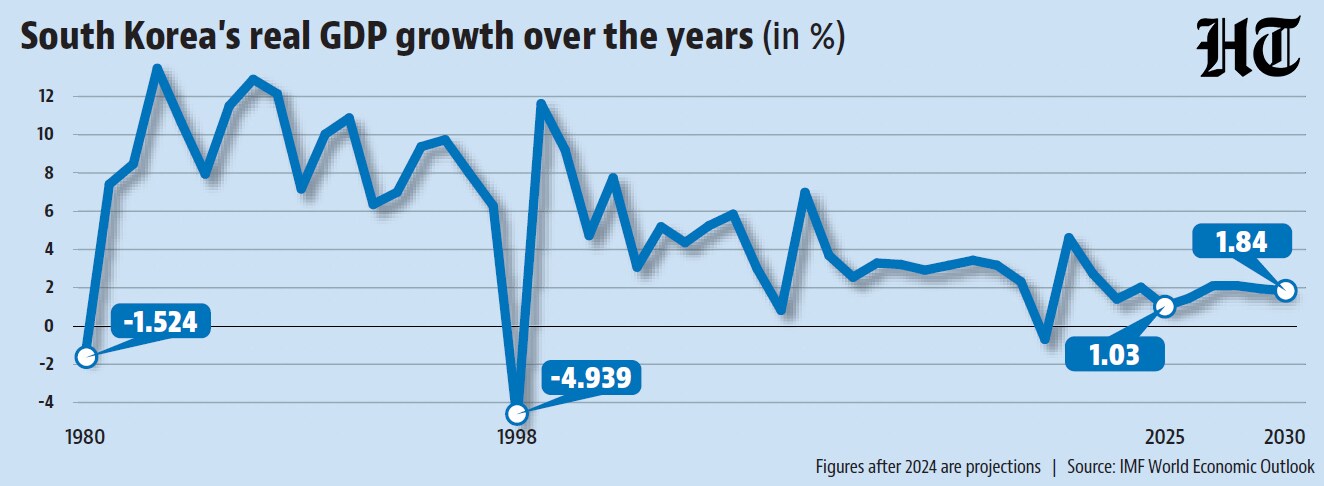
- S Korea’s growth performance has been tepid off lateLast month, South Korea’s exports to its two biggest markets—China and the US—both fell. Shipments to the US dropped 8.1% year-on-year to $10.05 billion, with automobile exports plunging 32% to $1.84 billion. Exports to China contracted by 8.4% in May, as semiconductor shipments (their largest export to China) declined 14.6%. Beyond external pressures, years of export-led growth have skewed the economy towards industry, leaving private consumption lagging . “A large share of Korea’s GDP is spent on supporting businesses, while a comparably small share is used to support people through the social safety net,” noted the OECD in a report published last year. Energy—two-thirds of which is used by industry—is relatively cheap, whereas food and clothing are expensive compared to OECD peers. These imbalances, combined with weak domestic demand and political instability, have stalled overall economic growth. In December 2024, the OECD forecast 2.1% growth for Korea in 2025. In March—citing the emergency martial law incident—it cut this to 1.5%, and three months later reduced it again by 0.5 points to 1.0%. As a result, Korea trails the G20 average of 2.9%. By contrast, the Korea Development Institute expect just 0.8% growth this year, while the IMF projects 1.03% in 2025 and 1.45% in 2026.
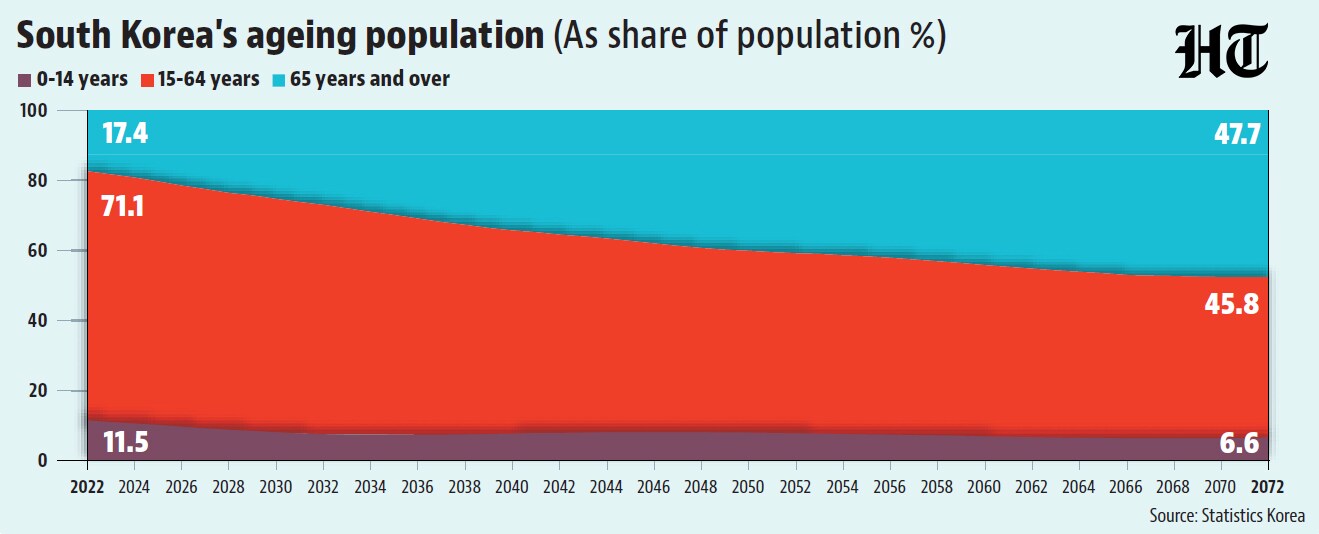
- South Korea also has to deal with its looming demographic challengesIn 1960, Korean women had an average of six children; by 2018 this had fallen to just under one, and it dropped further to 0.72 in 2023. As a result, the population is projected to halve over the next 60 years, with those aged 65+ making up nearly half of it by 2072. The aged dependency ratio—which is measured as the number of those aged 65 and over compared to the working-age population—currently at 29.3, is expected to climb to 104.3. In March, Bank of Korea governor Rhee Chang-yong warned that these demographic shifts would push South Korea’s potential growth down to near zero in the 2040s. Today, that rate is about 2%, compared with roughly 5% in the 2000s. “South Korea’s next president faces a far bigger challenge: creating economic opportunity and changing the perception that South Korea is too difficult of a place to raise a child and thrive as an adult,” said a report by Center for Strategic and Intelligence Studies, a US-based think tank published last month.


Unlock a world of Benefits with HT! From insightful newsletters to real-time news alerts and a personalized news feed – it's all here, just a click away! -Login Now!


