E-Paper



How batting frontiers expanded even further in IPL 2026
Sooryavanshi represents a peak of this IPL era, propelled by fearless tactical roles and advancements in modern swing mechanics.
Updated on: Jun 5, 2026, 22:25:49 IST


Share via


Copy link

The finals of the Indian Premier League (IPL) in 2026 were decided by scores that have become sub-par to the league—a chase of 156 runs. But IPL 2026 was defined by the ever-expanding possibilities in the batting department, with a 16-year-old providing an enthralling trailer and template of how the limits of batting prowess could be stretched even further in the shortest cricketing format. There were, in particular, three aspects of batting that stood out in IPL 2026, with each raising the bar to an all-time high in the tournament’s 19-year history.
Marching Towards 10
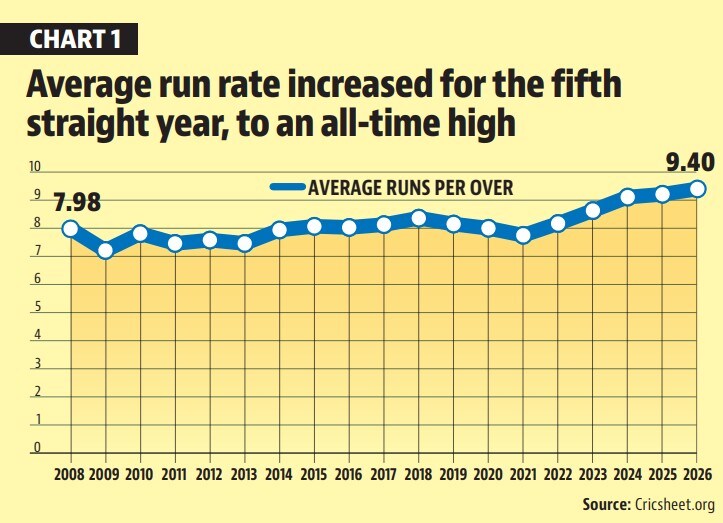
 Marching towards 10Across the 74 matches in IPL 2026, teams scored at an average rate of 9.4 runs per over—the fifth straight year of increase and an all-time high. To put this in context, that’s an average total of 188 runs per innings. This underscores a dramatic shift in how the tournament has evolved from a relatively balanced contest between bat and ball into a high-scoring, batter-dominated league. The progression can be divided into three phases. The first phase was between 2008 and 2013, when teams were figuring out strategies and analytics, and the rate never crossed 8 an over. The second phase was between 2014 and 2022, when the average rate crossed, teams stopped treating 160 as a safe score. Post-2023, there’s been an unprecedented, exponential surge in scoring, a period that has also seen the introduction of the ‘impact player’ rule, which effectively game teams an extra batsman or bowler.
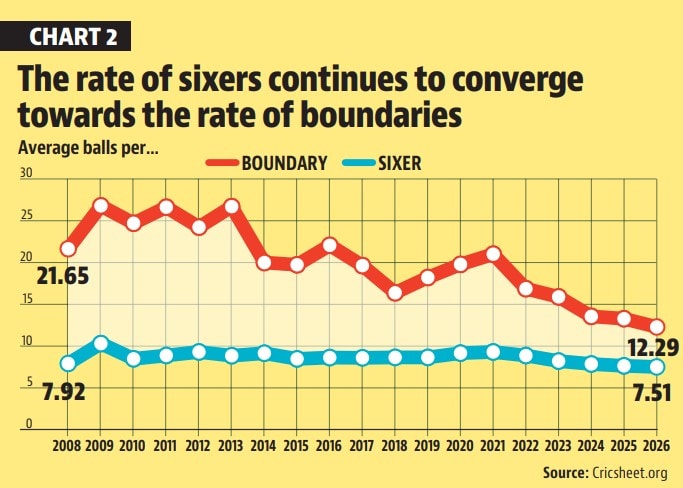
- Maximum impactThe safety net of an additional resource freed up top-order batters to play ultra-aggressive, high-risk cricket from ball one. The impact of that approach was most evident in the rate of accumulation of boundaries and sixers. The advances in sixers are especially pronounced. IPL 2026, on average, saw a six being hit every 12th ball. To put that in context, it was every 27th ball in 2011 and every 17th ball even as recently as 2022. The frequency of boundaries, by comparison, has increased marginally, though even these are at their highest levels. As a result, the average frequency of sixes continues to converge towards the average frequency of boundaries. A change in the risk-reward equation has also been accompanied by advances in cricket bats, which feature massive edges and sweet spots without being restrictively heavy. Combined with dedicated range-hitting coaching, batters are physically stronger and mechanically optimised to clear deep boundaries with greater ease.
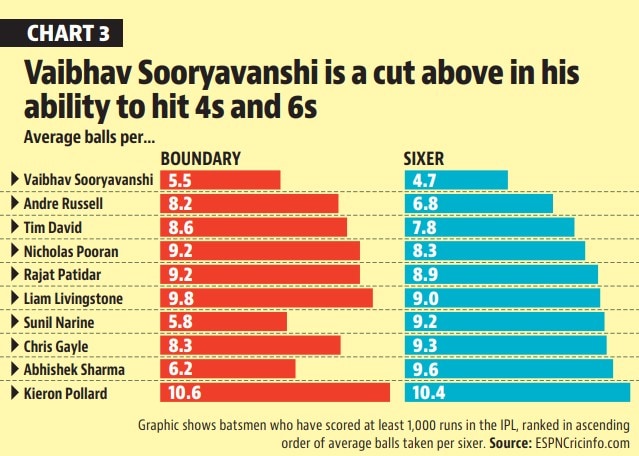
- Outlier SooryavanshiWhile batsmen in general were raising the bar, one name towered over them in how he redefined historical T20 benchmarks: Vaibhav Sooryavanshi, all of 16 years. He finished as the highest run-getter in IPL 2026 (776 runs). Among the top 30 runscorers of IPL 2026, he had the third-highest average of 48.5 runs per innings and the highest scoring rate of 237 runs per 100 balls. In only in his second IPL season, Sooryavanshi piled on the records: most sixes in a season, most sixes in a powerplay, most sixes in a playoff innings, fastest to 1,000 runs. In his ability to find the fence, Sooryavanshi appears less like an incremental improvement and more like a statistical anomaly. Across his IPL career, he averages a sixer every 4.7 balls. The next best among batsmen who have scored at least 1,000 runs in the IPL is Andre Russell (6.8 balls). Even in his ability to hit a boundary, Sooryavanshi is a cut above the rest.
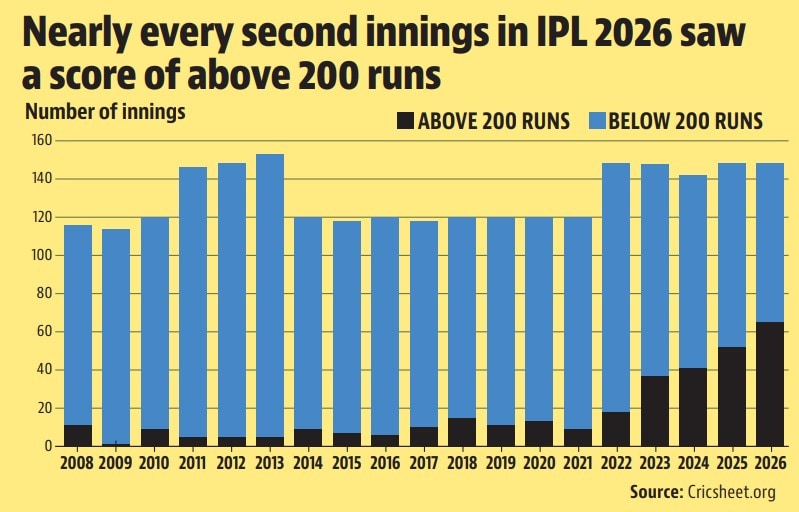
- 200, not a barrierFor the most part in IPL 2026, Sooryavanshi treated every delivery as an opportunity for a boundary. He represents a peak of this IPL era, propelled by fearless tactical roles and advancements in modern swing mechanics. As a result, scores of 200 runs and above—a run rate of 10 and above, which used to be psychological ceilings—have become par scores. Of the 148 innings in this IPL, the score exceeded 200 in as many as 65 innings—about 44%. This is the highest among all IPLs and is about four times what was seen in 2022. Equally impressive was the chasing record. Of the 38 matches where the team batting first crossed 200, the team batting second chased it down on 17 occasions—a near 50% record. Crossing 200 is no longer a rare milestone in the IPL; it has become the standard expectation. As have many other batting traits.