
 E-Paper



How does the world see India? | Number Theory
And does one of the world’s largest diaspora communities buy any goodwill? Data from a recently released survey by Pew Research Center offers some clues
Updated on: Aug 21, 2026, 06:42:53 IST

 Prefer HTon Google
Share via


Copy link

Seventy-nine years after Independence, India carries far greater economic and geopolitical weight than it once did. But soft power asks a different set of questions. Where is India actually liked? Where does it struggle to leave an impression? Does its claim to speak for the Global South travel beyond diplomatic forums? And does one of the world’s largest diaspora communities buy any goodwill? Data from a recently released survey by Pew Research Center offers some clues.
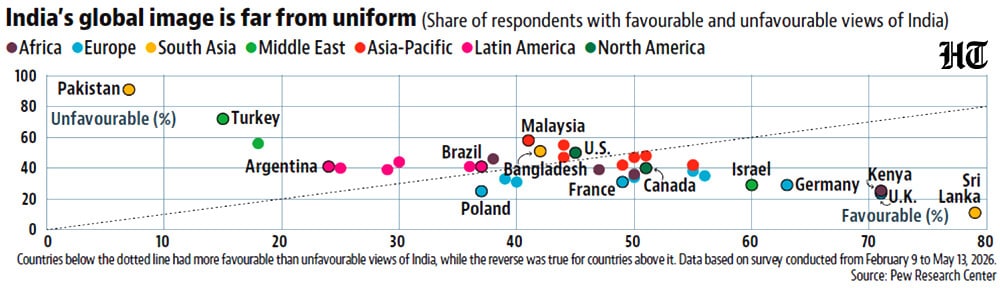
 India’s reputation changes with the mapPew Research Center’s latest 2026 survey finds a median 45% of respondents across 36 countries viewing India favourably, compared with 41% who see it unfavourably. Opinions vary across countries, as expected. Pakistan is the obvious outlier, and hardly a surprising one, with 91% holding an unfavourable opinion of India. But what’s more interesting is how sharply the opinion differs elsewhere. Sri Lanka is overwhelmingly positive at 79%, while Kenya and the UK are at 71% and Europe generally leans favourable. However, in every Latin American country surveyed, unfavourable views of India outweigh favourable ones. Asia is even harder to summarise, ranging from Sri Lanka’s warmth to Malaysia’s skepticism. To be sure, the takeaway here is not that India is unpopular, but that India’s reputation changes dramatically depending on where in the world you ask.
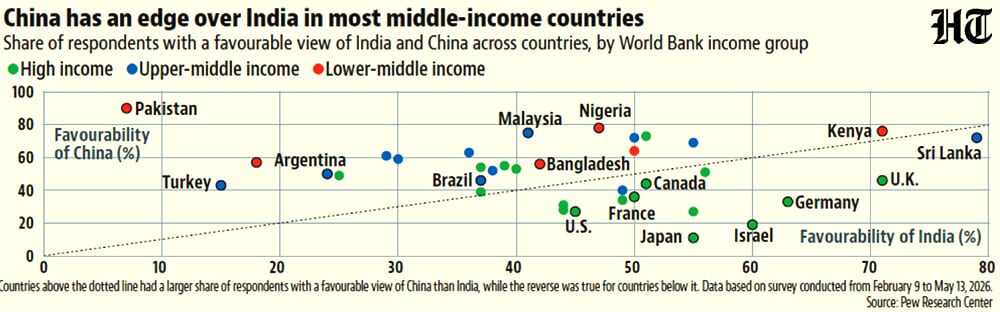
- The Global South paradoxIndia has always attempted to position itself as a voice of the Global South. However, public opinion does not always follow diplomatic branding. In Pew’s 2026 survey, China is viewed more favourably than India in every lower-middle-income country for which survey data is available for both the countries, including Bangladesh, Ghana, Kenya and Nigeria. Even among upper-middle-income countries, China leads in most cases—this includes Indonesia, Malaysia, Thailand, Turkey, South Africa and every Latin American country surveyed. India’s relative advantage shows up much more often in richer countries such as Germany, Sweden, Japan, Israel and the UK. To be sure, there are exceptions as well. Sri Lanka is warmer towards India than China, and the Philippines also gives India an edge. However, the larger pattern is awkward for India as China appears to command broader public favour across much of the Global South we have data for.
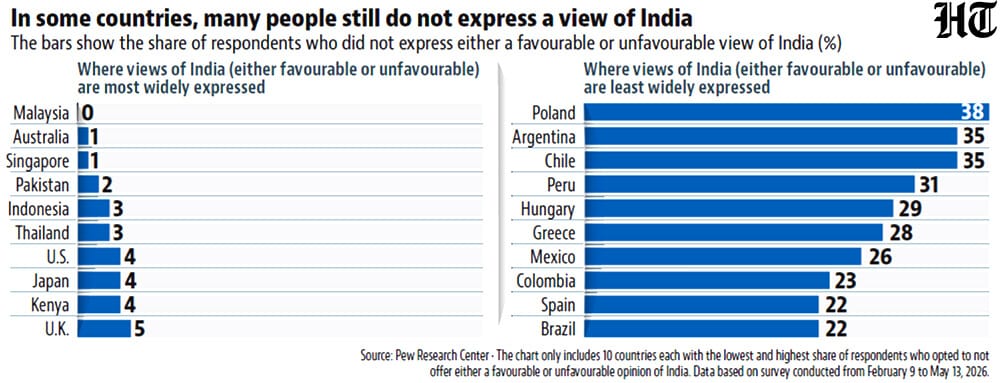
- India’s quieter soft-power challengeSoft power can fail loudly, when people dislike a country, or more quietly, when they do not express much of an opinion at all. For India, Pakistan, is an obvious example of the first. Almost everyone surveyed in the country had a view of India, and it was overwhelmingly negative. Malaysia, Australia and Singapore also had virtually no respondents without an expressed opinion—only Singapore had more respondents with a favourable opinion of India among them. On the other hand, in Poland, as much as 38% did not offer either a favourable or unfavourable view of India. The share was 35% in Argentina and Chile, 31% in Peru and more than a fifth in Mexico, Colombia and Brazil. To be sure, the survey data does not tell us whether these respondents know little about India, have yet to form a firm opinion or simply chose not to answer. But the contrast still matters. A country can suffer a reputation deficit when people know what they think and dislike what they see. But India’s challenge in parts of Latin America and Europe may also involve something more basic, getting enough people to form a view in the first place.
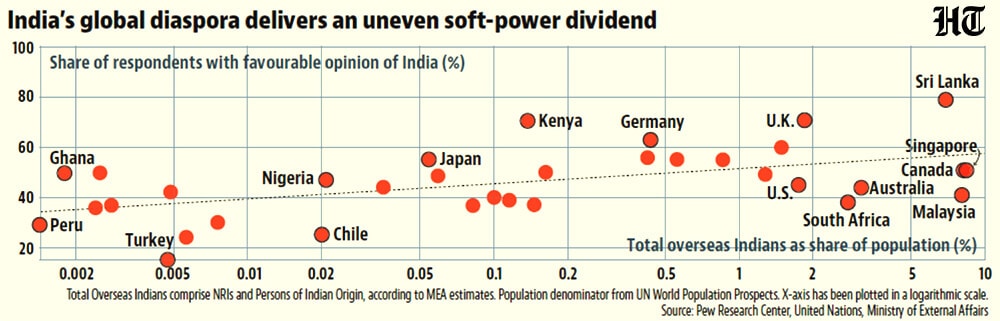
- The diaspora dividend is real, but patchyIndia’s vast diaspora is often touted as soft power in reserve. The numbers suggest there is something to this claim, but hardly a guarantee. Countries with larger overseas Indian populations generally tend to view India more favourably, but the exceptions are hard to miss. Canada, Malaysia and Singapore all have overseas Indians (and people of Indian origin) who account for around 8% of the population, but India’s favourability ranges from 41% in Malaysia to 51% in the other two. In Sri Lanka, where the share is nearly 7%, the favourability is 79%. Meanwhile, the UK and South Africa offer another useful contrast. Overseas Indians make up 1.8% of the UK’s population and 2.8% of South Africa’s, but favourability towards India is 71% in the former and just 38% in the latter. More interestingly, in Kenya, where 71% respondents had a favourable view of India, overseas Indians account for barely 0.1% of the population.


Unlock a world of Benefits with HT! From insightful newsletters to real-time news alerts and a personalized news feed – it's all here, just a click away! -Login Now!


