
 E-Paper



Less warm December to make 2025 third-warmest year | Number Theory
.
Updated on: Jan 1, 2026, 09:24:22 IST

 Prefer HTon Google
Share via


Copy link

Northern India woke up to either cloudy skies or fog on the morning of December 31, which could mean a cool end to 2025 for the region. This has one parallel with the earth on average. Aided by relative cooling in December, 2025 is now likely to end up only third warmest in more than half the datasets that track global temperature. To be sure, the difference with 2023 – ranked second warmest – is likely to be marginal. In all scenarios, global warming relative to the pre-industrial average is likely to be very close to 1.5°C in 2025, a level expected to lead to catastrophic climate change if it persists for a long time.

Less warm December to make 2025 third-warmest year
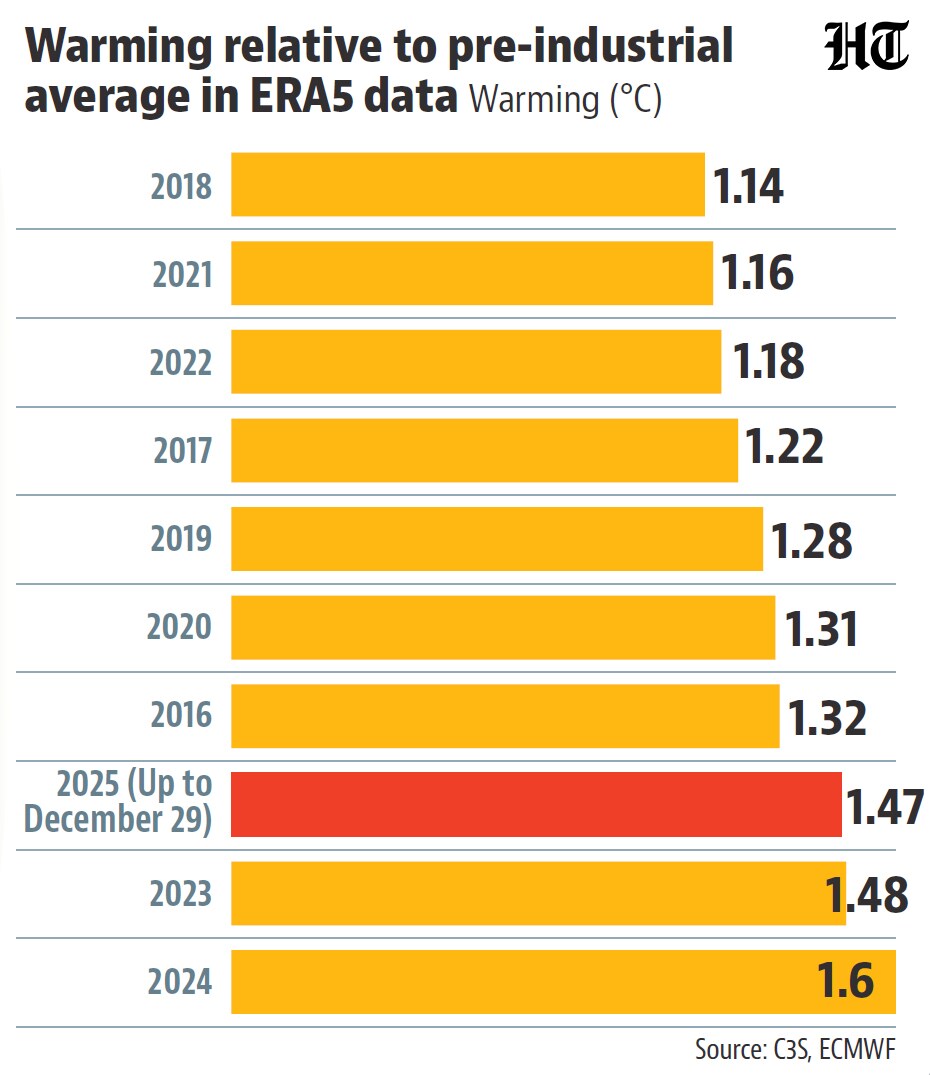
 2025 warming 1.47°C in ERA5 dataset: Third warmest by a very small marginAmong the six global temperature datasets that the World Meteorological Organization tracks, the ERA5 dataset published by the Copernicus Climate Change Service (C3S) of the European Centre for Medium-Range Weather Forecasts (ECMWF) is the only one with daily updates, although with a two-day lag. ERA5 daily data, available up to December 29, shows that the average warming in 2025 is 1.47°C. This makes 2025 warming the third highest, but only marginally below the 1.48°C level seen in 2023. This also makes 2025 the third straight year when global warming has been very close to the 1.5°C threshold, although only 2024 actually breached it. Is it possible that 2025 is ranked above 2023 after data for the last two days of the year is factored in? That is an extremely unlikely event that would require the last two days to average at least 4.2°C warming, when the maximum warming recorded on any day ever is 2.1°C.
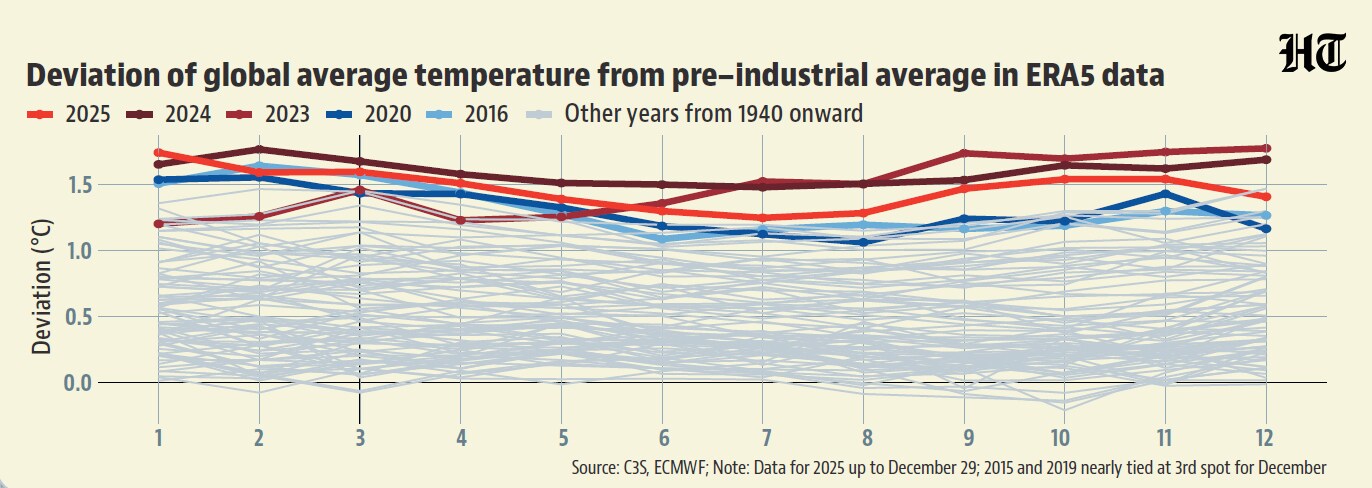
- 2025 ranked third warmest in ERA5 only because of less warming in DecemberAll months from January to November were ranked warmest to third warmest this year in the ERA5 data. This was good enough to make 2025 the second warmest year for the January-November period. The reason that 2025 has fallen behind 2023 is because December warming is averaging only 1.41°C, which is very likely to make it only the fifth warmest December month on record. This has helped the year’s average come down.
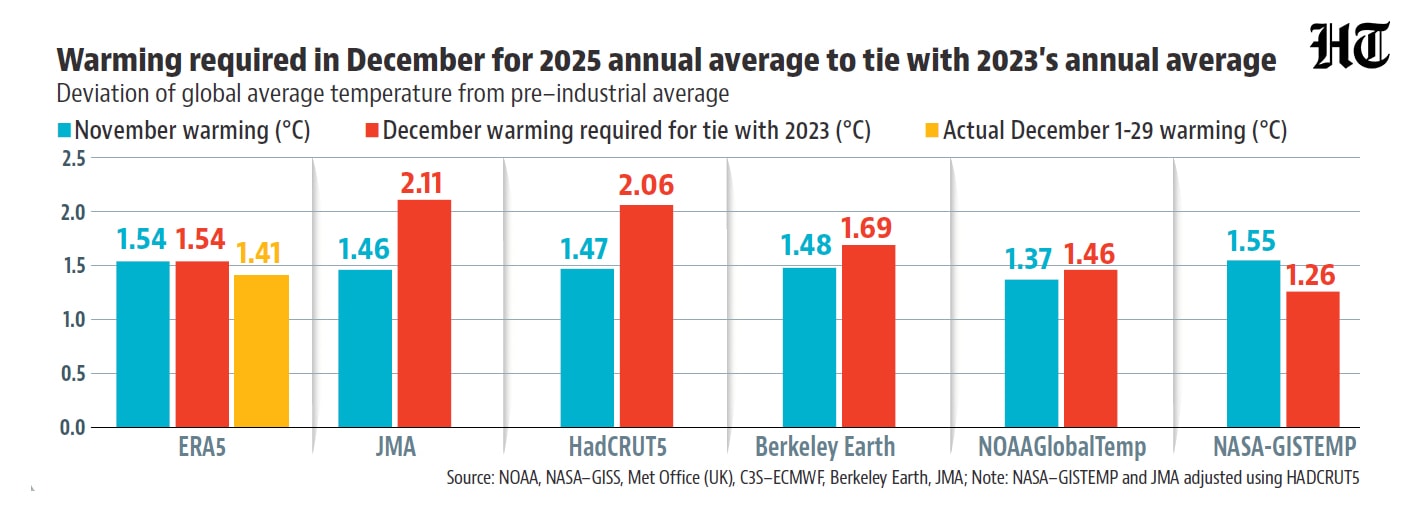
- ERA5 trends imply other datasets also likely to show 2025 as the third warmest yearAnalysis of other datasets – data for them is available only up to November -- also suggests that 2025 is most likely to end up third warmest. The January-November period is ranked third warmest in the data produced by Berkeley Earth (a US based non-profit), the UK’s Met Office Hadley Centre and Climatic Research Unit at the University of East Anglia, and the Japan Meteorological Agency (JMA). This means that they will need to warm up much more than November and the year so far for 2025 to be ranked second. That is unlikely. Datasets generally agree on month-on-month trends, which means other datasets are likely to find December warming less than November’s like ERA5. Similarly, while data produced by the National Oceanic and Atmospheric Administration (NOAA) of the US government shows the year up to November ranked second warmest, it also needs December warming higher than November’s for the year to be ranked second. Only the dataset produced by NASA requires less warming than November for the year to be ranked second warmest.
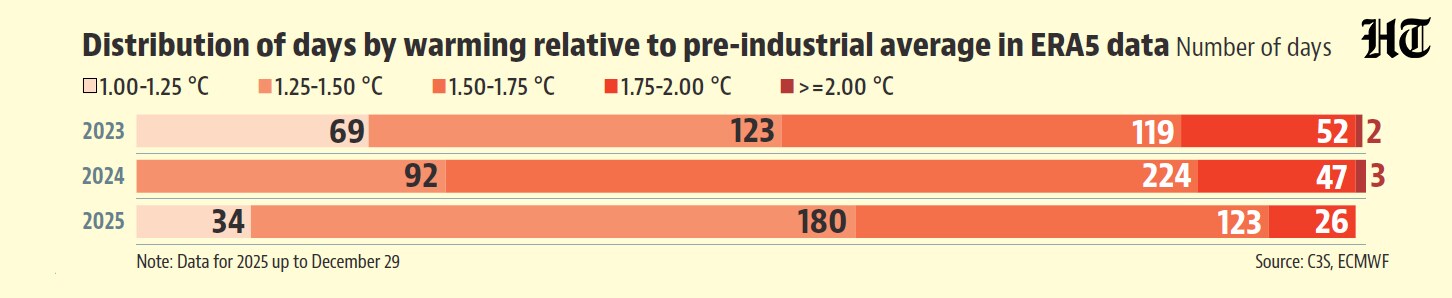
- No day of under 1°C warming for third straight yearTo be sure, irrespective of the year’s rank, 2025 was above previously usual thresholds even on a daily basis. ERA5 data shows that 2025 is the third consecutive year when no day recorded a warming of under 1°C, a trend that held every year up to 2022. To be sure, fewer days breached the 1.5°C compared to 2023 and 2024; and no day breached the 2°C threshold compared to two and three such days in 2023 and 2024. However, there was less bunching at the bottom in 2025 compared to 2023. Only 34 days recorded a warming of 1-1.25°C, compared to 69 in 2023. This happened despite the year being bookended by short La Nina conditions, which is a cooling of the equatorial Pacific Ocean that helps cool global temperatures. Clearly, the world is past what was its usual weather.


Unlock a world of Benefits with HT! From insightful newsletters to real-time news alerts and a personalized news feed – it's all here, just a click away! -Login Now!


