E-Paper



Number Theory: Can NDA retain its dominance in the Mumbai Metropolitan region?
All ten parliamentary constituencies (PCs) in what is described as the Mumbai Metropolitan Region (MMR) are voting on Monday
Published on: May 20, 2024, 11:07:45 IST

 Prefer HTon Google
Share via


Copy link

All ten parliamentary constituencies (PCs) in what is described as the Mumbai Metropolitan Region (MMR) are voting on Monday. The National Democratic Alliance won all of these PCs in both 2014 and 2019. Can it replicate it for the third time in 2024? Here are four charts which answer this question.
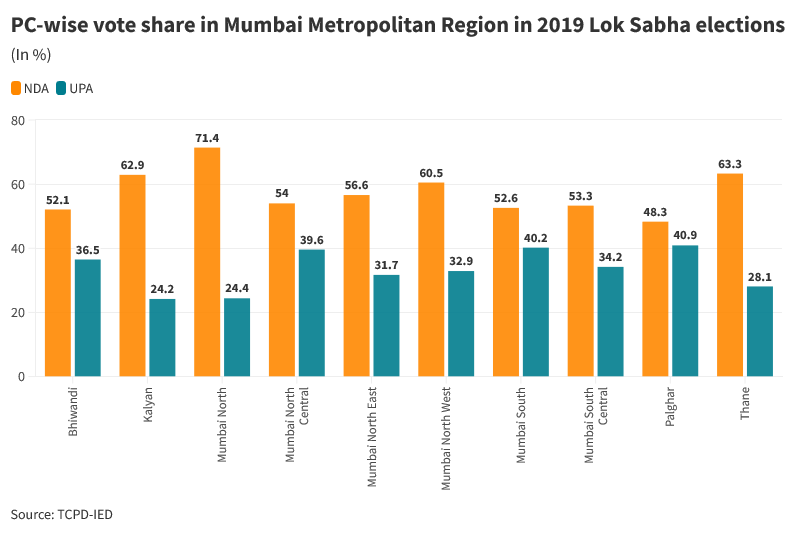
 NDA’s overall vote share was more than 50% in both 2014 and 2019MMR has ten PCs, namely, Mumbai North, Mumbai North West, Mumbai North East, Mumbai North Central, Mumbai South Central, Mumbai South, Palghar, Bhiwandi, Kalyan and Thane. The combined vote share of the NDA – comprising of the Bhartiya Janta Party (BJP) and Shiv Sena – increased by 25.2 percentage points between 2009 and 2014 to reach 55.1%. In 2019, this number increased further to 57.5%. In nine out of the ten PCs in MMR, the NDA’s vote share was more than 50% in 2019. The lowest margin which NDA candidates had over their nearest rivals from the UPA, which included Congress, Nationalist Congress Party (NCP) and Bahujan Vikas Aaghadi (BVA) in 2019 was 7.4% in Palghar against the candidate fielded by BVA. In every other PC, the victory margin was at least more than 12%. See Chart 1: NDA/Congress-NCP vote share in each PC in MMR in 2019
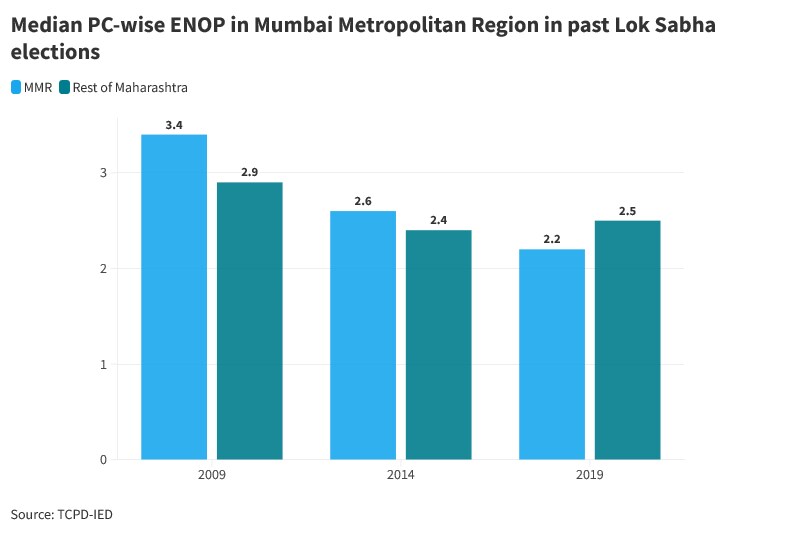
- NDA's rise in Mumbai has largely come at the cost of smaller partiesThis is the most important aspect of the political contest in MMR. Between 2009 and 2019, the combined vote share of the Congress-NCP alliance fell by just 3.4 percentage points to 33.2%. However, its seat share fell drastically from 90% to zero because the NDA could achieve a massive consolidation of other voters in these PCs. This becomes clear if one looks at the trend in PC-wise effective number of parties (ENOP) in MMR. ENOP is the reciprocal of the sum of squares of vote share of candidates in a constituency, and a higher number suggests that more candidates are in the fray. The median PC-wise ENOP in MMR stood at 3.4, 2.6, and 2.2 in 2009, 2014 and 2019 respectively. Meanwhile, the median PC-wise ENOP in rest of Maharashtra fell from 2.9 in 2009 to 2.4 in 2014 before increasing marginally to 2.5 in 2019. See Chart 2: median ENOP in rest of Maharashtra and MMR from 2009-2019
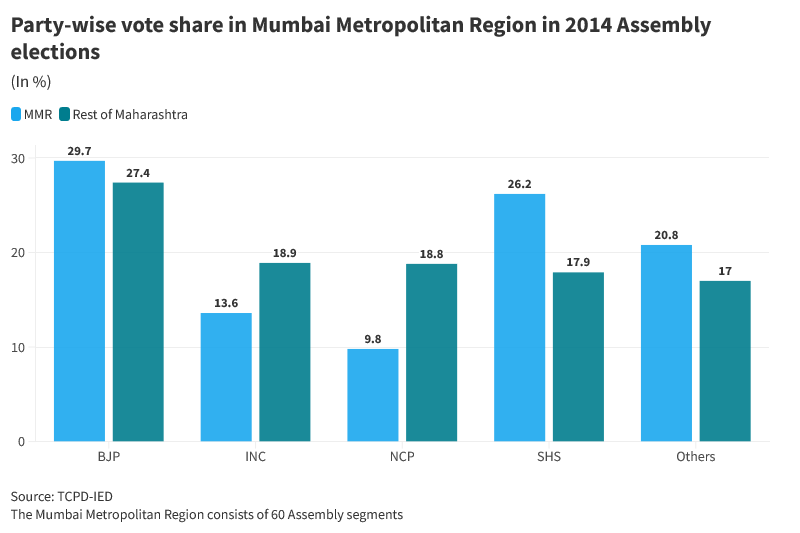
- How important was the Shiv Sena in NDA’s dominance in MMR?The Shiv Sena contested five and six out of the ten PCs in MMR in 2014 and 2019, respectively and won all of them. It has also been the leading party in the Brihanmumbai Municipal Corporation (BMC) elections held in 2012 and 2017 which cover 6 out of the ten PCs in MMR. To be sure, the BJP closed its gap with the Shiv Sena in a big way between the 2012 and 2017 BMC elections, with the Shiv Sena and BJP tallies being 75-31 and 84-82 respectively in 2012 and 2017. When the four major parties in the state contested separately in the 2014 assembly elections, the BJP finished ahead of the Shiv Sena in MMR with a vote share and seat share of 29.7% and 40%. In fact, the combined vote share of the BJP and the Shiv Sena from the 2014 assembly elections is not very far from the NDA vote share of 2014 and 2019. What is worth noting is that, 26 out of the 45 assembly constituencies which were won by the Shiv Sena and BJP from MMR in 2014 were won against each other. See Chart 3: 2014 vote share of parties in MMR and rest of Maharashtra.
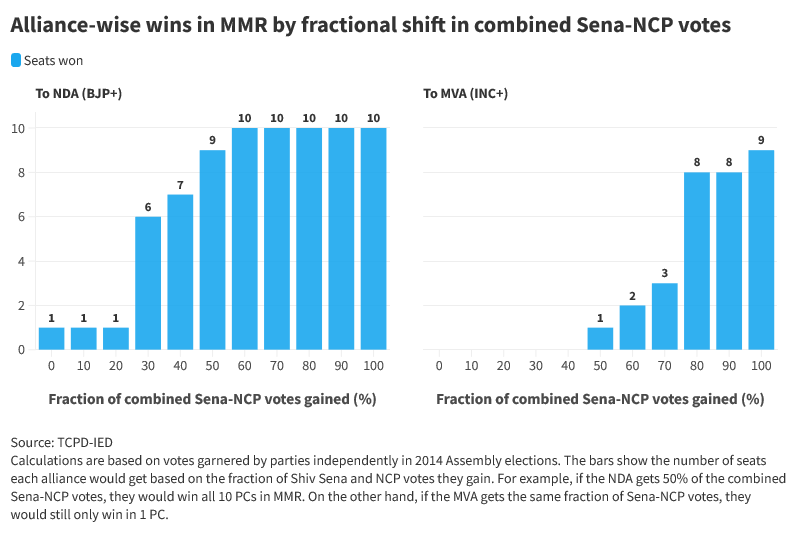
- How would the split in Shiv Sena and NCP affect the MMR contest?The BJP is contesting five out of the 10 MMR PCs this time compared to five and four in 2014 and 2019 respectively. The officially recognized group of the Shiv Sena, which is in alliance with the BJP, is contesting in the rest of the five seats. Although the NCP had contested in three MMR PCs in each of the last three Lok Sabha elections, it didn't win any of them in 2014 and 2019 after winning two in 2009. The party also only won just 4 MLAs from the region in 2014 Assembly elections. In the 2024 elections, the MVA has fielded seven Shiv Sena (UBT), two Congress candidates and just one NCP candidate from these 10 PCs. To understand how the split in Sena and NCP will affect the electoral contest in MMR, HT simulated the scenario by assigning different fractions of the combined Sena-NCP vote in 2014 to both the alliance. If the NDA gets even 40% of the combined Sena-NCP votes, they will win 7 out of the 10 PCs in the city. This number could increase to nine and 10 if the NDA manages 50% and 60% of the combined vote share of the Shiv Sena and the NCP in 2014 assembly elections. For the MVA to win even one seat, they will have to retain half of the combined vote share of the Shiv Sena and the NCP. See Chart 4: Alliance-wise wins in MMR by fractional shift in combined Sena-NCP votes