E-Paper



Number Theory: Core inflation, food basket, and the new targeting debate
Energy prices are an important driver of inflation in any modern economy, especially one such as India which is heavily import-dependent for its energy needs.

 Prefer HTon Google


India’s benchmark inflation number, as measured by the Consumer Price Index (CPI), fell to a five year low of 3.5% in July because of a favourable base effect. It was the first time in five years that the number was below RBI’s target of 4%. The respite from inflation, if one goes by RBI’s own projections, is only temporary and the headline number is expected to stay above RBI’s target of 4% in the current fiscal. Since the current inflation problem is a result of high food inflation -- it has a share of 39% in the CPI basket – there have been arguments, including from finance ministry’s Economic Survey, that the inflation-targeting framework should consider tracking core inflation – the non-food non-fuel part of the CPI basket – rather than the overall index. The argument is persuasive. Interest rates, after all, cannot correct supply-side shocks in food markets, which are the biggest reason for food inflation. High interest rates hurt overall growth. But when seen from a larger perspective, it might not be the best thing to do. Here are three charts which explain this argument in detail.
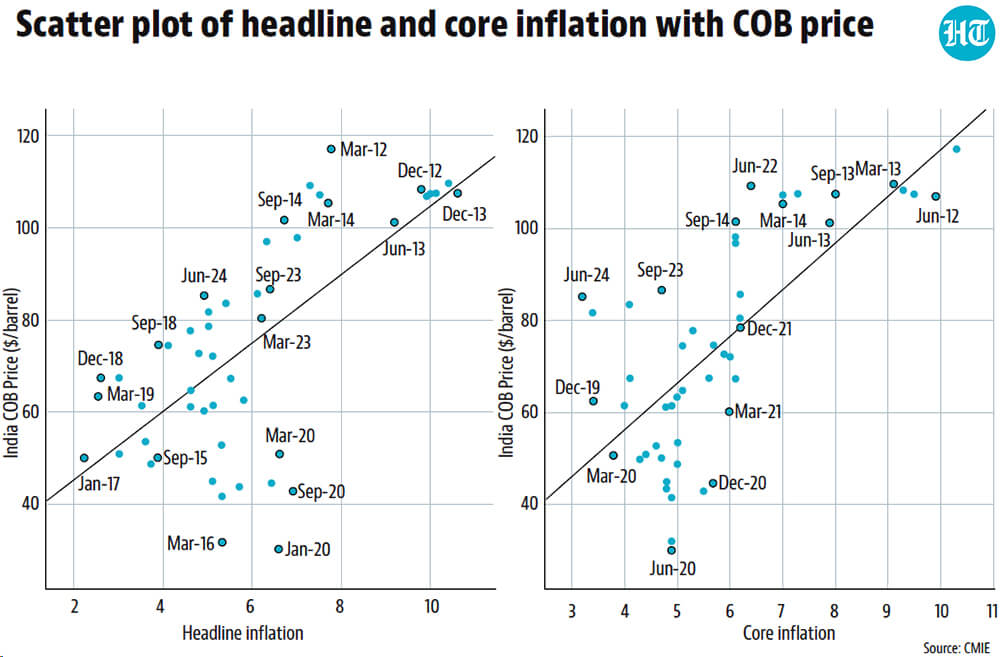
 Will adopting core inflation as the target decouple inflation from energy prices?Asking for core inflation to become the guiding anchor of the inflation-targeting framework entails discounting not just food but also fuel inflation from monetary policymaking. Energy prices are an important driver of inflation in any modern economy, especially one such as India which is heavily import-dependent for its energy requirements. Will adopting core inflation decouple inflation-targeting from energy prices? Not necessarily, shows a simple comparison of headline and core inflation with the price of India’s crude oil basket (COB). Both these comparisons show a strong positive correlation; it’s marginally higher for the core inflation-COB price relation.
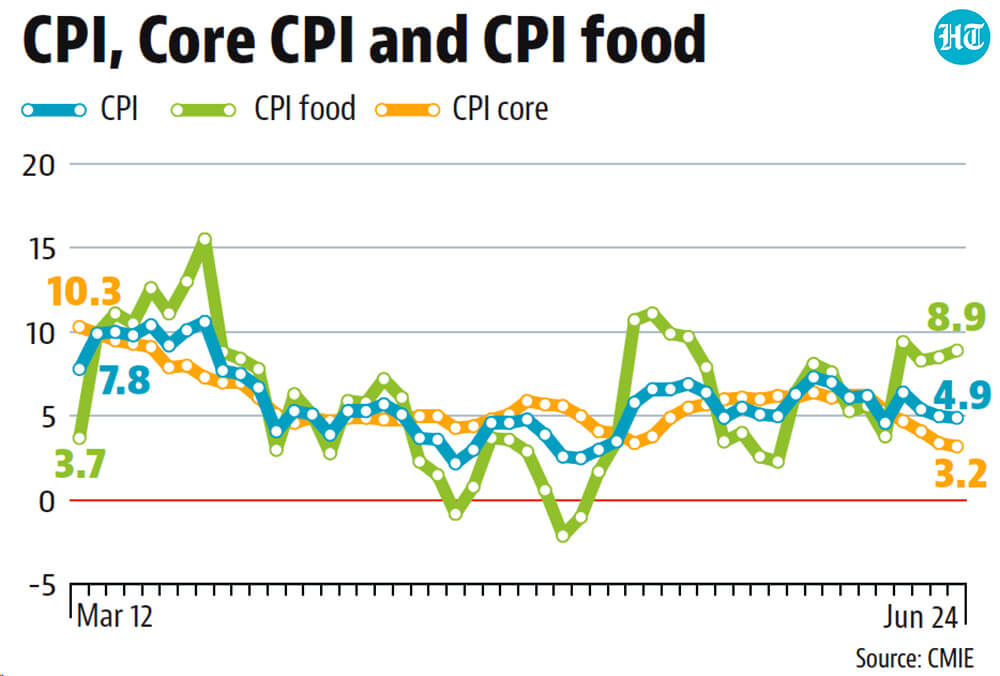
- How do various inflation measures compare vis-à-vis the 4% target?The argument for adopting core inflation as the guiding anchor of inflation-targeting appears tempting at the current juncture because core inflation has been lower than both the headline print and the 4% target in the past two quarters. India’s inflation-targeting framework requires MPC to send a report to the finance ministry if headline inflation is outside the 2% to 6% target band for three consecutive quarters. So far, this has happened only twice, once from the beginning of the pandemic lockdown in March 2020 to December 2020, and then between March 2022 and March 2023. In the second stint, which is when RBI actually sent a report to the government, both headline and core inflation were above 6%. If one were to measure the number of quarters in which different inflation measures have stayed above the 4% target, which is what RBI has been insisting on recently, core inflation has been above this target more frequently (45 times) than headline inflation (40 times) or food inflation (30 times).
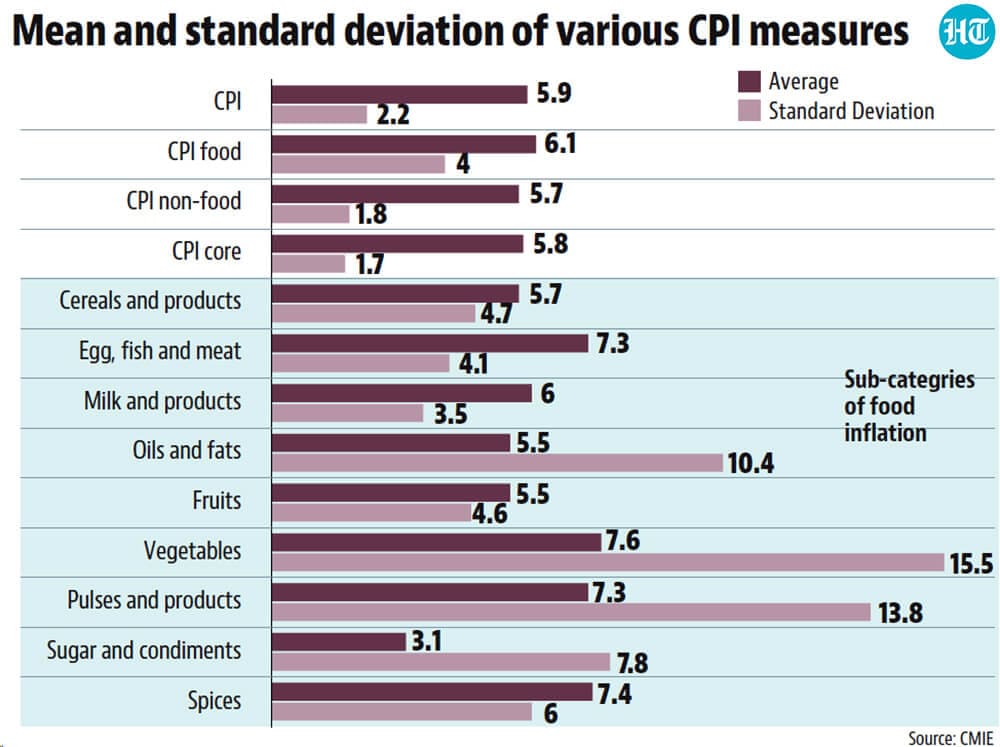
- But food and its subcomponents have a much bigger volatility problemThis is the main problem with food inflation. A simple average of quarterly inflation for overall CPI, CPI food, CPI non-food and core CPI from March 2012 to June 2024 shows that average food inflation is only marginally higher than the other measures. However, the standard deviation – it measures volatility from the average value – for CPI food is significantly higher than what it is for the other three measures. A disaggregated look at the food basket shows that the volatility is much higher for some food items than others. Vegetables, which are the most prone to seasonal shocks, have the highest standard deviation and second-highest standard deviation to mean ratio in the food subcategory.
- What we understand...It is this volatility in food prices that is becoming a problem for a rational conduct of inflation-targeting in the Indian economy. While there is merit in the argument that high interest rates are not likely to bring food prices under control, the counter that high food inflation matters a lot for the non-rich and therefore plays a crucial role in shaping inflation expectations cannot be ignored. Given that climate shocks are only going to increase going forward, food inflation’s noise in overall inflation expectations – inflation targeting is a forward looking policy making exercise – will only become louder . Would it not be a better idea for the fiscal policy arm to think of ways to stabilise food prices more effectively than dilute a monetary policy mandate given to RBI? This is a question which requires much more engagement and fiscal ballast than it is currently getting.