
 E-Paper



Number Theory: Delhi's legislature, executive profiled — 1
.
Updated on: Mar 19, 2025, 09:08:10 IST

 Prefer HTon Google
Share via


Copy link

The assembly elections in February led to a change of guard in Delhi, with the Bharatiya Janata Party (BJP) defeating the Aam Admi Party (AAP) which was in power for more than a decade. The political change aside, how has the socio-political profile of MLAs and ministers in Delhi been changing? HT built a database of all Delhi MLAs since 1993 to answer the question. This two-part series will summarise the findings of this database to give an idea of Delhi’s legislative and executive branches. The first part will look at the details of Delhi’s MLAs and ministers, by party and region, while the second part will look at their caste and religion.
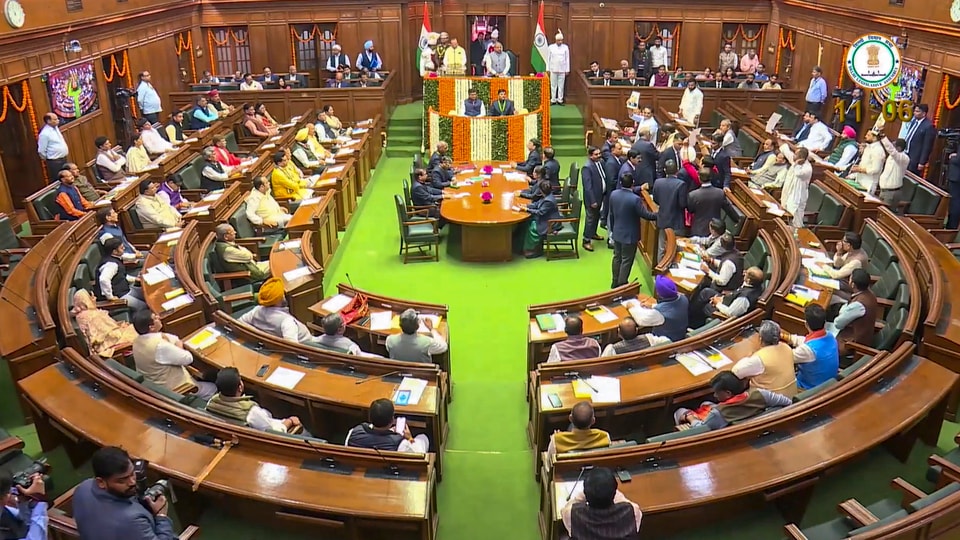
Delhi's legislature, executive profiled — 1
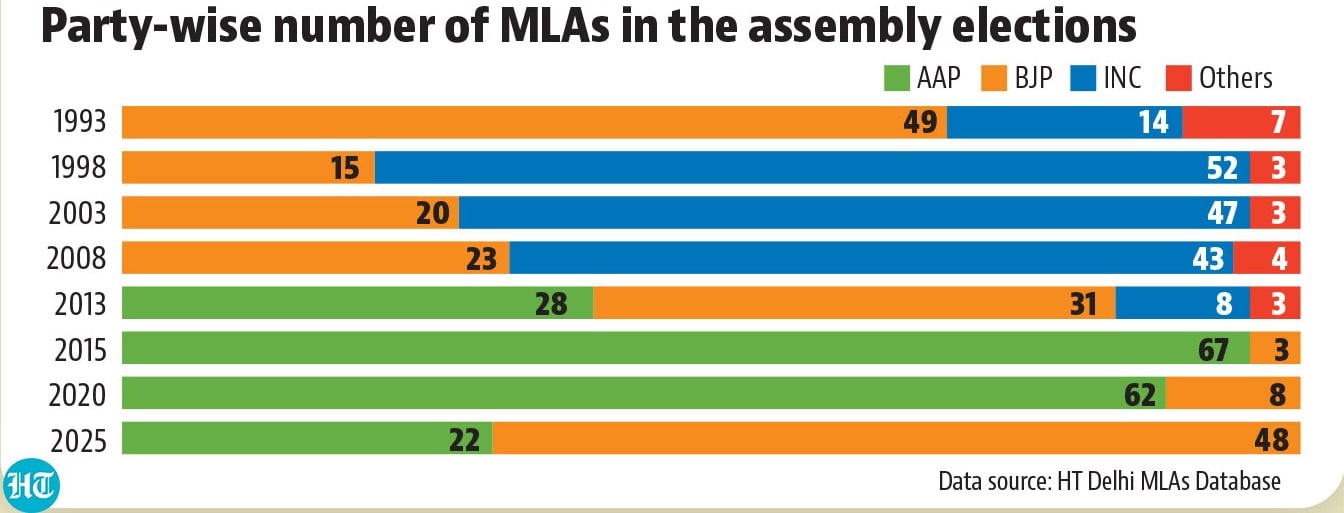
 With its 2025 victory, the BJP’s share is now the highest in Delhi’s total MLAsOf the 560 MLAs who have been elected in Delhi in all assembly elections since 1993 – this database does not include bypolls – the maximum (197) comes from the BJP. The AAP (179) and the Congress (164) are ranked second and third on this count. To be sure, the tripartite division in the total number of MLAs in Delhi hides the fact that its politics has largely been bipolar, with the 1993-2008 period being a Congress-BJP era and the 2015-2025 phase being an AAP-BJP phase.
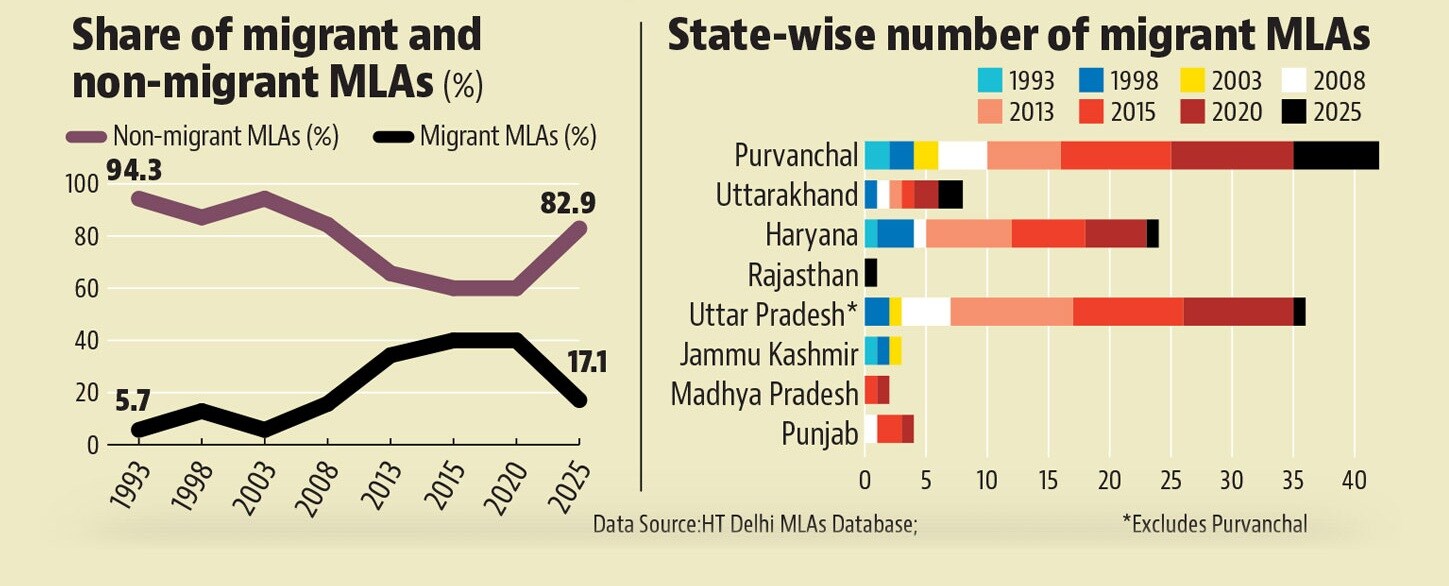
- More than 20% of Delhi MLAs can be described as migrantsThe 2011 Census data puts the share of interstate migrants in Delhi’s population at 37.6%, the highest in the country. Migrants from Bihar, Jharkhand, Uttar Pradesh and Uttarakhand constitute 25.8% of Delhi’s total population . To be sure, the actual share of migrants in the city-state’s population could be even higher as government publications themselves (the 2016-17 Economic Survey, for example) have indicated that census data undercounts migration. How many of Delhi’s MLAs can be described as migrants? HT’s database suggests that this number could be more than 20%. While 78.5% of Delhi’s MLAs come from Delhi, the remaining are from other states, with the largest share coming from Bihar and eastern Uttar Pradesh, which are together referred to as Purvanchal. The second largest share of migrant MLAs in Delhi come from Uttar Pradesh, excluding areas which have been counted as Purvanchal.The share of migrant MLAs in the Delhi assembly was the highest in 2015 and 2020 at 40% each. While this number fell in 2025, their cumulative share has been rising over time. MLAs have been described as a migrant in the database if they were born and brought up outside Delhi or have had some formal education in their place of birth.
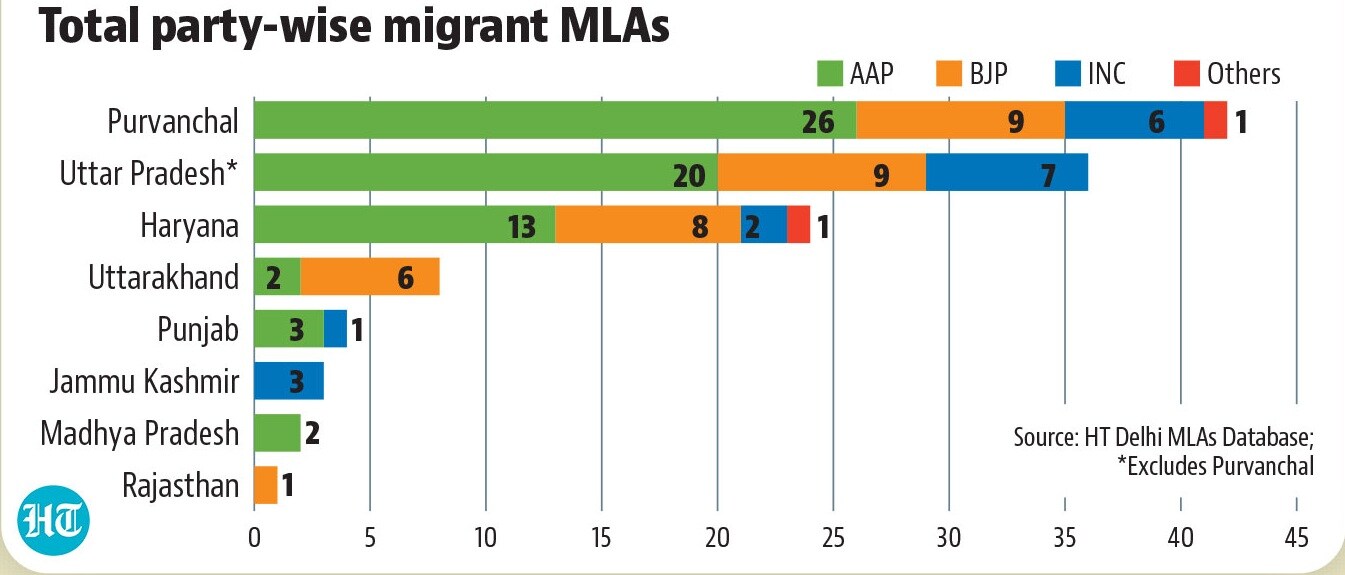
- Among political parties, AAP has the largest share of migrant MLAsThis is another important aspect that comes out from the database. The cumulative share of migrant MLAs in Delhi remained below 16% until the AAP arrived on the political landscape. The reason this number has been increasing continuously after this period is primarily because of migrant candidates from the AAP getting elected from the 2015 elections onwards. Among its total MLAs, AAP has the highest relative share – the share of migrant MLAs in a party divided by their overall share – of migrant MLAs, while the BJP and Congress have a less-than-proportionate shares of migrant MLAs.
- To be sure, the share of migrants in the council of ministers continues to be lowIn the current council of ministers headed by Rekha Gupta, out of six ministers, two are from the Purvanchal region (Pankaj Singh from Bihar and Kapil Mishra from Uttar Pradesh). During AAP rule between 2015 and 2025, Gopal Rai from the Purvanchal region was the minister for the full period, while Somnath Bharti was a minister for a brief time in Kejriwal’s first term. In the first ministry (1998) of Sheila Dixit, Parvez Hashmi who belonged to Allahabad (now Prayagraj) was a minister.

Unlock a world of Benefits with HT! From insightful newsletters to real-time news alerts and a personalized news feed – it's all here, just a click away! -Login Now!


