E-Paper



Number Theory: Four charts that explain elections in Haryana, Jammu & Kashmir
The Election Commission of India (ECI) announced assembly elections in Haryana and the union territory of Jammu & Kashmir on Friday
Updated on: Aug 16, 2024, 20:24:26 IST

 Prefer HTon Google
Share via


Copy link

The Election Commission of India (ECI) announced assembly elections in Haryana and the union territory of Jammu & Kashmir on Friday. While Jammu and Kashmir, which is seeing assembly elections for the first time since the abrogation of Article 370, will be voting in three phases from September 18 till October 1, Haryana will be voting on October 1. Here are four charts that explain the nature of political contests in these two states.
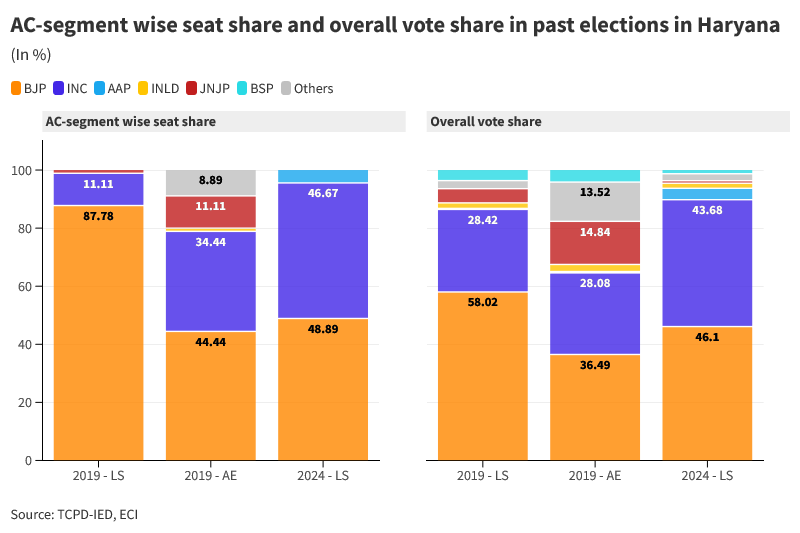
 State elections in Haryana were far more competitive than Lok Sabha elections even in 2019The BJP won all ten parliamentary constituencies (PCs) in Haryana in the 2019 Lok Sabha elections. But in the assembly elections held just five months later, the Congress managed to increase its vote share by 23.3 percentage points compared to its Lok Sabha showing and the BJP could not manage a simple majority in the 90-MLA assembly. The Congress’s performance in the 2024 Lok Sabha elections has been much better than 2019. Both the BJP and the Congress won five PCs each this time. If one breaks the PC results at the assembly constituency (AC) level, the seat share of the INDIA Block (the Congress gave one PC to the AAP) turns out to be 51.1% compared to 48.9% for the BJP. If the Congress retains its 2024 Lok Sabha momentum it could have an advantage vis-à-vis the BJP in these elections. To be sure, the BJP still has a formidable support base in the state.
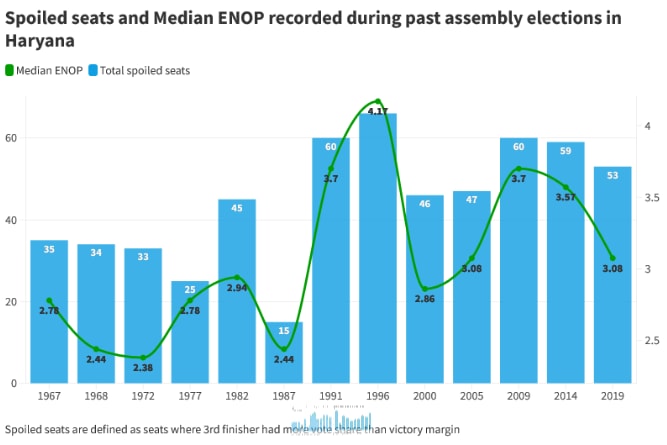
- Will 2024 see a more polarised election in Haryana?Unlike in 2014, the BJP did not get a simple majority in the 2019 assembly elections and had to form the government in a post-poll alliance with the Jananayak Janata Party (JJP). The BJP broke ranks with the JJP before the 2024 Lok Sabha elections and the later performed very badly. A comparison of median value of effective number of participants (ENOP) and number of ACs which had spoilers shows that the electoral competition in Haryana has increased after the Congress lost its dominance in the last decade. ENOP is defined as the reciprocal of the sum of squares of the vote share of all candidates in a constituency, and a higher value denotes greater political fragmentation in the elections. For example, if there are four candidates in a constituency and they get 26%, 25%, 25% and 24% votes ENOP value will be 3.99. If these votes share numbers change to 50%, 45%, 3% and 2% ENOP will fall to 2.2. An AC is considered to have a spoiler if a candidate on the third position secures more votes than the victory margin. Will Haryana see a significant fall in the fragmentation of electoral competition this time? Whether or not this happens could have an impact on the Congress’s chances which has typically done better when politics is less fragmented.
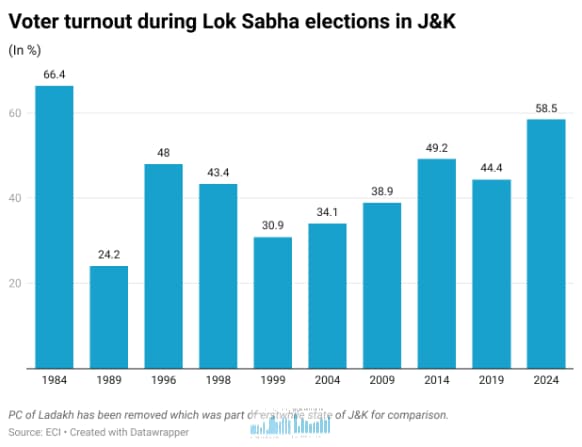
- Will Jammu and Kashmir retain the high turnout seen in the 2024 Lok Sabha elections?The announcement of assembly elections in Jammu and Kashmir after ten years is an important step towards restoration of local democracy in the union territory. These elections will be the first serious political contest at the UT-level – the government has maintained that Jammu and Kashmir’s statehood will be restored eventually – after the abrogation of Article 370 which gave special constitutional status to the erstwhile state of Jammu and Kashmir. This context means that participation itself is an important factor for Jammu and Kashmir notwithstanding what the results are. It is on this count that the Lok Sabha elections held in the UT were extremely encouraging. Taken together, the five PCs in Jammu and Kashmir recorded their highest voter turnout in 35 years at 58.46% during the 2024 Lok Sabha elections. Within the Kashmir valley which includes three PCs and 47 out of the 90 newly formed ACs, the 2024 Lok Sabha voter turnout stood at a three decade high of 50.86%.
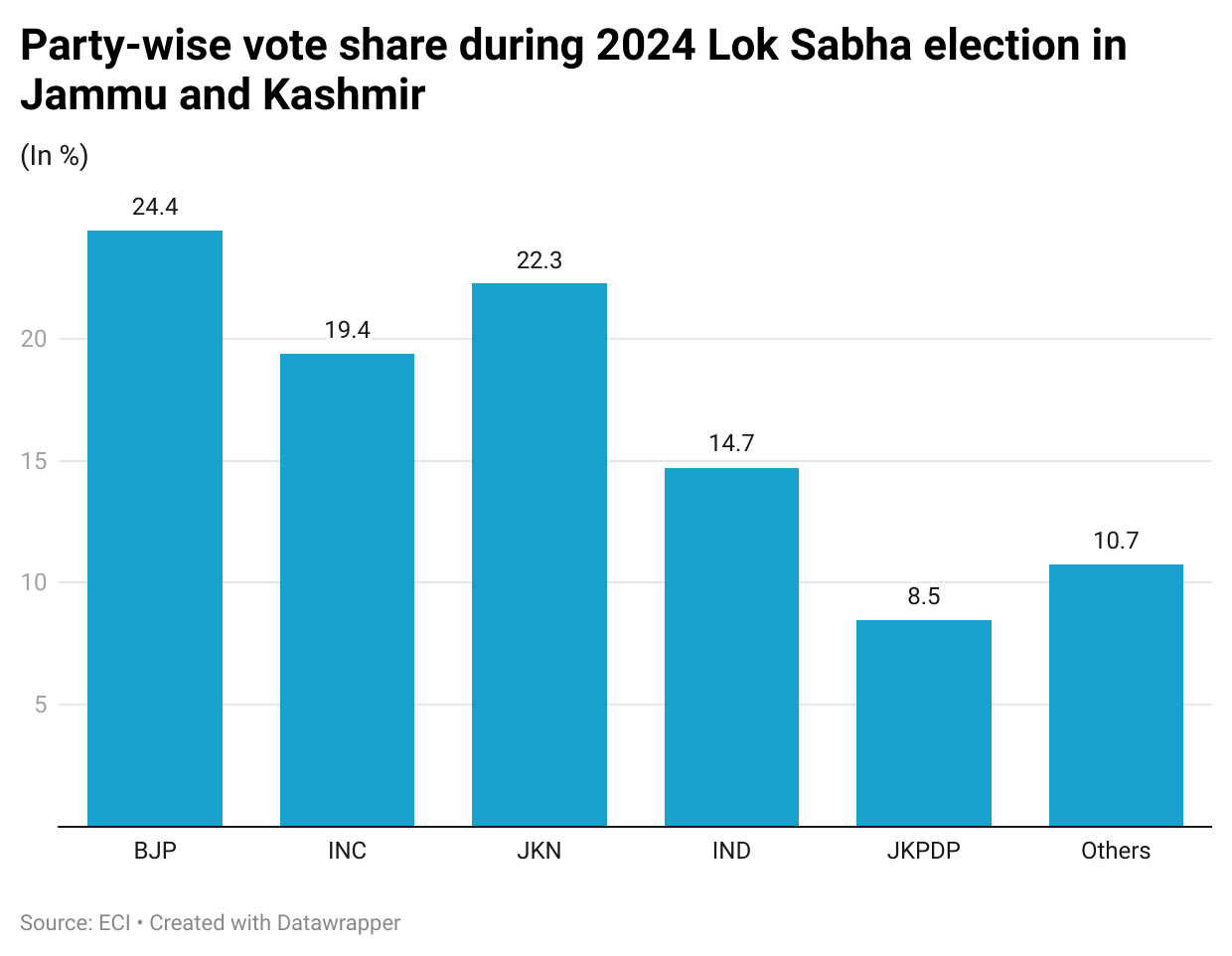
- But J&K's political climate remain uncertainGiven that the 2024 Lok Sabha elections were the first general elections held in Jammu and Kashmir after the abrogation of Article 370 and the subsequent delimitation exercise, and with the upcoming elections being the first assembly elections, direct comparisons with previous election results are not feasible. However, the overall vote share patterns show that the political climate in the state remain uncertain, especially with none of the parties even managing to secure a quarter of the votes cast in the 2024 Lok Sabha elections.