E-Paper



Number Theory: Four charts which capture 10 years of Jan Dhan Yojana
Out of the 531 million bank accounts opened under the PMJDY, just 16 million have been opened with private banks.
Published on: Aug 28, 2024, 08:58:45 IST

 Prefer HTon Google
Share via


Copy link

The Pradhan Mantri Jan Dhan Yojana (PMJDY), which was announced on 15 August 2014 and launched on 28 August 2014, completes 10 years today. What are the major achievements of the scheme? What has this scheme meant for the Indian economy and the banking system? Here are four charts which answer this question.

Four charts which capture 10 years of Jan Dhan Yojana
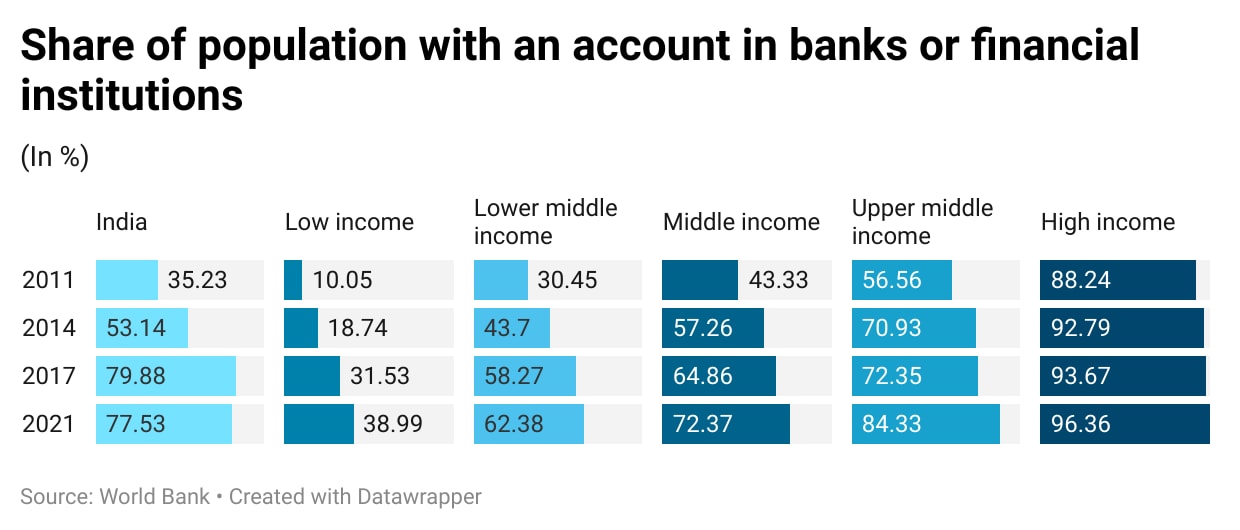
 PMJDY has helped India punch above its weight in financial inclusionThe World Bank’s Global Findex Database makes it clear. The share of the population above the age of 15 years having an account with a bank or financial institution was 35% in 2011 in India. This was slightly above the average for lower middle income economies but significantly lower than the average number of middle income and richer economies. The World Bank classifies countries with a per capita Gross National Income (GNI) of $1,145 or lesser into low; between $1,146 and $4,515 into lower-middle; between $4,516 and $14,005 upper-middle; and those with more than a GNI per capita of $14,005 into high income economies. With a per capita GNI of $2,540, India is a lower-middle income economy. India started closing the financial inclusion gap the year PMJDY was launched and it crossed the middle income economies on the financial inclusion front in 2021 itself, the last year for which World Bank data is available. Given the fact that the number of PMJDY accounts has increased from 442 million in 2021 to 531 million as of now, India’s financial inclusion score and the relative advantage on this front is likely to have increased even further. This is remarkable, considering that without these schemes, India would have taken much longer to provide banking services to around 80% of its adult population. According to a study by the Bank of International Settlements, using traditional growth measures, it would have taken till 2055 for the country to reach the figure.
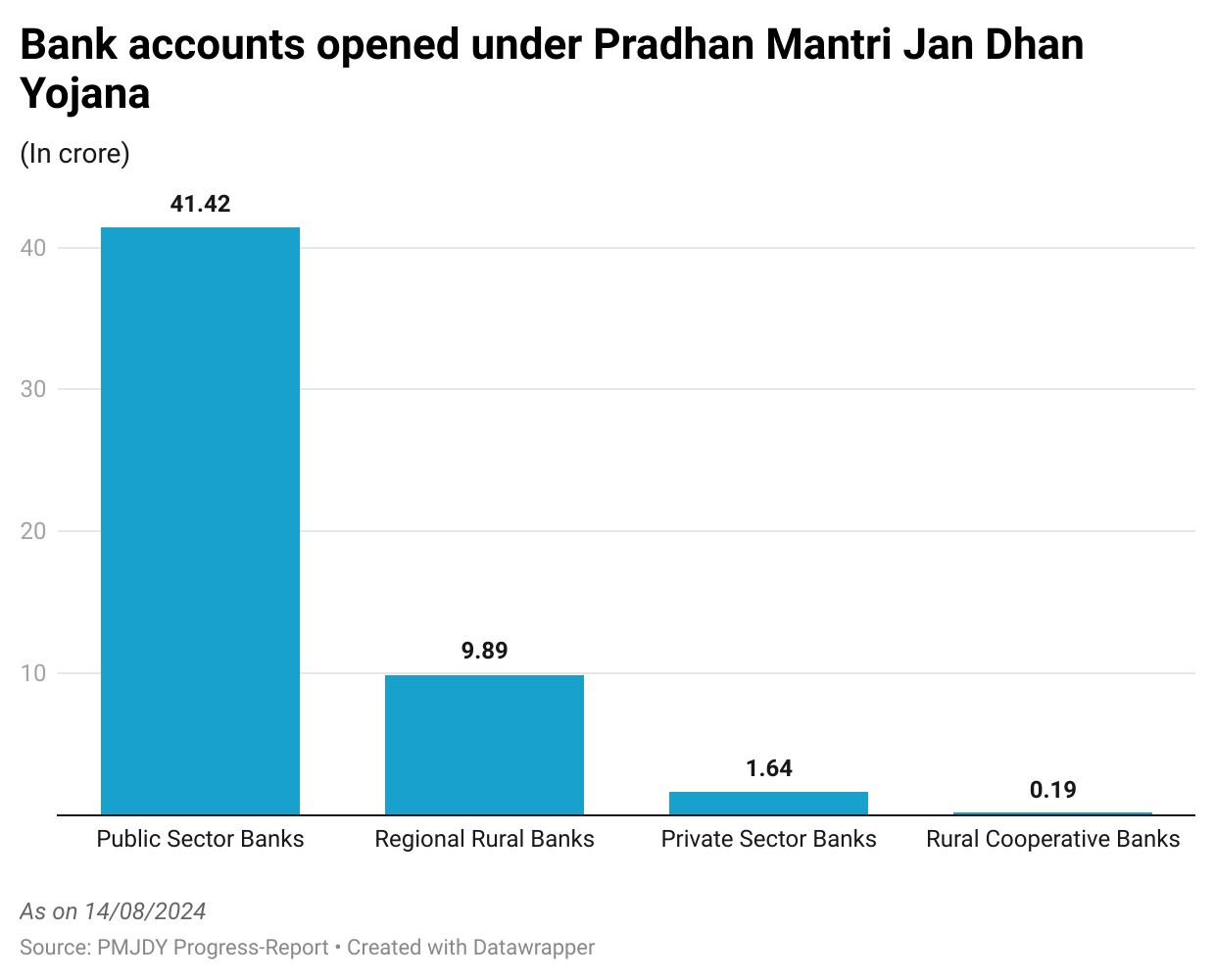
- PMJDY’s success is basically the doing of government banksOnce again, numbers from the scheme’s dashboard show it clearly. Out of the 531 million bank accounts opened under the PMJDY, just 16 million have been opened with private banks. Public Sector Banks have opened 78% of these accounts while regional rural banks and rural cooperative banks have opened the rest. The PMJDY’s egalitarian impact on financial inclusions becomes even more important given the fact that majority of the banks have been opened in rural-semi urban areas and almost half of the beneficiaries are women.
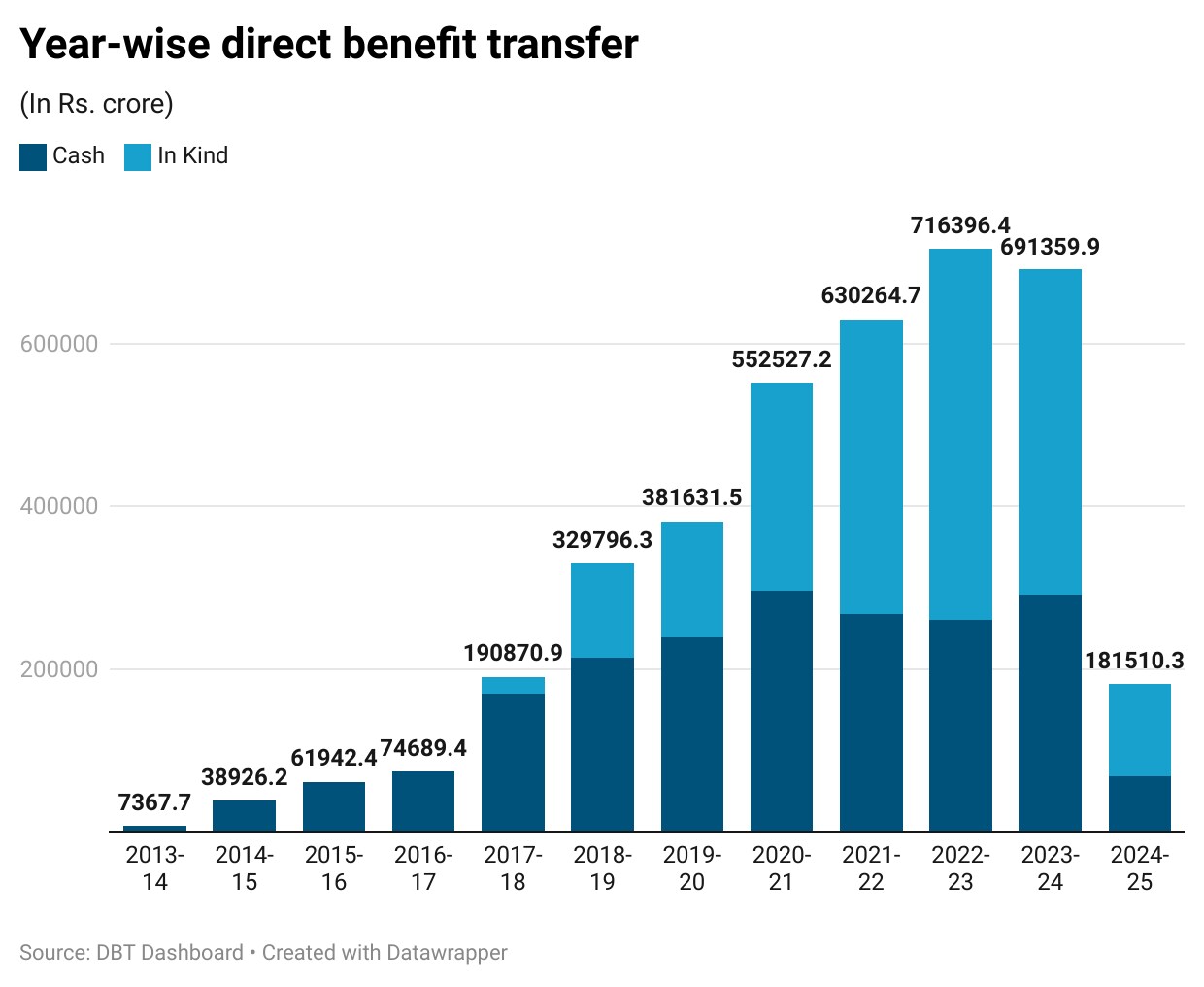
- PMJDY has played a big role in the DBT revolutionWhile financial inclusion was one of the objectives of PMJDY, the other was to allow the government to channel the benefits of its scheme directly to the beneficiaries through Direct Benefit Transfers (DBT). "The DBT scheme and JAM (Jan Dhan-Aadhaar-Mobile) trinity have been boosters of fiscal efficiency and minimisation of leakages," said the report titled 'Indian Economy — A Review' published by the Ministry of Finance before the 2024 interim budget was presented. Till date, the government has cumulatively transferred around ₹38.6 lakh crore for various schemes through DBT. Out of this, 51.7% were in cash payments, which are directly sent to the bank accounts of beneficiaries, while 48.3% were in kind, which were distributed through the Public Distribution system. According to the DBT dashboard, as of March 2023, the central government has saved nearly ₹3.5 lakh crore by the removal of "removal of duplicate/ fake beneficiaries and plugging of leakages" using DBT and other government reforms.
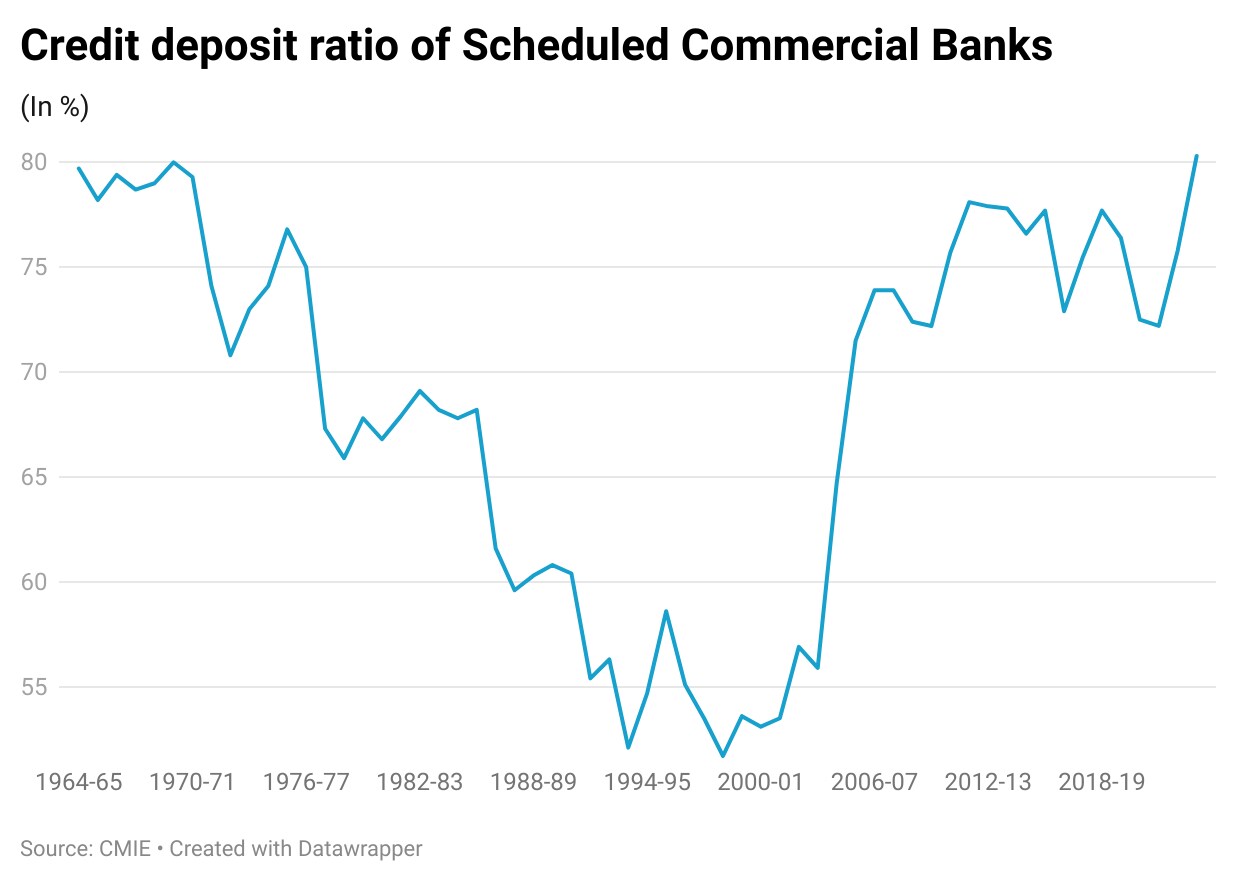
- To be sure, PMJDY hasn't done much for the issue of slow growth in bank depositsWhile the number of Jan Dhan accounts has increased consistently from 17.9 crore in August 2015 to 53.12 crore as of August 2024, a rise of 196.8%, deposits within scheduled commercial banks themselves haven't grown so steadily. This is simply because having a bank account in itself doesn't lead to an increase in financial well-being. While, in total, there are currently ₹2.31 lakh crore in Jan Dhan accounts across the country, on average, each of those accounts on average only contain ₹4,352. Moreover, according to data submitted by the government to the Parliament, as of December 2023, as much as 10.34 crore Jan Dhan accounts are inoperative. And with the bank accounts under the scheme having no minimum balance requirement, as many as 4.3 crore accounts were recorded to have zero balance. At a time when banks are worried about mobilising enough deposits and the credit deposit ratio has been climbing up, the PMJDY has been of very little help in meeting this challenge.