E-Paper



Number Theory: How bad are the floods in northeastern states?
The area exposed to pluvial floods is larger in all states (due to urban settlements) than those affected by fluvial floods, except in Assam, Manipur, Mizoram.

 Prefer HTon Google


Parts of all northeastern states have been affected by floods this monsoon season. But how bad is the situation? Assessing the extent of floods is a long and complicated exercise . However, a part of this problem can be simplified for the North-East since large parts of the populated region in these states are exposed to floods because of overflowing rivers , or fluvial floods. This is different from pluvial floods, which are caused by poor drainage of rainwater. Therefore, the water level in rivers can be a reasonable indicator of the severity of the hazard. Here is what the data shows.
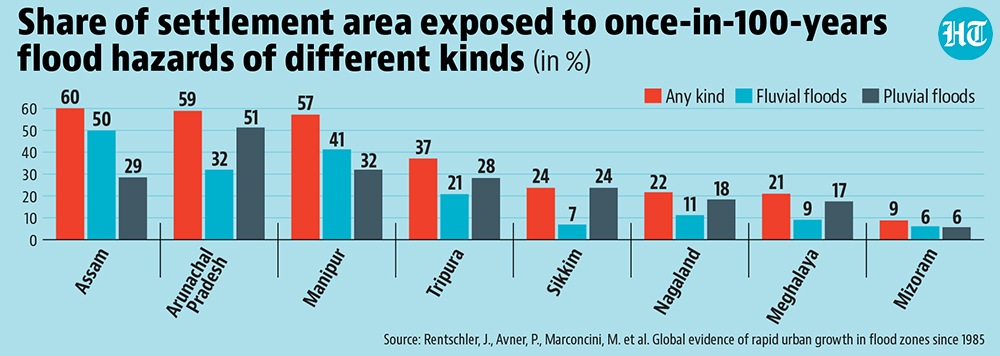
 Which states have the most settlement area exposed to fluvial floods?This question is important because most data on floods (including river-level data used in this analysis) is limited. We can understand whether those gaps will affect our analysis if we know the exposure to different kinds of flood hazards. This can be calculated from a study published in Nature last year: “Global evidence of rapid urban growth in flood zones since 1985”. The study estimated the settlement extent in areas exposed to once-in-100-years flood events, with the most recent data available for 2015. This shows that around 60% of the settlement area in Assam, Arunachal Pradesh, and Manipur is exposed to both kinds of floods. This area is 37% in Tripura; between 21%-24% in Meghalaya, Nagaland, and Sikkim; and 9% in Mizoram. Of the overall exposed area, at least half in all states is exposed to fluvial floods, except Meghalaya and Sikkim. This means that river levels can reasonably indicate the severity of floods in most northeastern states. To be sure, the area exposed to pluvial floods is larger in all states (due to urban settlements) than those affected by fluvial floods, except in Assam, Manipur, and Mizoram.
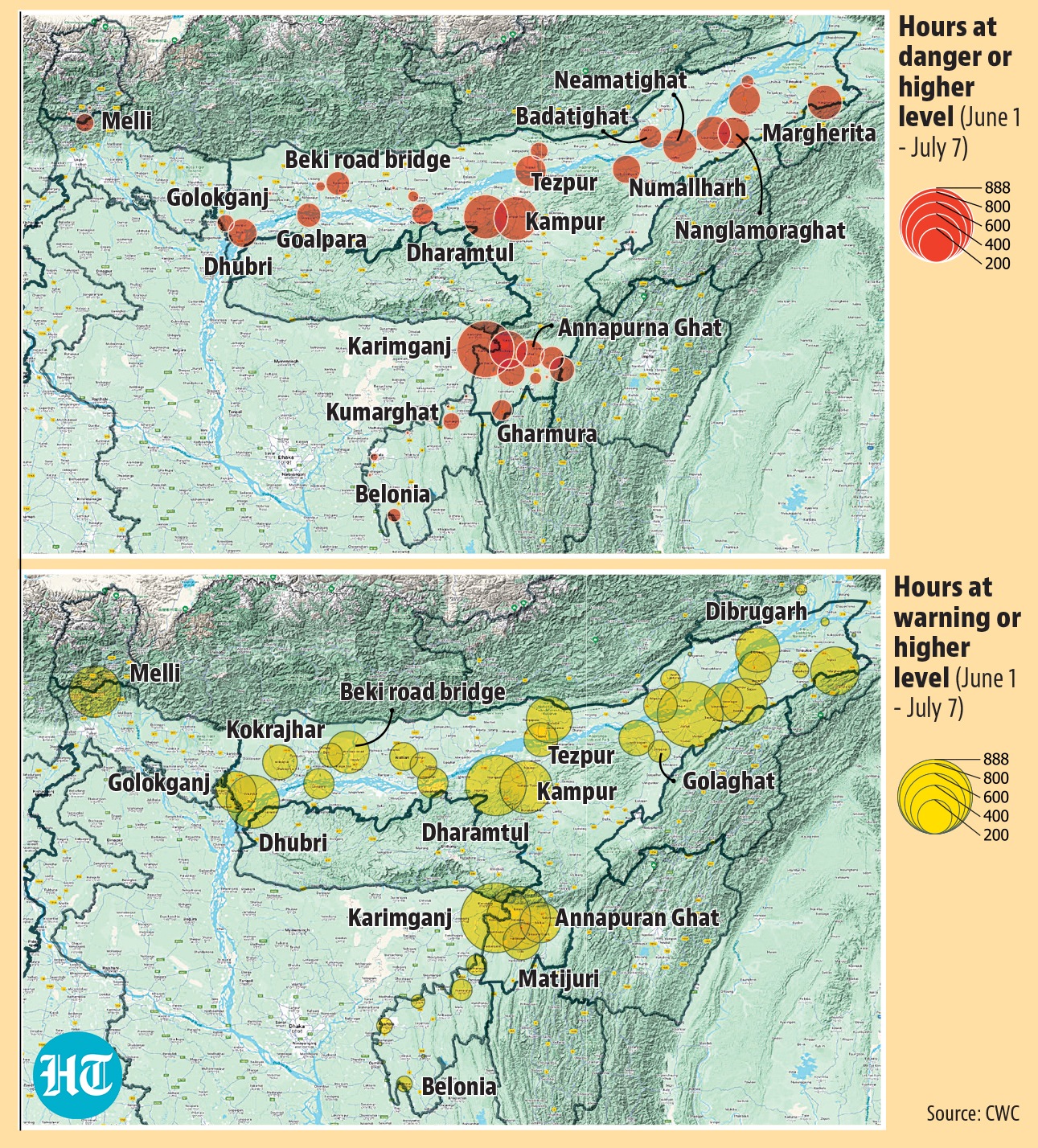
- How long have rivers been flowing above danger mark in northeastern states this monsoon?The Central Water Commission (CWC) displays water-level data for 221 stations across the rivers of northeastern states. However, only 53 stations have data for most of the June 1 -July 7 period and have a warning or danger level specified: 36 stations in Assam, 10 in Tripura, three each in Arunachal Pradesh and Sikkim, and one in Manipur. While Meghalaya and Mizoram do not have such stations, they also have relatively smaller exposure to fluvial floods. Among the 53 stations with better data, the river crossed the danger level at 31 stations for at least one hour in the June 1-July 7 period. These stations make up 26 of 36 stations in Assam, three of 10 in Tripura, and one each in Manipur and Sikkim. The worst affected is the Karimganj station in Assam, where the Kushiyara river has flown above the danger level for 538 of the 888 hours uncer consdieration. The few Manipur, Sikkim, and Tripura stations do not show promising trends either. The Barak River was above the danger mark for 111 hours at the Chotabekra station in Manipur’s Imphal East district; Teesta for 56 hours at the Melli station in Sikkim’s Namchi district; and the Manu river for 47 hours at Kumarghat station Tripura’s Unakoti district. To be sure, as the accompanying maps show, even more stations crossed the warning level: 36 for at least one hour and 34 for at least 24 hours. Warning level was available for only 47 stations.
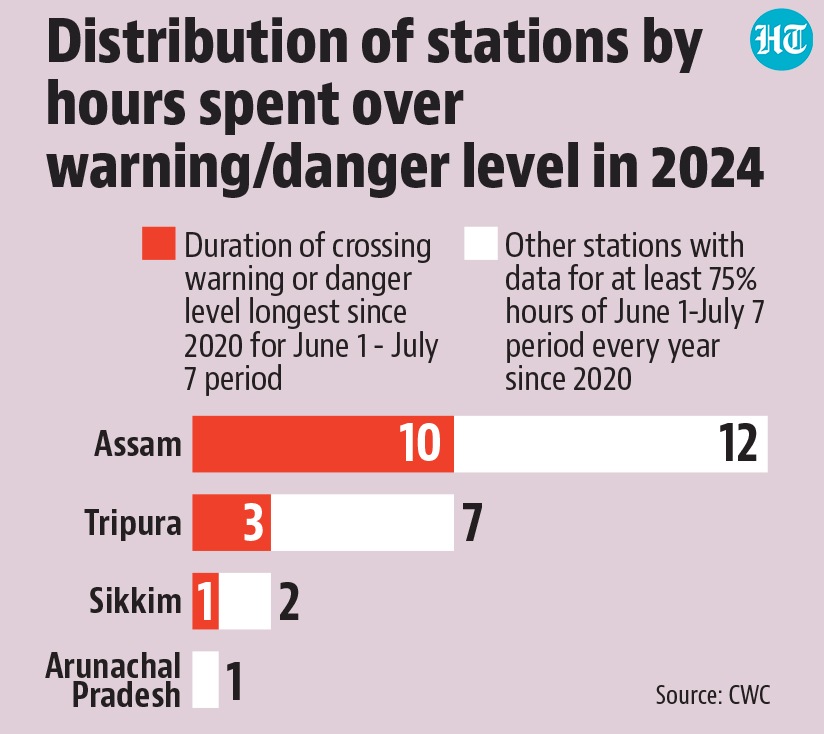
- How bad are river levels this monsoon compared to earlier?Any comparison with the past reduces the number of stations with sufficient data. For example, only 36 of the 53 stations analysed above have data for at least 75% of the hours under consideration from June 1 to July 7 in every year since 2020. It is possible that there are fewer readings in some because there was no threat then. However, HT has used only the 36 stations with high coverage for ranking. This shows that river levels crossed the warning or danger level for the longest duration this year since 2020 at 14 of the 36 stations. These stations are 10 of the 12 stations in Assam, one of two in Sikkim, and three of seven in Tripura.
- Disasters due to rain can extend to locations other than what the river data suggestsOne reason for this is the exposure of settlements to pluvial floods. Moreover, most northeastern states are also reporting landslides. Therefore, it is important to check the fraction of these states dealing with a large surplus of rain. This shows that for the June 1-July 9 period, at least half of Assam, Meghalaya, Nagaland, and Sikkim received excess or large excess rain, which is defined as 20% or more rain than the long period average or LPA (average rain during the 1971-2020 period). Such area also covers 25%-33% of Arunachal Pradesh, Tripura, and Mizoram. There is no such region in Manipur, but only because the state flooded only in July.
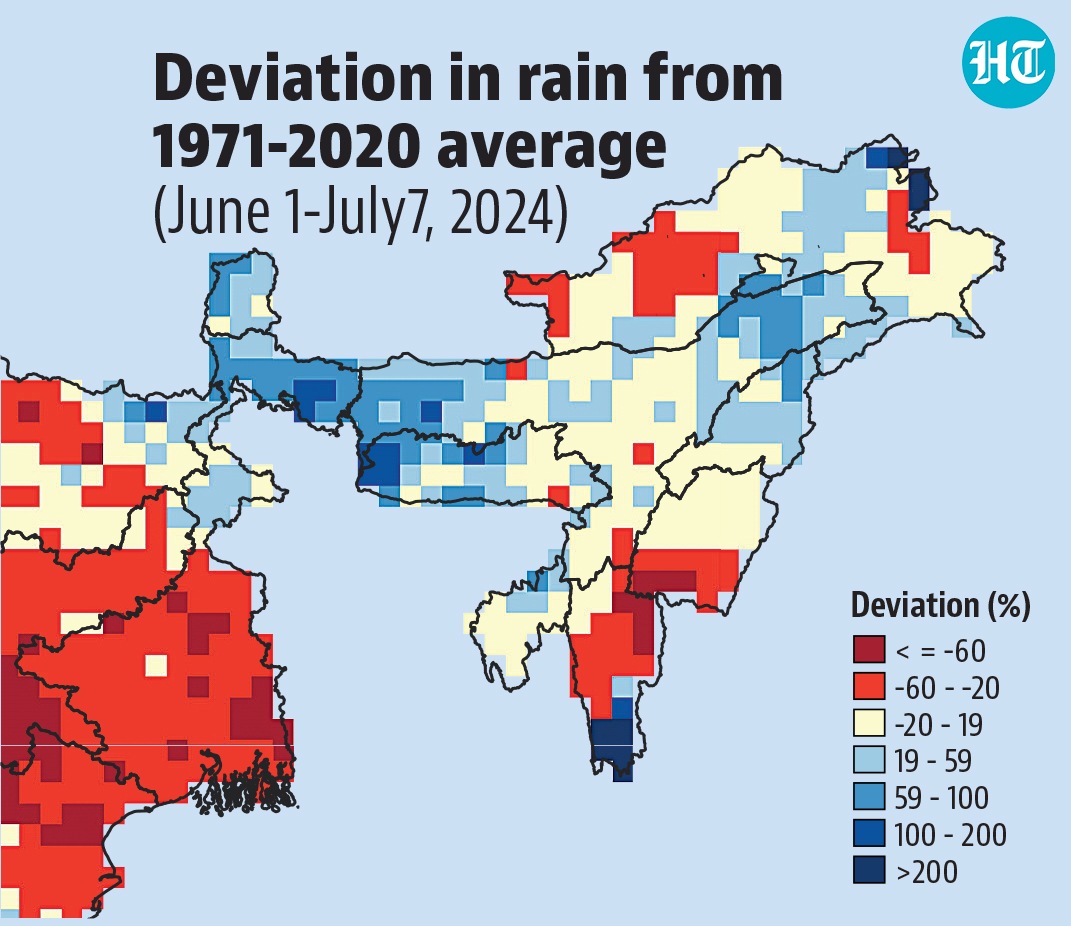
These numbers taken together highlight that the floods in north-eastern states this year are widespread and likely far from the norm. Rivers have crossed the danger mark at almost 60% of stations where the mark is specified. The duration of crossing such danger/warning levels is also the longest in at least five years at 40% of stations. With excess rain, this threat from the river is likely to be accompanied with landslides in hilly terrain, making this a disastrous monsoon for north-eastern states.