E-Paper



Number Theory: How credible are official stats on sexual violence against women?
Official statistics show a wide divergence across states in crime against women

 Prefer HTon Google


Even as the protests against the rape and murder of a woman doctor at R G Kar Hospital continue in Kolkata, the West Bengal government has passed a new law to control heinous crime against women. To be sure, this is not the first time a new law has been passed after widespread outrage following an incident of crime against a woman. How effective can such policies be? As was pointed out in these pages last week (https://tinyurl.com/5dvtjrkh) crime against women is the result of lack of resources within the criminal justice system in the country, but also state apathy and entrenched patriarchal norms.

To be sure, there is another important question as far as crime against women is concerned. How credible are the statistics of crime against women? This is an important question because if the official statistics on crime against women under report violence, they will make the criminal justice system look better than what it is when it comes to ensuring justice and preventing such crimes.
This two-part series will look into the question of credibility or lack of it of official statistics on crime against women and whether there is a way to measure the extent of underreporting. The first part will explain why official statistics on crime against women can be misleading and the second part will draw on recently published research which measures the extent of under reporting of such crimes in India.
Official statistics show a wide divergence across states in crime against women
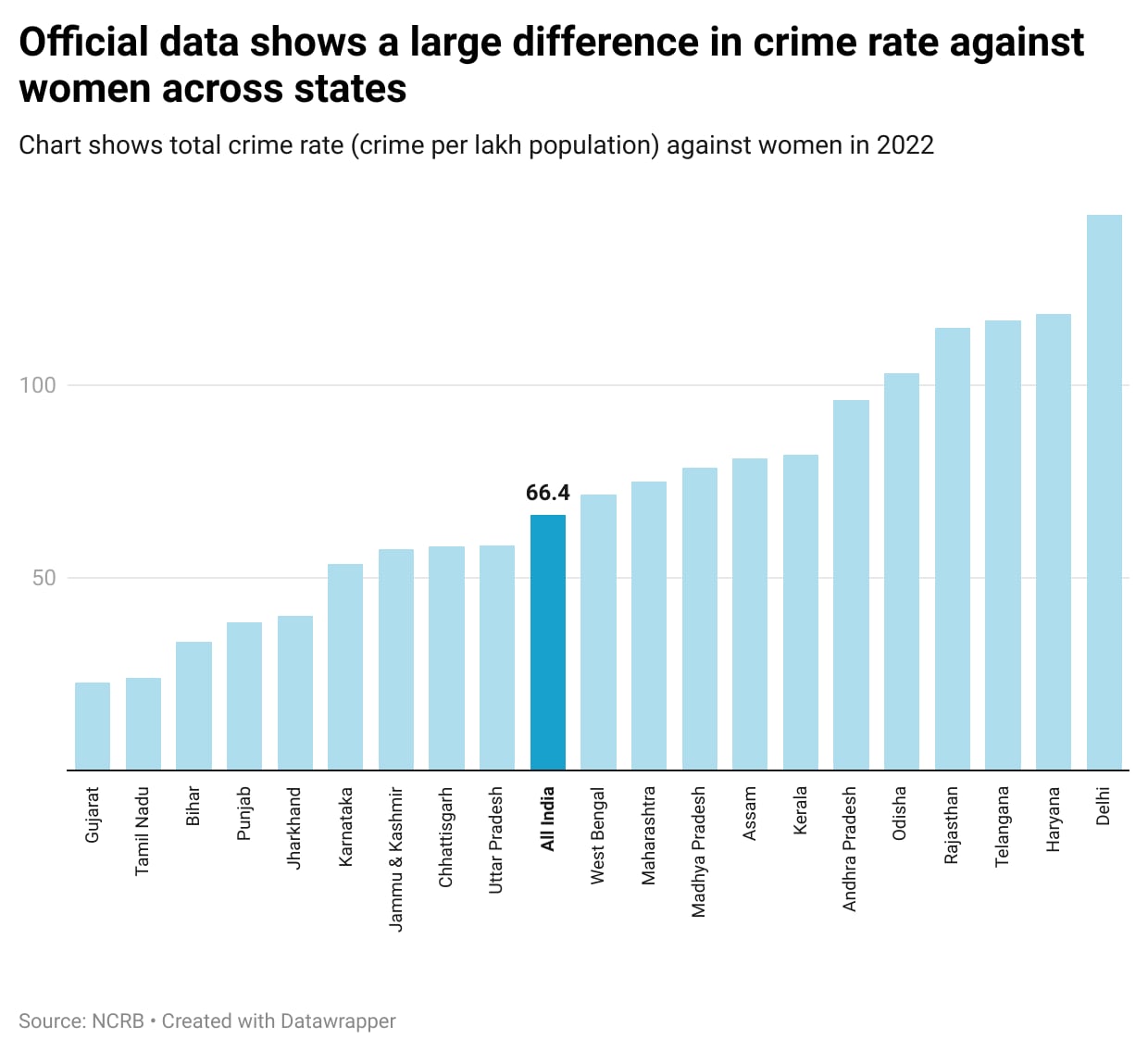
Official crime statistics are published by the National Crime Record Bureau (NCRB) which works under the home ministry. NCRB's Crime in India’s latest available data for 2022 shows that there is a very large variation across Indian states when it comes to crime against women. While the crime rate of total crime against women (number of reported crimes per lakh population) was just 23, 24 and 33 in Gujarat, Tamil Nadu and Bihar it was as high as 119 and 144 in Haryana and Delhi. Are parts of India drastically different when it comes to crime against women or do these numbers do not tell us the entire story?
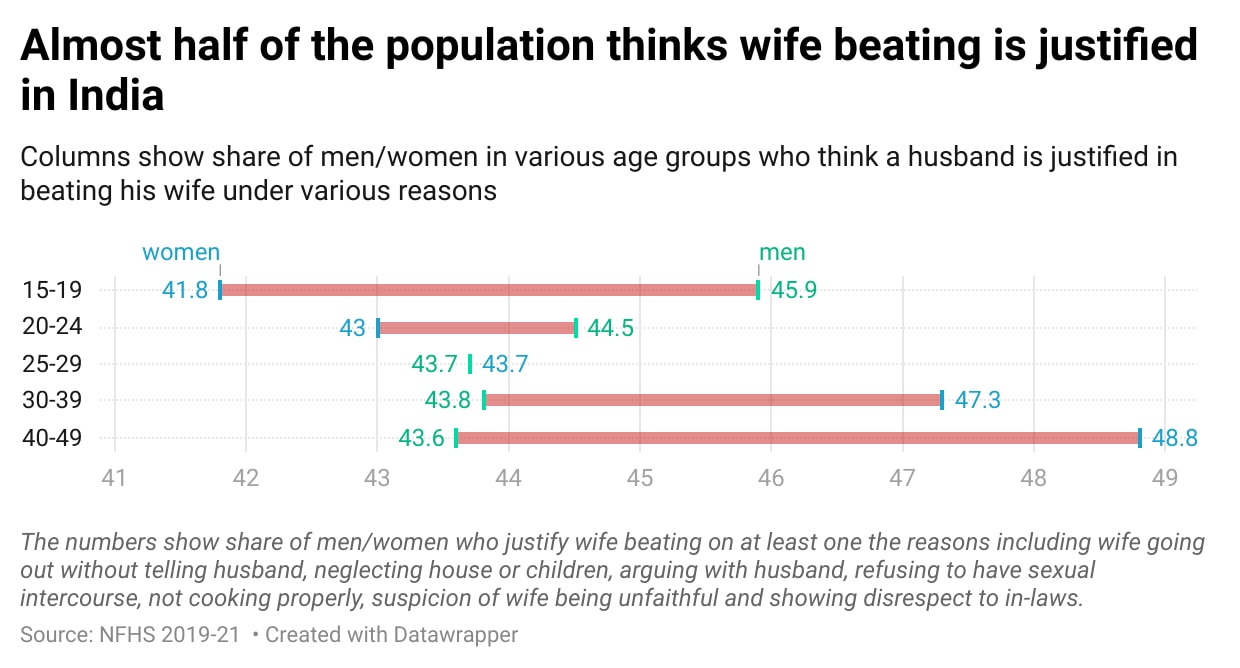
 Patriarchal backlash from the criminal justice system and the community could play a big role in reporting of crime against womenJustice J S Varma Committee report, which was formed in the aftermath of the 2012 protests against the gangrape of a young woman in Delhi, spoke about the police’s dubious role in dealing with cases of crime against women categorically. “The demand of justice is a fundamental charter of freedom which is guaranteed under the Constitution to every individual. In the context of a woman, it is all the more necessary that we snap the link between shame and honour, on the one hand, and the crime itself… We do notice that this concept of shame has somehow led the police to have an upper hand. The police have become arbiters of honour. The police, without registering even a FIR, assume that they have the moral capacity to pronounce upon the rights and wrongs of the rapist as well as the rape victim. This is simply deplorable and it is inconceivable in a modern society, which is governed by republican values”, the report says. There is good reason to believe that that societal norms, including those held by women, encourage prompt reporting of crime or violence against women as well. For example, data from the fifth round of National Family and Health Survey (NFHS) – it was conducted between 2019-21 – shows that close to half of men and women believe that physical violence by husbands against wives is justified on some pretext. If these norms dominate then it is only to be expected that crime against women would be underreported.
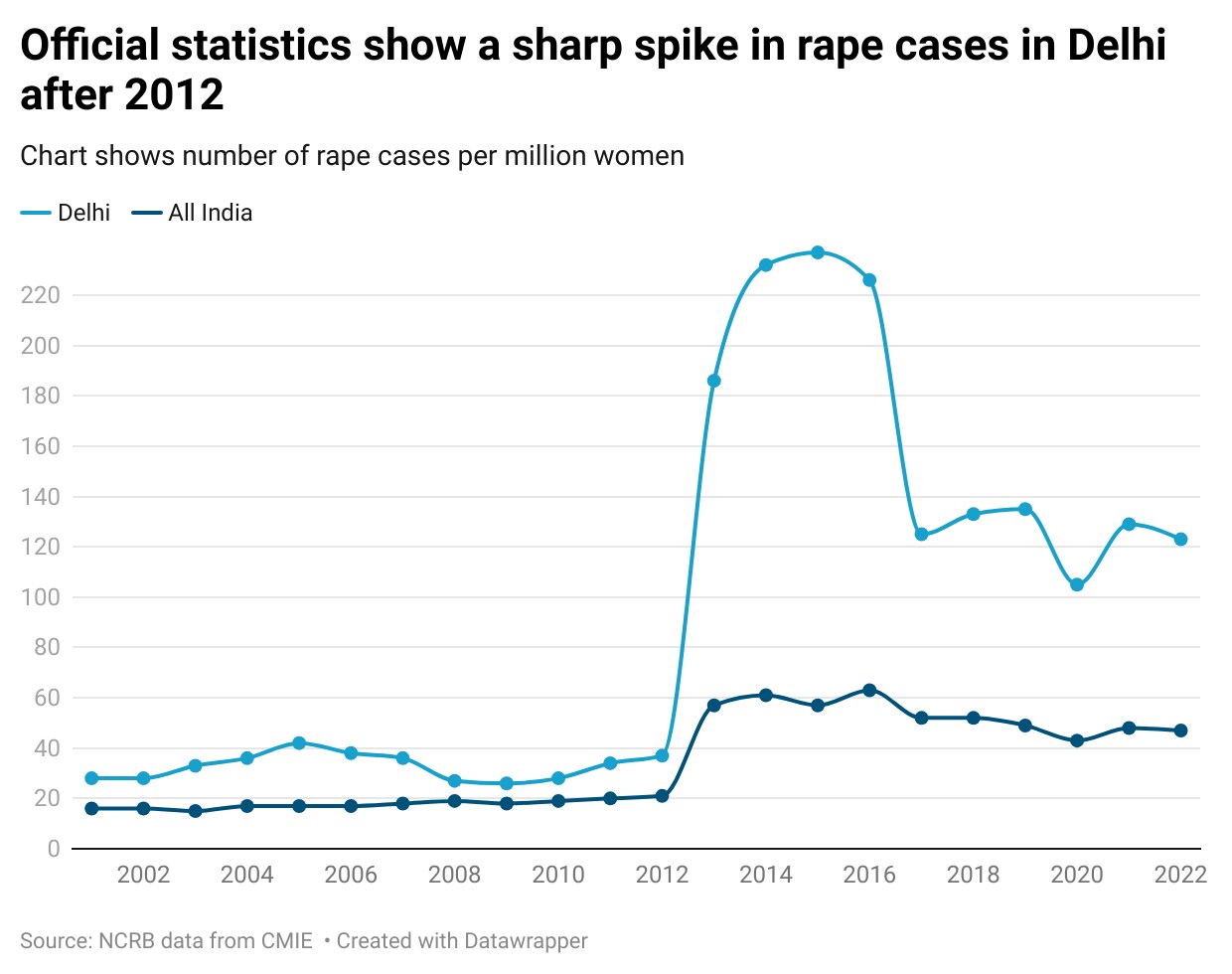
- Pushback against such norms can change things drasticallyA comparison of crime data for Delhi and All-India before and after 2012 shows this clearly. According to data from Centre for Monitoring Indian Economy (CMIE) Delhi reported largely the same number of rapes per million women for a decade until 2012. However, this number saw a huge jump in the aftermath of the 2012 protests against the gangrape of a young woman and has never really gone back to old levels. While the all-India number also saw a small increase after 2012 it was much smaller than the spike seen in Delhi. It is very unlikely that the incidence of rape would have changed so drastically in Delhi and what the data shows is most likely better reporting because of the discourse which was generated by the anti-gangrape movement.
- Is there a better way to measure reporting or lack of it of crime against women in India?A recently published paper in the Economic and Political Weekly by sociologists Kanika Sharma and Aashish Gupta gives some interesting insights into this question. The second part of this data journalism series will discuss these results in detail. This is the first of a two-part series on credibility of official statistics on violence against women. The second part will draw on the findings of recently published research which tries to measure underreporting of sexual and physical against women in India.