
 E-Paper



Number Theory: How hyperlocal were the 2025 Delhi assembly elections?
.
Published on: Feb 13, 2025, 08:23:40 IST

 Prefer HTon Google
Share via


Copy link

Delhi is one of the most densely populated urban clusters in India. This also means that assembly constituencies (ACs) are among the smallest in terms of area. This opens up a possibility that hyper local electoral issues overwhelm everything else. Was this the case with the 2025 Delhi elections? Or did Delhi vote from a macro anti-incumbency sentiment?
HT has compared the results of 2020 and 2025 assembly elections with the 2022 Municipal Corporation of Delhi (MCD) elections to try and answer this question.
How hyperlocal were the 2025 Delhi assembly elections?
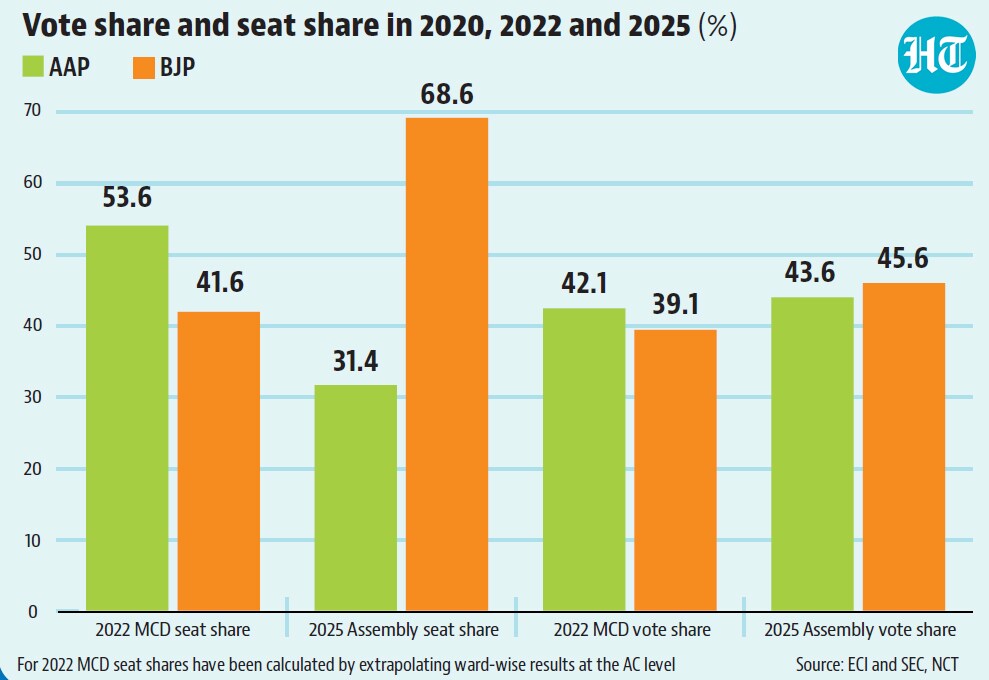
 AAP’s seat share fell between 2022 MCD and 2025 assembly elections despite a rise in vote shareDelhi has three local bodies: Municipal Corporation of Delhi (MCD), New Delhi Municipal Council (NDMC) and Delhi Cantonment Board. Of these, MCD is the biggest and its wards cover 68 out of 70 ACs in Delhi, except New Delhi and Delhi Cantonment. Because the existing MCD came into being after a delimitation of wards and merging of three separate bodies, the 2022 MCD results cannot be compared with past results. If one were to extrapolate the 2022 MCD results at the AC-level – add votes in wards within the same AC – and compare the vote share and seat share numbers with the 2025 assembly elections, an interesting pattern emerges for the AAP. Its vote share increased by 1.5 percentage point between the 2022 MCD and 2025 assembly elections but its seat share fell by 22 percentage points. The biggest reason for fall in AAP’s seat share despite an increase in vote share between 2022 and 2025 is that BJP’s vote share increased by a bigger amount.
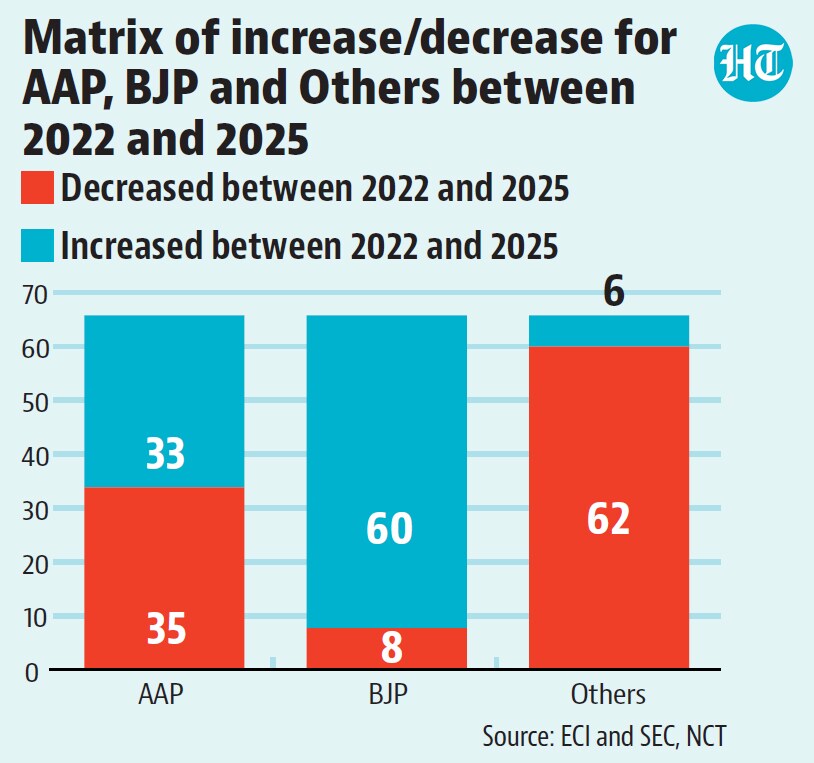
- Headline vote share comparisons between 2022 and 2025 hide differences in AC-level trendsA comparison of AC-wise results for the 2022 MCD results and 2025 assembly election results shows that the headline vote share comparison does not tell us the entire story. Out of the 68 ACs for which MCD and assembly results can be matched, the AAP lost vote share in 35 ACs between 2022 and 2025. It was AAP’s gain in the remaining 33 ACs which led to an increase in its overall vote share between 2022 and 2025. The BJP, on the other hand, gained vote share in 60 out of the 68 ACs between 2022 and 2025. Vote share of non-BJP non-AAP parties fell in 62 out of the 68 ACs between the 2022 and 2025 elections.
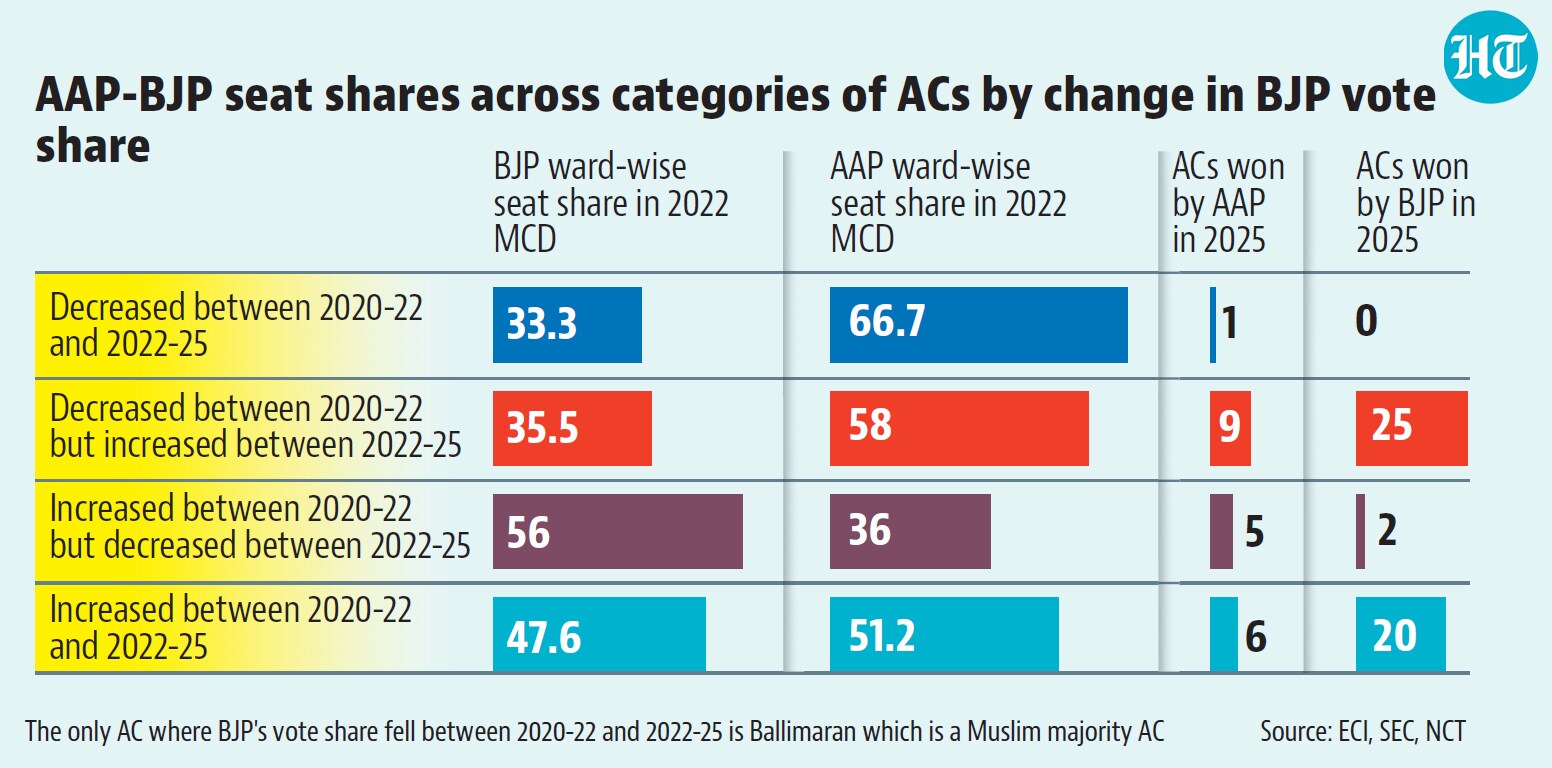
- And MCD anti-incumbency seems to have played a role in 2025 resultsIf one were to make a matrix of ACs won by the BJP and the AAP – no other party has won any seat – by change in the BJP’s performance between 2020 assembly to 2022 MCD elections and 2022 MCD to 2025 assembly elections – it gives four categories: increase: increase, increase: decrease, decrease: increase and decrease: decrease – only 20 out of the 48 ACs won by the BJP in 2025 saw an improvement in its vote share between both 2020-2022 and 2022-2025 elections. Twenty-five of the ACs won by the BJP are those where its vote share fell between 2020-22 but went on to increase between 2022-2025. This is where the BJP really made an effort to improve its performance. In another seven ACs, the BJP’s vote share increased between 2020 and 2022 but fell between 2022 and 2025, suggesting that it frittered away the gains of the MCD elections. If one reads these numbers with party-wise MCD seat shares in these AC categories, BJP’s worst and best performance (excluding Ballimaran, which is a Muslim-dominated AC) seems to have come in AC categories where the AAP’s seat share was the lowest and highest in MCD elections. This suggests a role of MCD-driven anti-incumbency for both the BJP and the AAP.



Unlock a world of Benefits with HT! From insightful newsletters to real-time news alerts and a personalized news feed – it's all here, just a click away! -Login Now!


