E-Paper



Number Theory: Is harsh weather the norm in cereal-producing states?
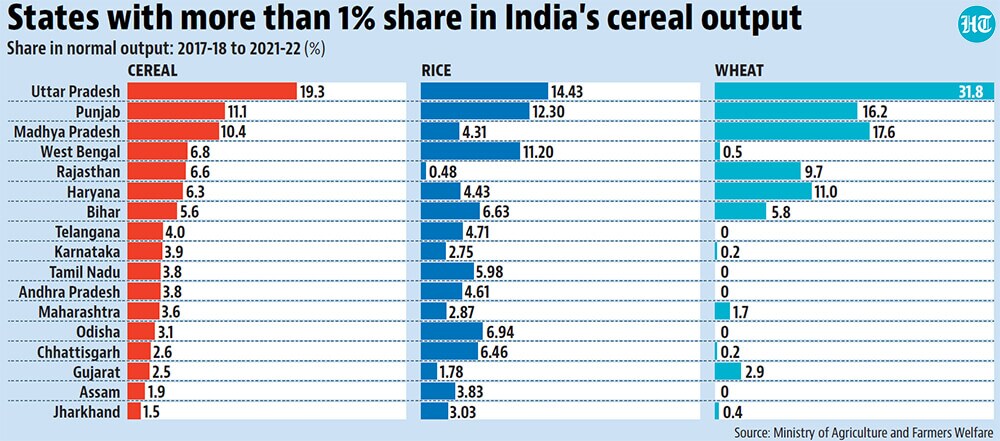
Only 17 states account for 97% of India’s cereal output, according to normal estimates of cereal production from the agriculture ministry.

 Prefer HTon Google


A survey of small farmers conducted in April by Forum of Enterprises for Equitable Development, an independent non-profit, has found that almost half of those producing rice and wheat, India’s staple diet, were affected by crop loss due to an extreme weather event in the past five years. The results of the survey, released on June 25, come at a time when summer maximum temperatures have made new records in India’s cereal producing states and the monsoon’s arrival is delayed over the Gangetic plains. This makes it important to check if extreme weather is now the norm in India’s cereal producing states. While the general answer to this question is an expected one, the following four charts will attempt to answer the question in context of cereal production and past month’s weather pattern of high temperatures and delayed rains.
 All of India does not need extreme weather for a disruption in cereal productionOnly 17 states account for 97% of India’s cereal output, according to normal estimates of cereal production from the agriculture ministry. However, just five states – Uttar Pradesh, Punjab, Madhya Pradesh, West Bengal, and Rajasthan – account for more than half of India’s cereal output. This means that even if the climate becomes extreme in a small area, it can adversely affect India’s cereal output. To be sure, there is a difference in distribution for rice and wheat. For example, the top five wheat states -- Uttar Pradesh, Madhya Pradesh, Punjab, Haryana, and Rajasthan -- account for 86% of its output. The top five rice states – Uttar Pradesh, Punjab, West Bengal, Odisha, and Bihar – account for just over 50%.
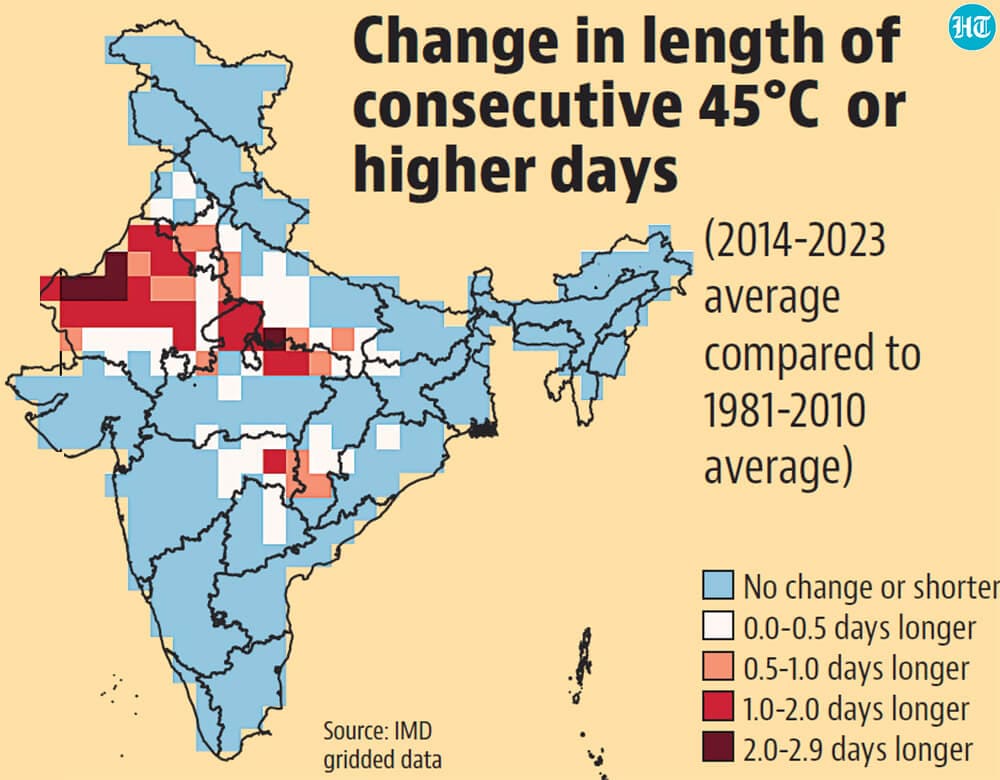
- Extremely high temperatures have affected at least a part of most cereal statesTo check whether extreme temperatures have become sustained in India’s cereal states, HT checked if the average duration of 45°C or higher temperatures in the past decade had increased. Such days were counted only if they occurred for two consecutive days, which is the criteria for heat waves by absolute temperature. In Punjab, Haryana, Uttar Pradesh, and Rajasthan, all important for either wheat or paddy, the area where such heat waves became longer than the 1981-2010 average (considered the normal for temperature) in the past decade was 50% or more. To be sure, some such area was also present in another seven states, but that needs to be read with caution. For example, almost all such areas in Maharashtra were in the Vidarbha region, which contributes to around third of the state’s wheat output and 45% of rice output. This may not be the case in every such state. Similarly, such area has also decreased in parts of some states, but that may not mean the incidence of 45°C on non-consecutive days or temperatures close to 45°C has decreased. Another caveat that one needs to read with this analysis is that it is based on Indian Meteorological Department’s (IMD) gridded dataset. Since each grid in the data gives the average temperature for an area of around 100 km X 100 km, the gridded data can possibly blunt extreme temperatures in a smaller area.
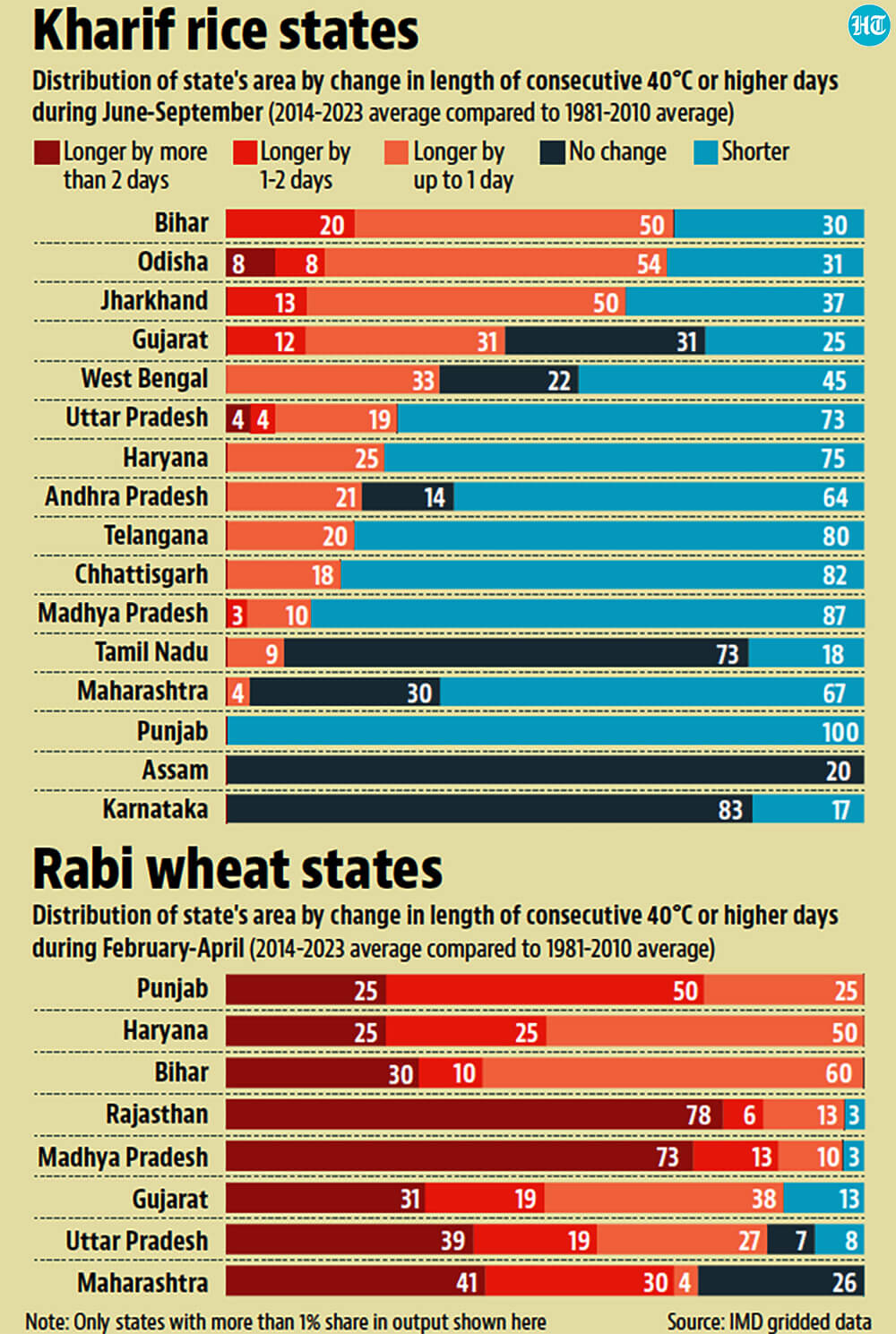
- So far, high temperatures may be more of a wheat problemThis can be understood from the fact that paddy cycle does not start before monsoon rains, when heat waves are rare. This is also borne out by data. HT lowered the threshold for high temperatures to 40°C, the minimum level required for declaring heat waves when looking at deviation from normal; and tested a breach of the 40°C threshold on at least two consecutive days. This was done separately for relatively cooler months: the February-April period (the final part of the wheat cycle) and the June-September monsoon season (the pre-harvest period for paddy). This analysis shows that among rice states, breaches of the 40°C threshold increased in the past decade over a majority of the area only in Odisha, Bihar, and Jharkhand. If this happened before monsoon’s arrival there, temperatures may be less of a problem for paddy, at least up to the last decade. This is not the case with wheat. At least three-fourth area of all important wheat states has seen consecutive 40°C breaches increase in the past decade in the February-April period.
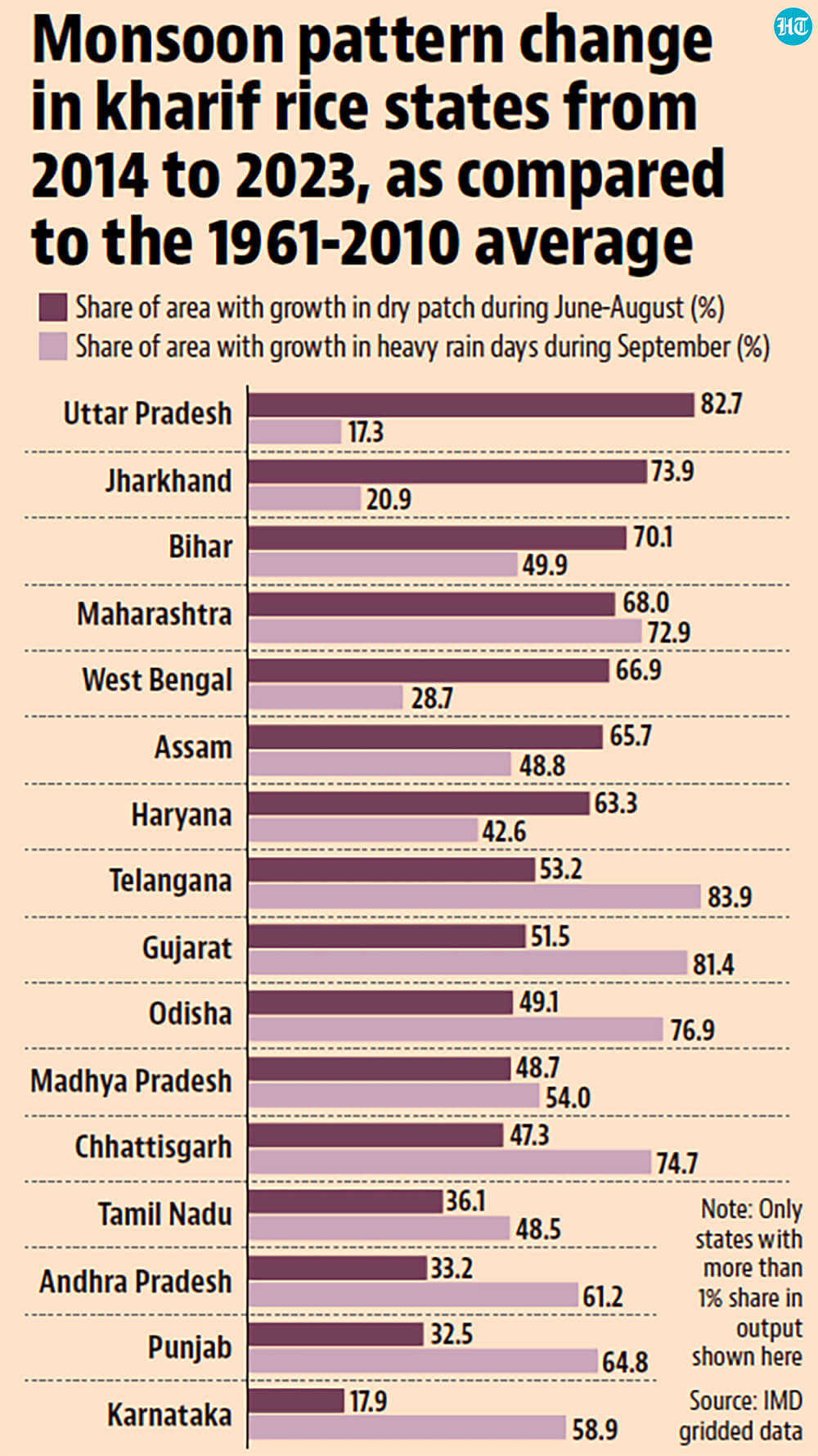
- Patchy rain in the start and heavy rain in the end may be a worry for riceThe rice crop’s water requirements in India follow the trends of the monsoon season: less rain in June and September and more in July and August. However, monsoon’s timely arrival is necessary in June for the crop cycle to start. Therefore, HT checked for dry patches – less than light rain (2.5 mm) for seven consecutive days – from June to August. Similarly, since heavy rain at the end of the crop cycle can be harmful, HT checked for days of heavy rain in September. This shows that one of the two problems increased in a majority area of almost all rice states in the past decade. To be sure, big farmers with access to irrigation can adapt to at least the dry patches in monsoon, and the exact crop cycle may differ from one region to another. However, weather’s helping hand in the cycle might be vanishing fast.