E-Paper



Number Theory: Key takeaways from 2 hard years for the Adani Group
What does that entail for the Indian economy at large? Here are four charts that try to answer this question

 Prefer HTon Google


On November 20, the United States Department of Justice (DoJ) issued an indictment against Gautam Adani and two executives of Adani Green Energy for allegations of bribery in India, which put them in breach of US capital market regulations. While a trial is awaited in the court, the DoJ indictment was the second blow to the multi-billion-dollar Indian conglomerate in as many years. In January last year, the group was targeted by a US-based short-seller Hindenburg, which accused it of various irregularities – Indian stock market regulator Sebi has not found any of them true – and held its stocks as significantly overvalued. The ripple effects of these allegations continue to animate politics in the country with opposition parties accusing the government and its regulators of overlooking the group’s alleged malpractices. Politics, allegations and trials aside, what have the last two years brought for the Adani Group in the markets? What does that entail for the Indian economy at large? Here are four charts that try to answer this question.
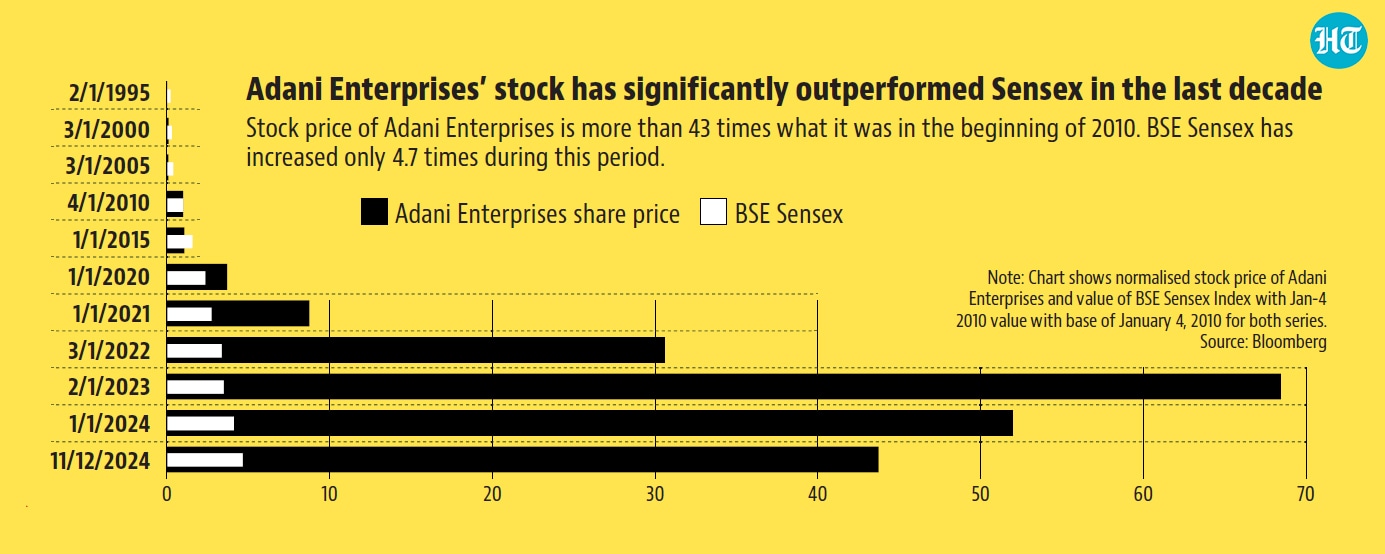
 Adani Group’s rise pre-Hindenburg report was remarkableAdani Group’s rise has been one of the most remarkable stories of growth in India’s history. The market cap – it is the value of total shares of a company – of its flagship company, Adani Enterprises, increased 8.2 times between March 31, 2014 and March 31, 2022 (the last fiscal year before the Hindenburg report). The overall cap of the Bombay Stock Exchange increased just 3.6 times during this period. On January 23, 2023, a day before the Hindenburg report was released, Adani Group’s market cap was ₹19.3 lakh crore with nearly 75% of the value in four out of the eleven stocks of the group, namely, Adani Total Gas, Adani Enterprises, Adani Energy Solutions and Adani Green. See Chart 1: Market cap of all Adani Group stocks before the Hindenburg report
- But the Hindenburg report led to a massive erosion in the group’s valueThe release of the Hindenburg report led to a massive downward rally in Adani Group stocks and it lost 48.3% of its pre-Hindenburg market cap in ten trading sessions. The overall market cap bottomed out on February 27, 2023 when the combined market cap of Adani Group hit 35.5% of its pre-Hindenburg value. While things started recovering thereafter, the group and most of its companies are yet to reach their pre-Hindenburg market cap even today. See Chart 2A: Combined marketccap of Adani Group See Chart 2B: Latest market cap of each Adani company compared to pre-Hindenburg market cap
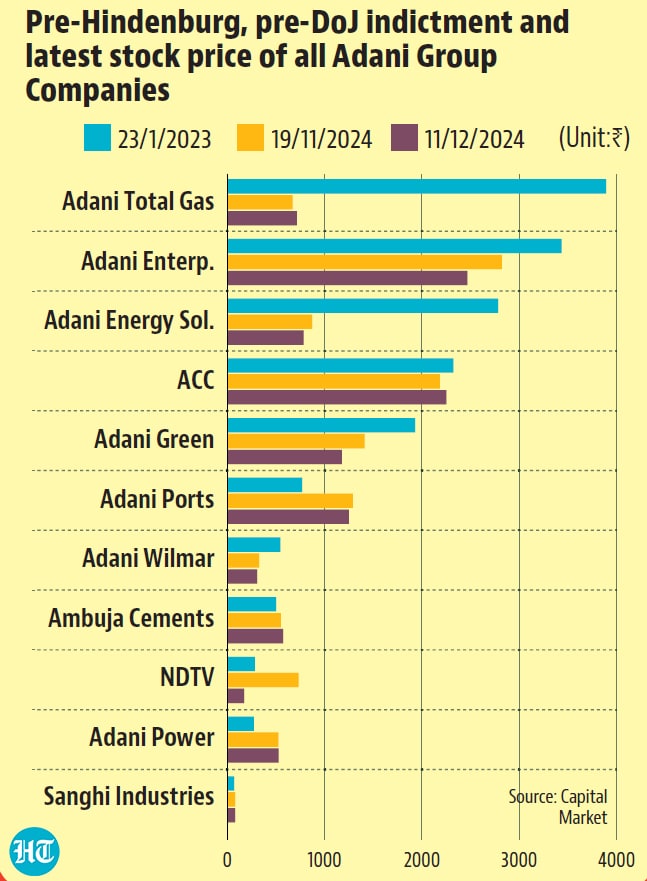
- The equity market impact of DoJ indictment has been relatively muted compared to HindenburgA comparison of stock prices during the two episodes shows this clearly. Four out of the 11 Adani Group companies are yet to reach their pre-Hindenburg stock price levels on any given day post the Hindenburg report and the overall market cap of the group is 69.1% of what it was pre-Hindenburg. Stock prices of all Adani group companies fell after the DoJ indictment as well. But not only was the fall much smaller compared to the Hindenburg report, seven out of eleven companies have already regained their pre-DoJ indictment stock prices. See Chart 3: Adani group companies pre-Hindenburg, pre-DoJ indictment and latest stock price
- Are Adani Group’s stocks overvalued?Because share prices are often a reflection of a company’s future prowess, there is no entirely objective indicator of exuberance or the lack of it in their value. If one were to take one of the more conventional measures of this share price exuberance, namely the price-earnings multiple – it measures the ratio between stock price and earning per share – different Adani Group stocks show different levels of exuberance. Two of the group stocks, which are also listed in the Nifty-50 index, namely, Adani Enterprises and Adani Ports, have their PE multiples ranked 16 and 29 in the list. To be sure, PE multiples of more than half of Nifty-50 stocks are above the conventionally accepted optimal threshold of 25, which suggests that Indian equities are overvalued generally. The other two large companies by valuation, namely, Adani Power and Adani Green, also show very different PE multiples compared to their peers. Adani Green has suffered the worst loss in value after the DoJ indictment, as the allegations were related to business dealings in this company. These four companies, account for 70% of the Adani Group’s total market cap.
- The link between Adani’s and India’s growth storiesThat the Adani Group has lost a significant amount of its value in the aftermath of the Hindenburg revelations suggests that the markets did see some merit in them irrespective of regulatory action. That the group continues to have formidable value even today shows that markets still trust it to make profits and create value in the future. To be sure, a lot of the trust comes from the long-term bet on the India growth story, where the Adani Group has established itself as a key player. Markets go up and down in the short run and so do fortunes of companies, but there is no substitute for robust business and governance in the long run.