E-Paper



Number Theory: The directional shifts that defined the polls
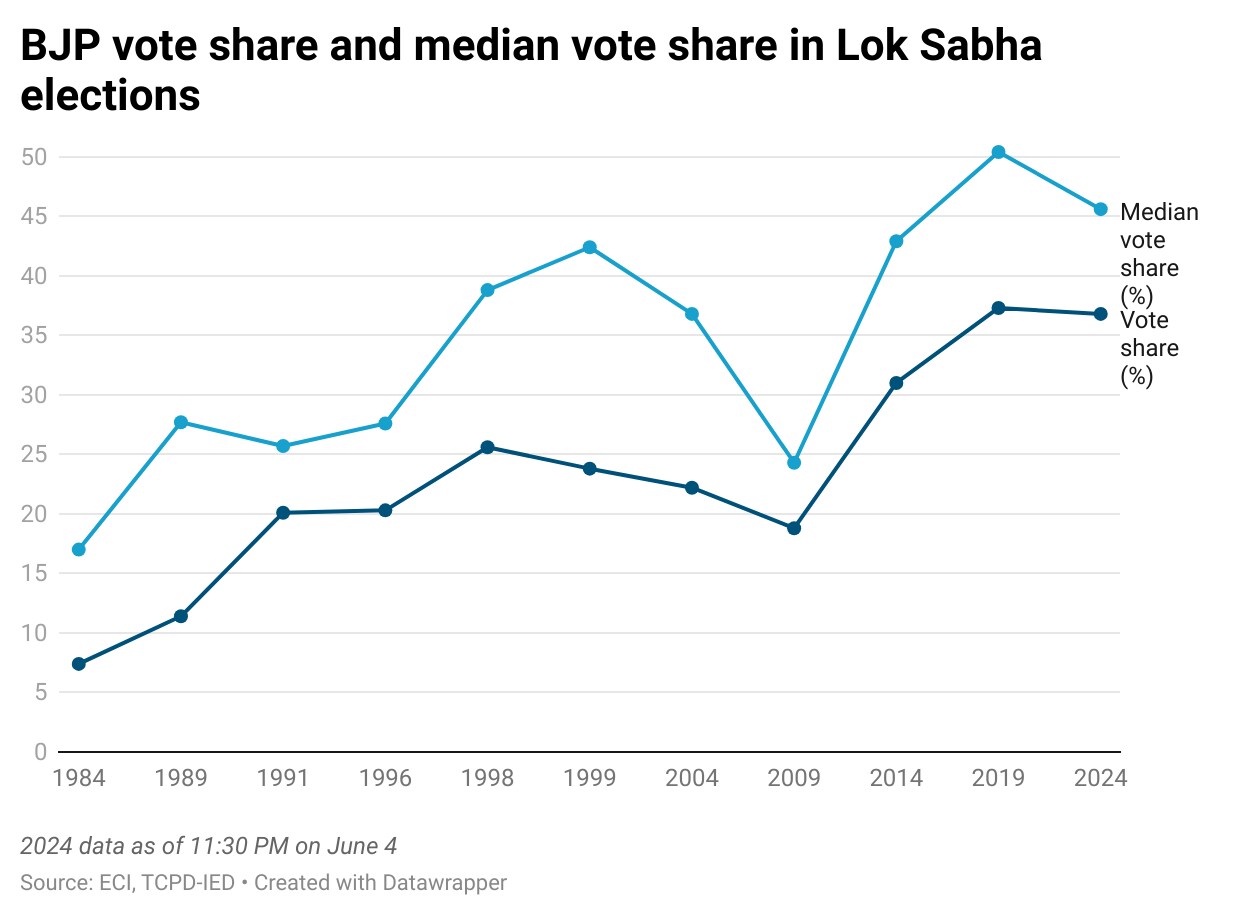
While the BJP has maintained its overall vote share compared to 2019, its median vote share has decreased compared to 2019.
Published on: Jun 5, 2024, 07:46:23 IST

 Prefer HTon Google
Share via


Copy link

The 2024 Lok Sabha elections are a big shift from the past two general elections. While the Bharatiya Janata Party (BJP) won single-party majorities in 2014 and 2019, and increased its seat share and vote share between the two elections, its seat share has fallen below the majority mark in these elections. However, this is not the only directional shift in 2024. Here are five charts that summarise the major changes.
Number Theory: The directional shifts that defined the polls
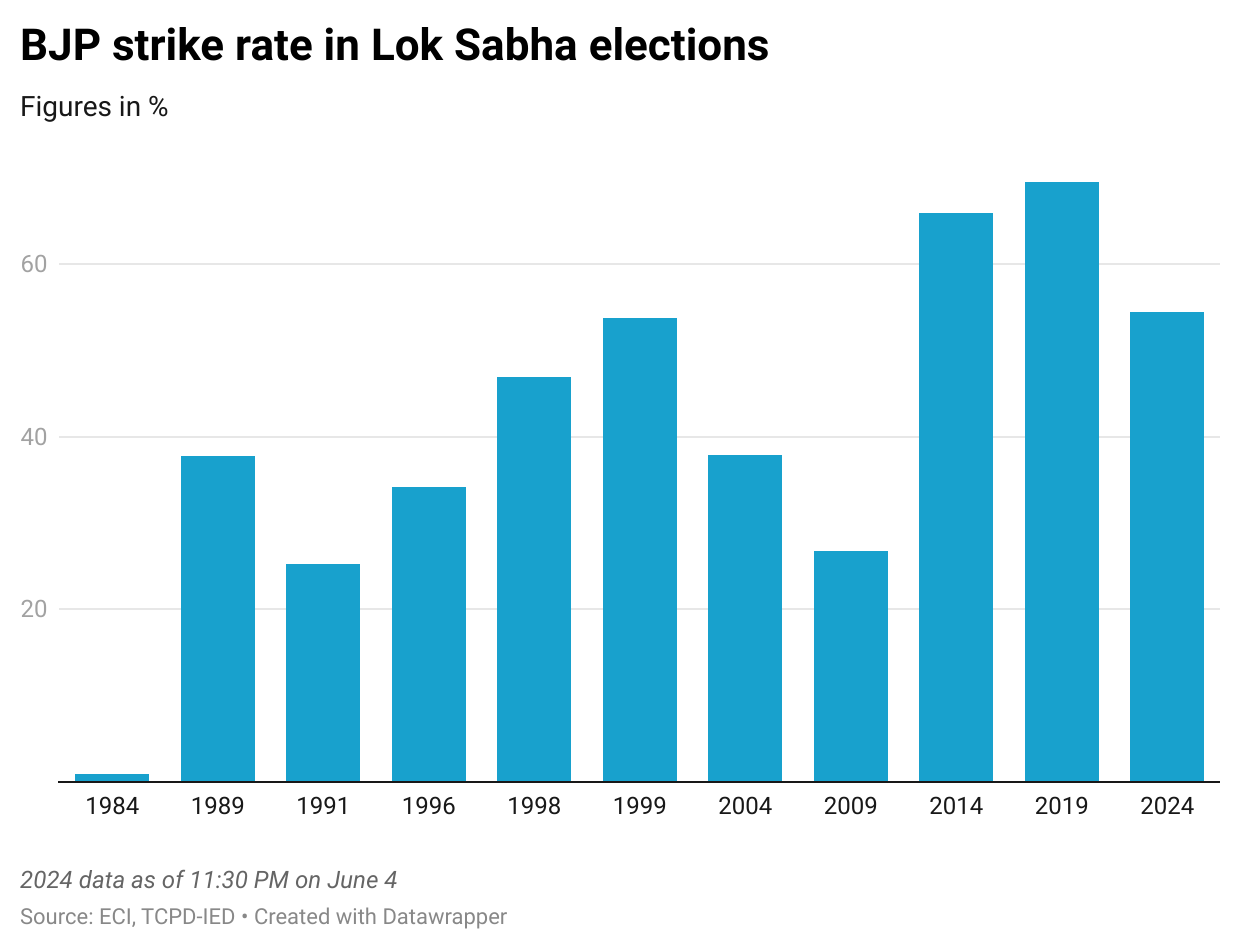
 BJP’s strike rate has fallen below 2014 levelsThe BJP did not just increase its seat share between the 2014 and 2019 Lok Sabha elections. It also increased its strike rate – the proportion of contested seats won by a party – between the two . The party increased its strike rate from 65.9% in 2014 to 69.5% in 2019 although it contested a slightly higher number of seats in 2019 (436 parliamentary constituencies or PCs) than in 2014 (428 PCs). In 2024, the party’s strike rate has fallen along with its seat share. Of the 441 seats the party contested in 2024, it has won just 240. This gives a strike rate of just 54.4%, below both 2014 and 2019 levels.
- BJP maintained its overall vote share, but its median vote share across PCs has fallenIn a first-past-the-post system, just maintaining or increasing vote share is not good enough. A party can increase its vote share by just contesting more seats. This does not guarantee wins because if overall votes are distributed thinly across PCs, the vote share in a PC may not be enough to win them. This seems to be the case with the BJP in 2024. While the BJP has maintained its overall vote share compared to 2019, its median vote share has decreased compared to 2019. Median vote share is a good indicator of distribution of overall vote share because it shows the middle value in a series of numbers. To be sure, the BJP’s median vote share in 2024 is still better than what it was in 2014.
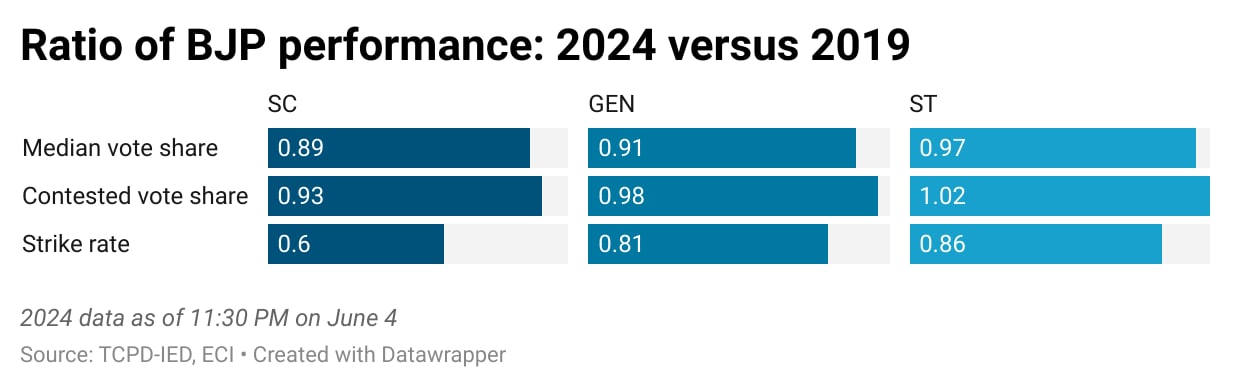
- Was there a demographic factor to BJP’s performance?Yes. A clear demographic pattern can be seen in the BJP’s performance by the reservation status of PCs. The BJP’s median vote share, vote share in seats contested, and strike rate -- all have fallen the most in PCs reserved for Scheduled Castes (SCs) than in non-reserved seats or seats reserved for Scheduled Tribes.
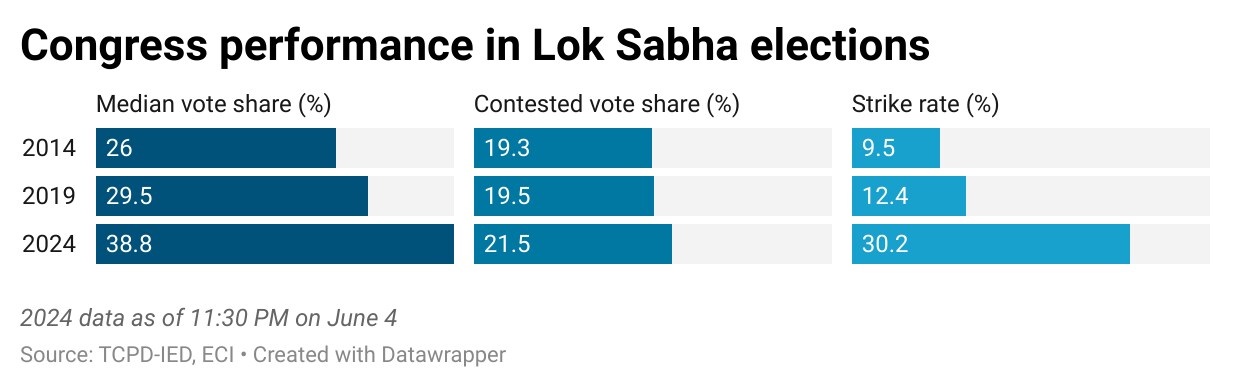
- Congress improved its performance at PC levelThe Congress contested the fewest number of PCs it has ever contested in 2024 (328 PCs). Whether or not the party intended to do this to concentrate on winnable seats, the party has managed to improve its winnability. Its strike rate has more than doubled compared to 2019. Between 2014 and 2019, the party had improved its strike rate only modestly, from 9.5% to 12.4%. This was possible by the party dramatically increasing its vote share in the seats it had contested. Its median vote share, too, has increased from 26% in 2014 and 29.5% in 2019 to 38.8% in 2024. As a result of this, its vote share has increased compared to 2019 although it contested fewer seats.
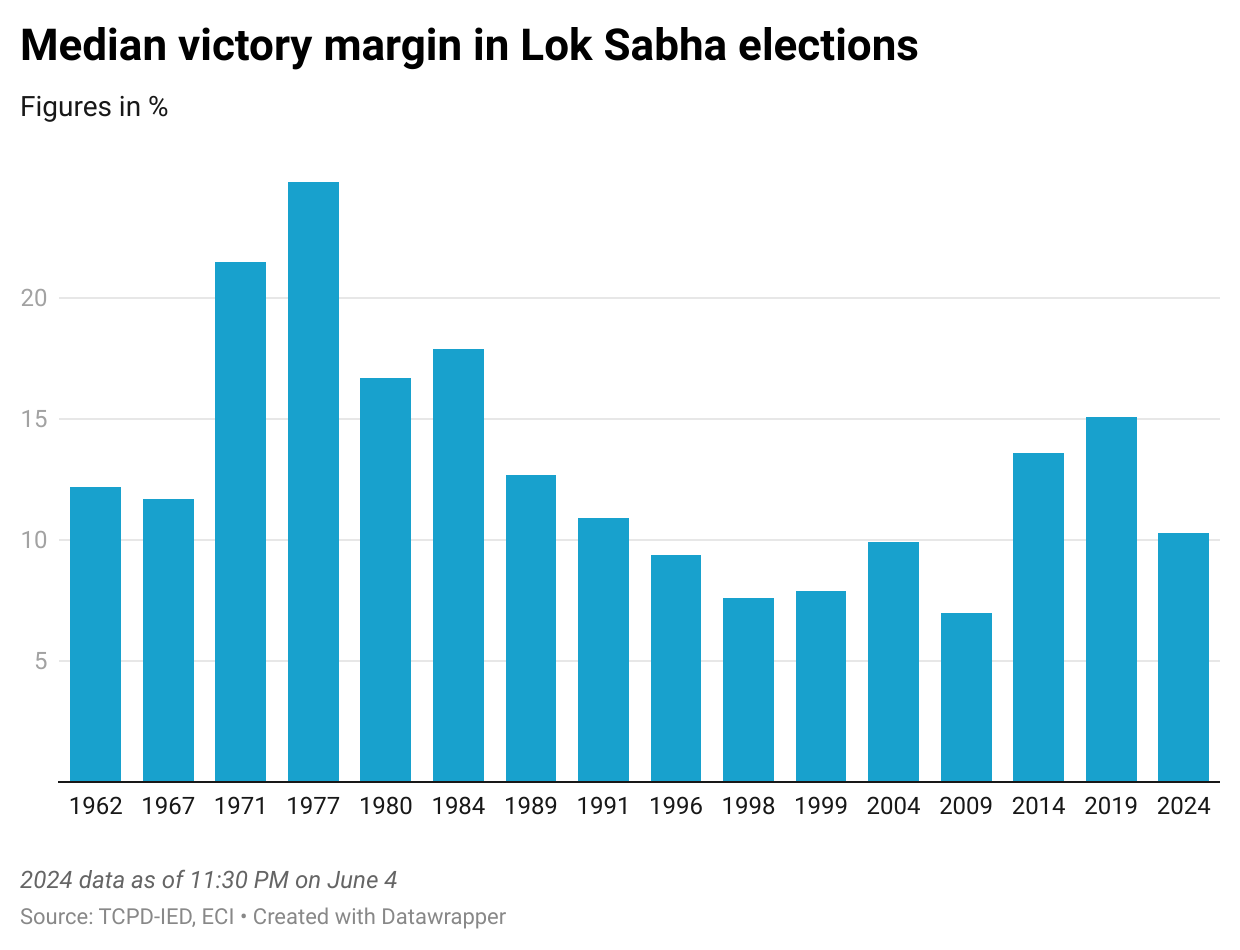
- A more competitive election than 2014 and 2019This can be seen in the median victory margin in this election. The median victory margin in 2014 and 2019 was 13.6% and 15.1% respectively. This has fallen to 10.3% in 2024, a drop of almost five percentage points. This is yet another reversal in electoral trends seen in the past two Lok Sabha elections.