E-Paper



Number Theory: What will Trump's trade war mean for the world?
.
Published on: Nov 16, 2024, 09:15:46 IST

 Prefer HTon Google
Share via


Copy link

Not only has Donald Trump been re-elected as the US president, the Republican Party also has a much greater control on the government with majority in both houses of the parliament. This coveted trifecta will give much more freedom to Trump in policymaking than what he had in his last term. Raising tariffs on imports in the US has been among the most important things in Trump’s 2024 election campaign. What will a trade war, if Trump were to walk the talk on his promises, entail for both the US and the world? How different could it be from Trump’s trade policy in his last term? Here is what the data shows.
What will Trump's trade war mean for the world?
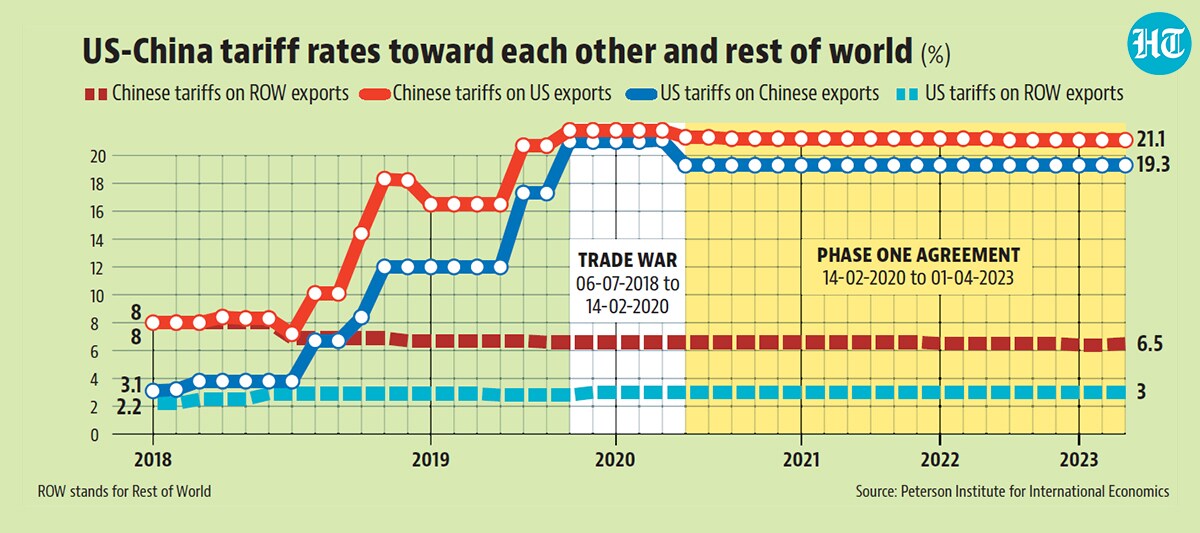
 Did Trump walk the talk on tariff in the last term?Bringing down imports was a big part of Trump’s campaign in the 2016 elections as well. Did he actually raise tariffs in his first term? Data shows that he did. Data from the Petersen Institute for International Economics shows that Trump started a full-fledged trade war with China in the second half of his first term, leading to a massive increase in US tariffs on Chinese imports. This number increased from under 4% in July 2018 to just under 20% by February 2020. Interestingly, compared to China, the first Trump administration, other than a few exceptions, raised tariffs only marginally for the rest of the world. Not only has Trump promised much higher tariffs , up to 60%, on Chinese imports this time , he has also threatened to impose higher tariffs on other countries. If implemented, this would entail a much bigger trade disruption than his last term.
- But Trump’s first trade war did not really help US’s merchandise trade deficitOnce again, the data is unambiguous on this front. The US’s merchandise trade deficit as a share of GDP increased continuously from the 1970s to the period until the 2008 global financial crisis. This number has since then settled at a lower level, but is still significantly higher compared to what it was until the 1990s. The Trump administration’s tariff hikes did not do much to bring down this number. It is important to look at trade deficit as a share of GDP, as absolute numbers do not tell us about the size of the economy over time.
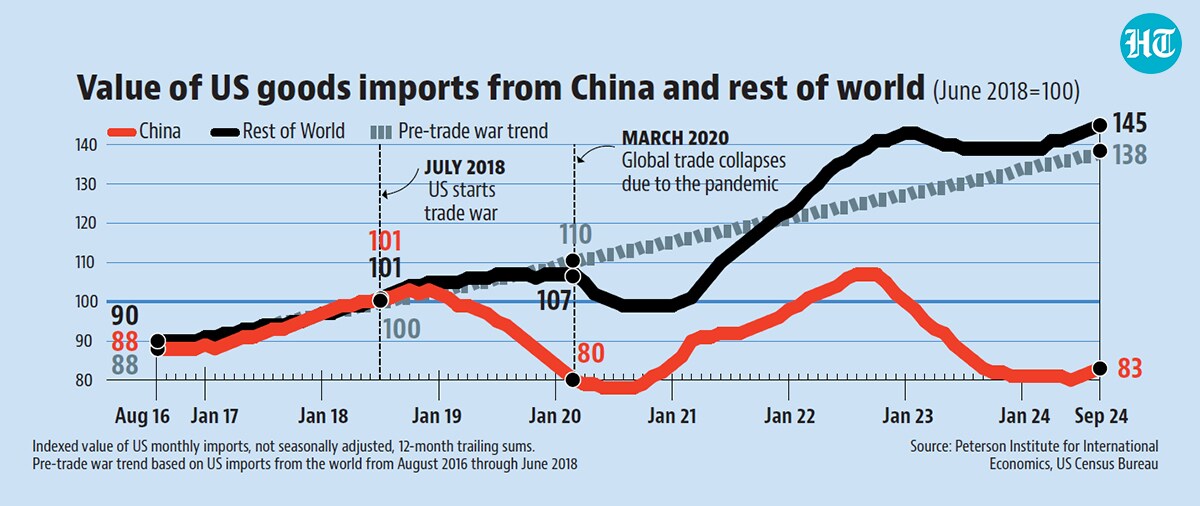
- This is because a fall in Chinese exports to the US was accompanied by a rise in exports from other countriesUS imports from China remain well below the pre-trade war trend, as defined by US imports from the world, and have dropped below the pre-trade war levels of June 2018 since 2023, following a brief resurgence in 2022. This decrease occurred as the Biden administration reinforced several of Trump’s tariffs on China. The country now accounts for only 14% of total U.S. goods imports, down from 22% at the start of the trade war. In contrast, U.S. imports from other countries are now 45% higher than pre-trade war levels and have shown a strong recovery since the onset of the pandemic. This suggests that the reduction in the bilateral trade deficit with China was more than compensated by rising trade deficits with other countries. As far as the economic interests of US workers are concerned, a trade deficit is a trade deficit, whether from China or elsewhere.
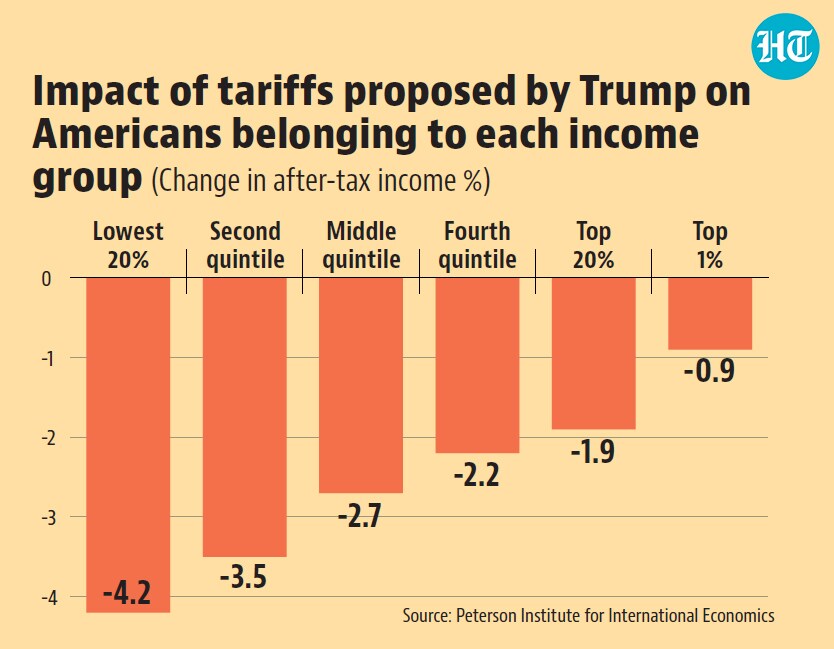
- In fact, Trump’s trade war could have ended up hurting, not helping the poorest AmericansWhen a country imposes a tariff, the legal tax is paid by the importer, but the economic burden (or “incidence”) can fall on various parties. If foreign producers lower their prices to offset the tariff, they bear some cost. If they do not, the tariff burden is borne by the importer at the cost of lower profits or passed down to domestic consumers through higher prices. A 2019 working paper by the US National Bureau of Economic Research show that the 2018–2019 tariffs were almost fully passed through to U.S. consumers, costing them $3 billion monthly in added taxes and $1.4 billion in lost income. Further increase in tariffs, as announced by Trump during his presidential campaign, could see more burden fall on the shoulders of the US consumer. The Peterson Institute for International Economics estimates that Trump’s proposed new tariffs would reduce American incomes, with the poorest 20% losing 4.2% and the wealthiest 1% around 0.9 %.
- In the end...These facts aside, the election results show that there is a lot of political traction for Trump’s political rhetoric on a host of issues including a pivot to mercantilism for the US. The world must brace itself for a new round of massive economic disruption when Trump takes office in January next year.