E-Paper



Number Theory: Will Karnataka continue to favour the BJP in national elections?
14 out of the 28 parliamentary constituencies in Karnataka will vote in the second phase of 2024 general elections on April 26.
Published on: Apr 24, 2024, 09:14:37 IST

 Prefer HTon Google
Share via


Copy link

The Bhartiya Janata Party (BJP) had swept the state in the 2019 elections, winning 25 out of the 28 parliamentary constituencies (PCs) while one PC was won by a BJP supported independent candidate. Political fortunes shifted drastically in the 2023 assembly elections in the state when the Congress won a seat share of 60%. The 2023 results also led to a realignment in the state’s politics which bringing the BJP and the Janata Dal (Secular) or JD(S) together. In 2019, it was the Congress and the JD (S) which were in a pre-poll alliance. Which way could Karnataka vote in the 2024 elections? Here are three charts which answer this question.
Will Karnataka continue to favour the BJP in national elections?
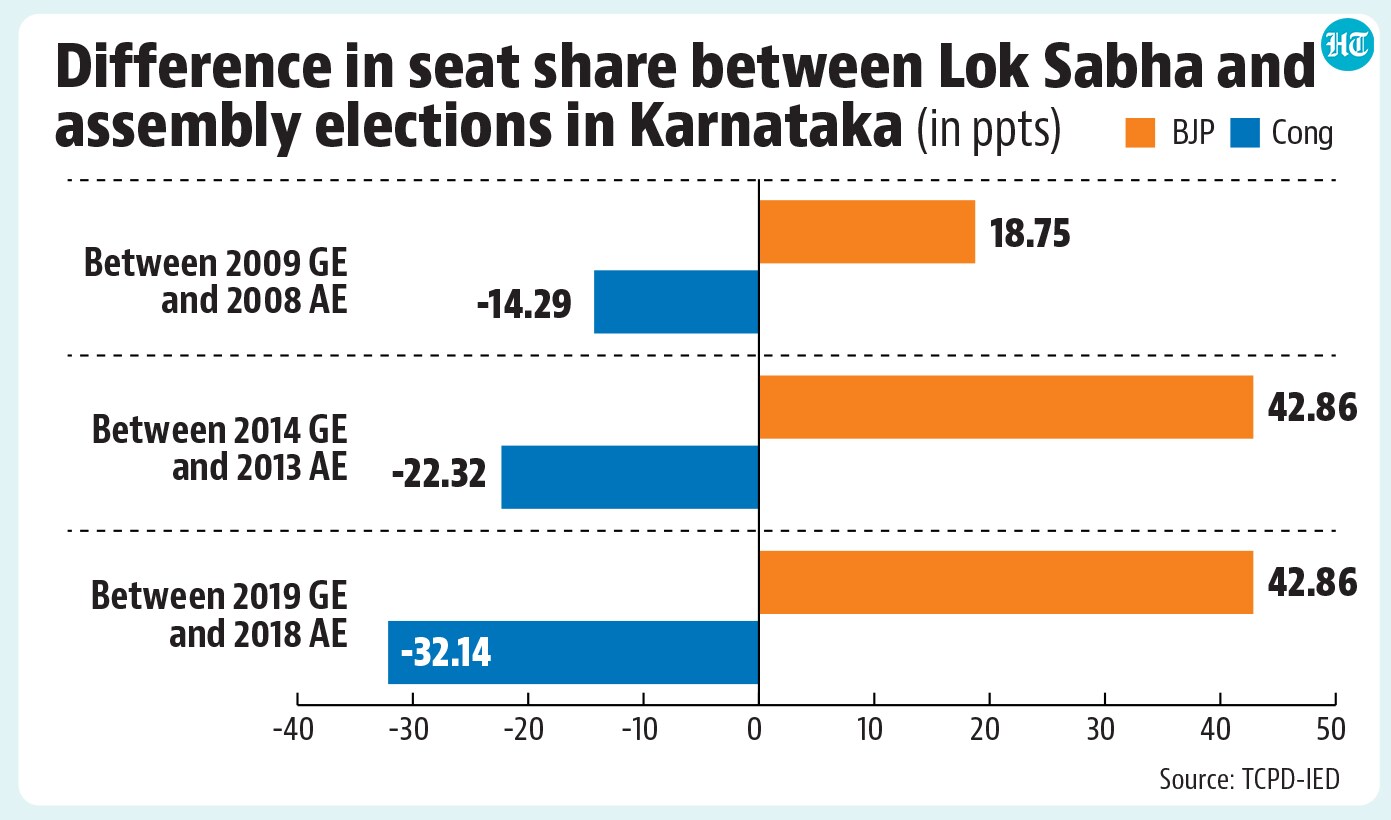
 The BJP has had an edge in national elections in KarnatakaThis is borne out by a simple comparison of seat shares of two parties in Lok Sabha elections with the preceding assembly election. The current election cycle in Karnataka—it has continued since 2008—entails a gap of around a year between an assembly election and a Lok Sabha election. In the three election cycles since then, the BJP’s seat share in Lok Sabha election has always been higher than its seat-share in the preceding assembly election. This trend held even in the 2009 elections which were otherwise not good for the BJP. For the Congress, the trend has been the opposite in the state. What explains this premium for the BJP in Lok Sabha elections? While part of it could be the national premium which Prime Minister Narendra Modi being on the ticket brings to the BJP in Lok Sabha elections, part of it could also be a reflection of the fact that the BJP’s state-unit is mired in factional disputes and they come to the fore in a much bigger way in state election as well as the functioning of a BJP government when it gets elected in the state. For example, one of the biggest reasons for the BJP’s extremely poor showing in the 2013 assembly elections was its veteran leader B S Yeddyurappa walking out of the BJP to form a new party.
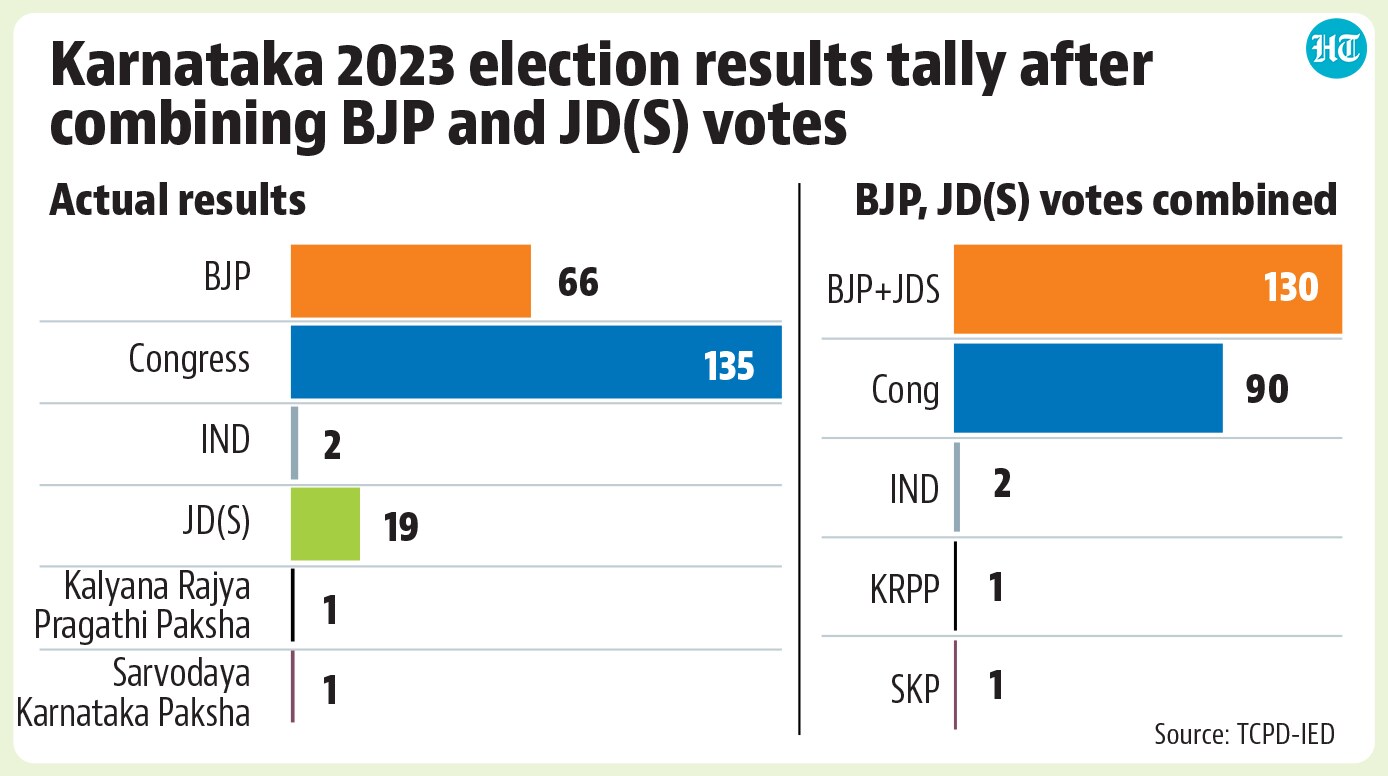
- Will an alliance with the JD (S) help the BJP in the state?In September last year, former Karnataka chief minister and Janata Dal (Secular) leader HD Kumaraswamy announced that his party would be contesting the 2024 Lok Sabha elections as a part of the BJP-led-NDA alliance. The BJP and JD (S) are contesting 25 and 3 PCs respectively in these elections. All three PCs being contested by the JD(S) will go to poll on April 26. Will an alliance with the JD(S) help the BJP? Simple arithmetic would suggest that it would. If one were to add the votes of the BJP and JD (S) from the 2023 elections, the assembly tally would change from 135, 66 and 19 for the Congress, BJP and JD (S) to 90 and 130 for the Congress and BJP-JD(S) combined. To be sure, there is no guarantee that the arithmetic for an alliance remains the same before and after an election. The Congress and JD (S) learnt it the hard way in the 2019 Lok Sabha elections. An extrapolation of 2018 assembly election results for a Congress-JD (S) alliance would have given them a combined 21 PCs instead of the 11 and four PCs where the Congress and JD(S) led in the 2018 elections. In the 2019 elections, the Congress-JD(S) alliance managed to win only two PCs.
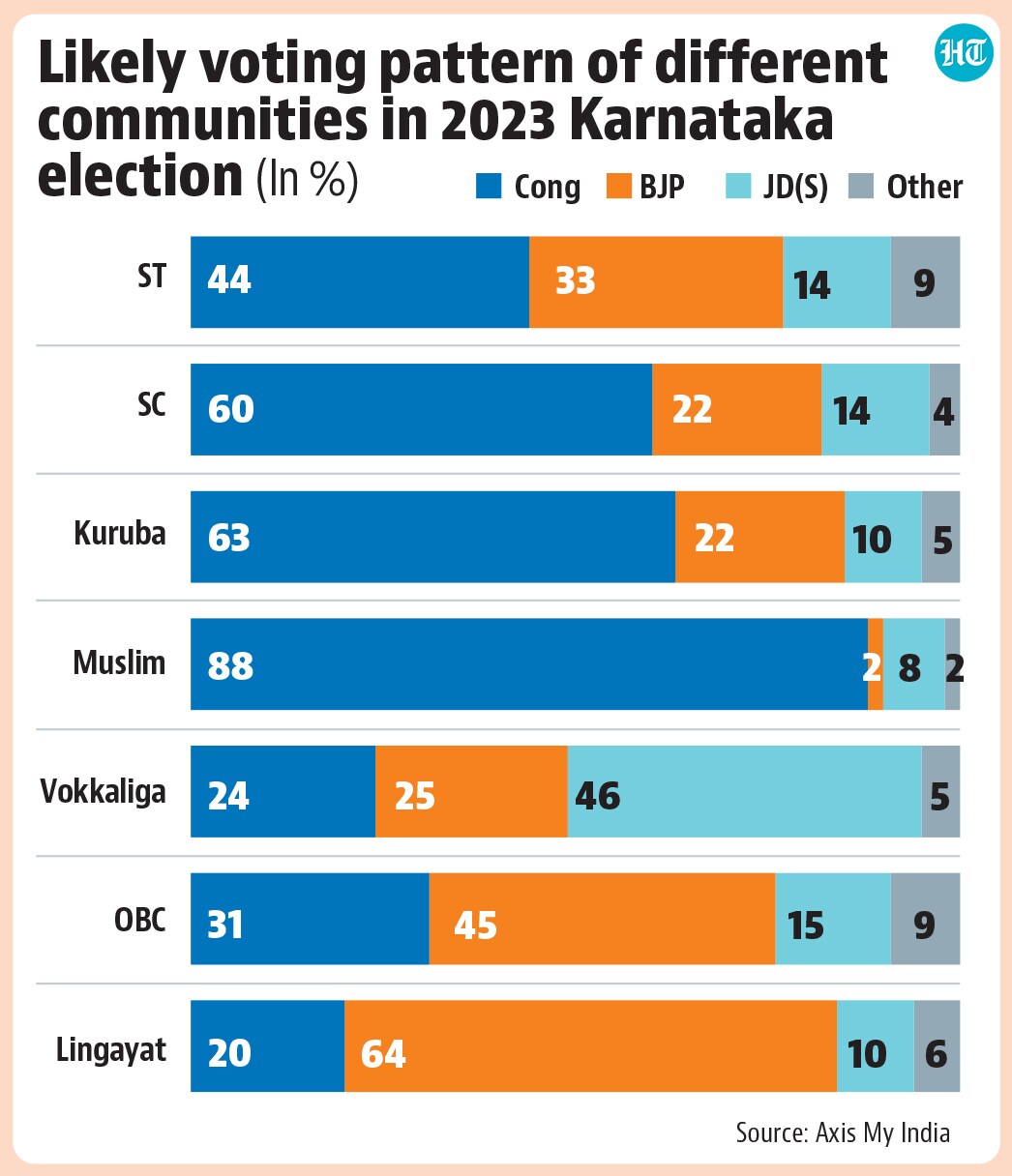
- This is where social arithmetic will become importantHistorically speaking, the BJP and JD(S) draw their core support from the numerically dominant Lingayat and Vokkaliga communities in Karnataka. While this core-base has been essential to their organizational resilience, on its own it cannot win them elections, especially at the Lok Sabha level where constituencies are larger and also more diverse. If the Congress manages to portray the BJP-JD(S) alliance as a consolidation of two numerically dominant communities against everyone else, it might be able to build a larger counter-consolidation in the state. In many ways this was the formula of the Congress victory in the 2023 elections as well. Whether or not this strategy works for the Congress will only be known when the results are declared on June 4.