
 E-Paper



Pitfalls of IMD's seasonal monsoon forecasts | Number Theory
.
Updated on: Apr 21, 2025, 08:49:57 IST

 Prefer HTon Google
Share via


Copy link

The India Meteorological Department’s (IMD) monsoon forecasts, HT reported on April 16, have less accuracy than predicting a coin toss. A more careful reading of the forecasts shows that this is only a part of the problem with IMD’s forecasting. Forecasting errors are bigger in El Niño years than La Niña or neutral conditions in the Pacific Ocean. El Niño and La Niña are cyclical warming/cooling conditions in the central and eastern equatorial Pacific Ocean which decrease/increase southwest monsoon rainfall. Also, IMD’s second forecast, which is made one and a half month after the first one, is as likely to be wrong as the first one. Here is a detailed explanation.

Pitfalls of IMD's seasonal monsoon forecasts
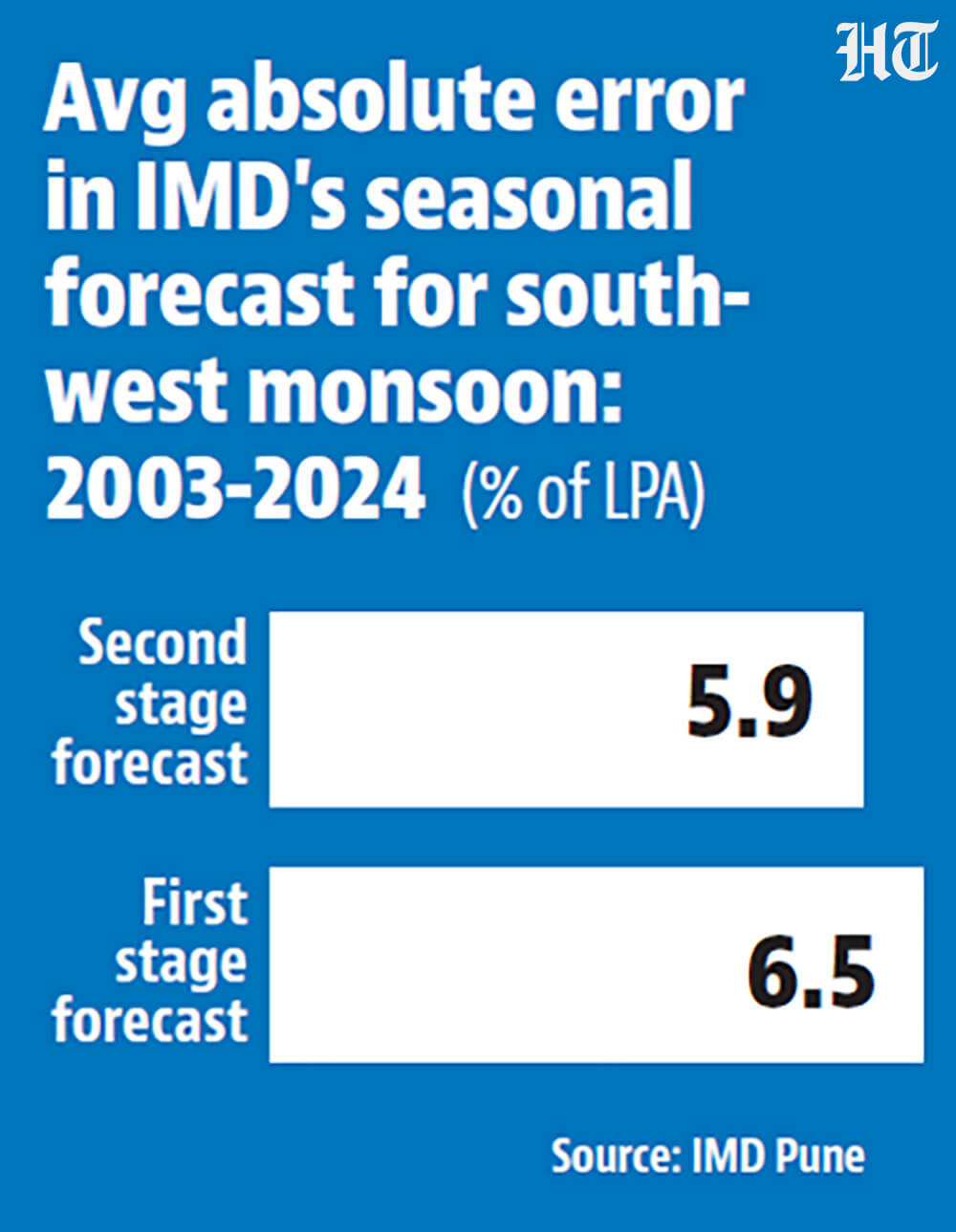
 IMD’s second forecast is as inaccurate as the first oneIMD started issuing long range forecasts (LRF) of monsoon rain for India as a whole only from 1988. The forecasting model used earlier failed at predicting rain in eastern parts of the country. While the model in use since 1988 has undergone multiple changes, 2003 is an important milestone in this evolution. This is when IMD started issuing forecasts in two stages – one in the middle of April and another in late June to early July period. IMD considers June-September as the official monsoon season. The late June to early July forecast was shifted forward to late May or June 1 in 2018, which means that both these forecasts are now made before the monsoon arrives in most of the country. While a forecast closer to the monsoon should have shown higher accuracy, the second forecast in the 2003-2024 period shows only a marginal improvement over the first one.
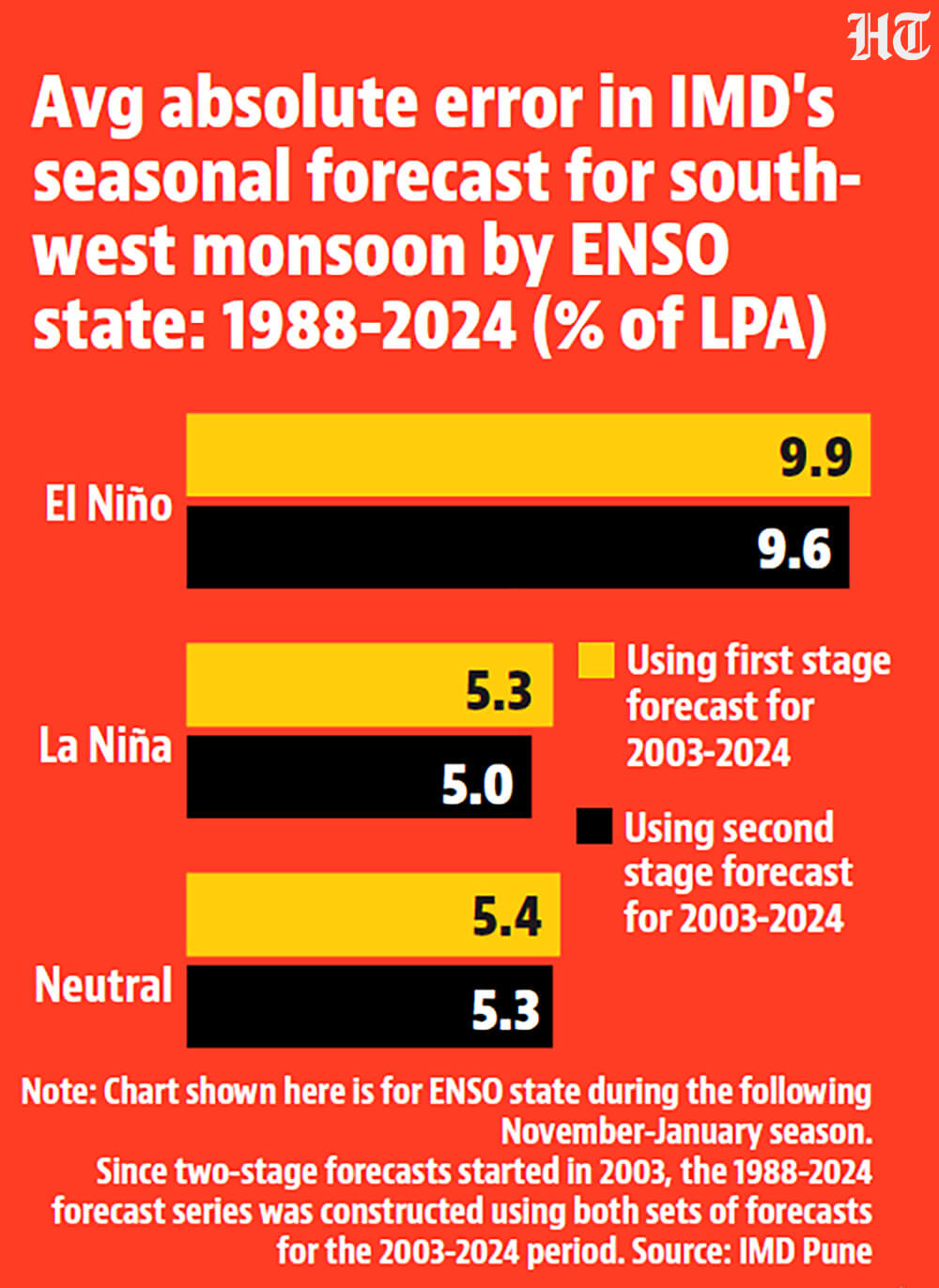
- Accuracy decreases during El Niño yearsBesides the lack of significant improvement in the second forecast, an analysis of both sets of forecasts between 1988 and 2024 shows that IMD’s errors almost double in a monsoon affected by El Niño. On average, LRFs in El Niño years differed from actual rain by around 10% of the long period average (LPA), a historical average used to track rain’s performance. The current LPA reference period is 1971-2020. In monsoons affected by La Niña or when neither El Niño or La Niña conditions (called neutral condition) were present, the forecast error was around 5% of LPA. The amplification in forecasting error in monsoons affected by El Niño largely remains unchanged irrespective of how one defines an El Niño year: an El Niño developing during June-September, an El Niño maturing in the following November-January period, or a relative index (which accounts for global warming) showing El Niño in its maturity in December. There could be systemic as well as technical reasons for the El Niño year errors being larger, such as atmospheric conditions during El Niño being very different from La Niña and neutral conditions, which models used in LRFs are struggling to capture.
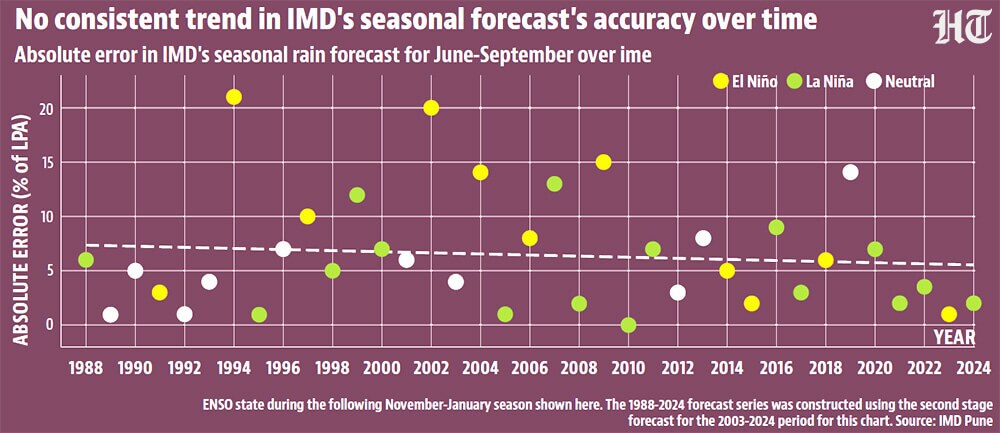
- A longer-term analysis also reduces the salience of recent improvement in IMD’s forecastsAs HT reported on April 16, IMD’s forecasts in the past five years were within the 5% error margin in the three out of the past five years, compared to one or two in five-year periods ending 2019, 2014, and 2009. This suggests a marginally better success rate in the past five years. However, a long-term comparison shows that there is no consistent trend as far as an improvement over time in IMD’s forecasts is concerned.
- Regional seasonal forecasts also a challengeEven if the IMD were to get its national forecast relatively right, as in the past five years, challenges would remain. National average rainfall numbers tell us very little about whether or not it serves its economic purpose. For example, just five states – Uttar Pradesh, Punjab, West Bengal, Odisha, and Bihar -- account for around 50% of India’s output of rice, cultivated primarily in the monsoon. Getting the regional forecast right is as more important as the headline number. A visual inspection – granular analysis is difficult because of lack of long-term data – of these forecasts suggests that they also go wrong not just in an El Niño (2023) year but also a La Niña (2024) year.




Unlock a world of Benefits with HT! From insightful newsletters to real-time news alerts and a personalized news feed – it's all here, just a click away! -Login Now!


