
 E-Paper



Putting the leash in front of the dog | Number Theory
SC’s order, while driven by a genuine crisis which is taking a huge toll, misses the larger point about the nature of the problem
Updated on: Aug 12, 2025, 08:58:09 IST

 Prefer HTon Google
Share via


Copy link

The Supreme Court on Monday passed an order that all stray dogs in Delhi and the National Capital Region (NCR) be rounded up within eight weeks and put in dog shelters without any provision of releasing them whether or not they are sterilized or vaccinated. SC’s order, unless revoked by a larger bench, puts an end to a long jurisprudence on the issue of stray dogs in not just Delhi-NCR but also the country at large. A Supreme Court order is pretty much the law of the land. SC’s order, while driven by a genuine crisis which is taking a huge toll, misses the larger point about the nature of the problem. Here’s why:
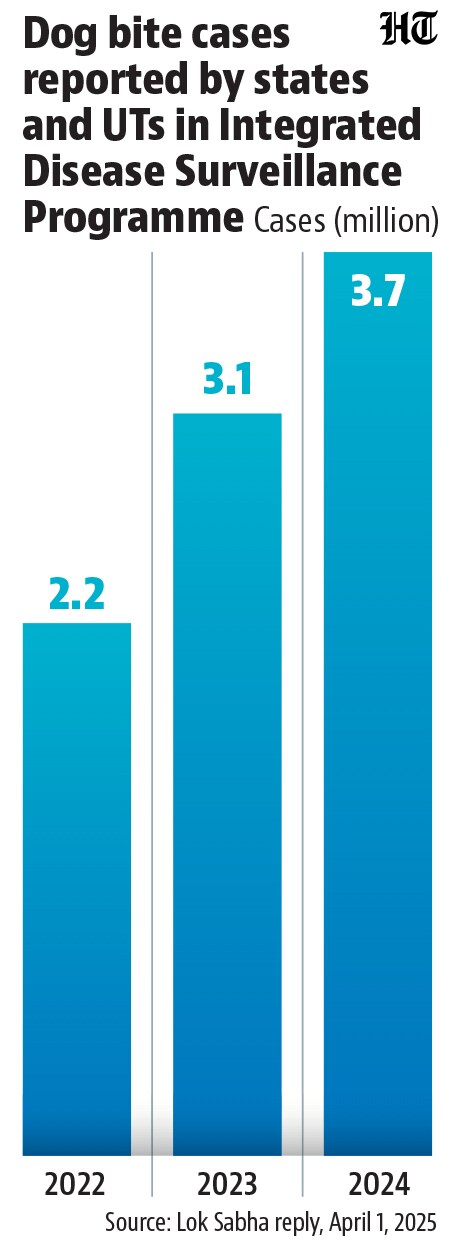
 Dog bites are a huge problem in IndiaThe debate around stray dogs, especially in larger cities, is often centered around groups trying to preserve things such as designated feeding spots and prevent forceful evictions either under official drives or following complaints by other people living in such localities. While various court orders prior to Monday’s SC order have often upheld or rejected these demands, sometimes in toto, sometimes partially, the real problem is seen in macro statistics of growing dog bites and an uncomfortably large number of rabies deaths – not all of them are on account of dog bites – in India. Data furnished by the central government in the Lok Sabha on April 1 shows that there were 3.75 million cases of dog bites in India in 2024 and this number has been consistently high in the past few years. Not all of these bites result in deaths, but the number is expected to be large. Official estimates -- based on Integrated Disease Surveillance Programme – put the number around 180 for 2024 (the number from IDSP was only 54 for 2024 in a parliament reply on April 1 but increased to 180 by the time of a reply on August 5); a recent ICMR study claimed India sees 5700 deaths annually from rabies; and the government cited a 2004 WHO study in parliament to say the burden may be in the tens of thousands. When read with the fact young children or senior citizens are less likely to fend off such attacks, and that stray, especially feral dogs, are also a danger to wildlife, the problem requires a more serious approach than looking at it from the prism of warring factions in the gated societies of metros. See Chart 1: Dog bite cases in India
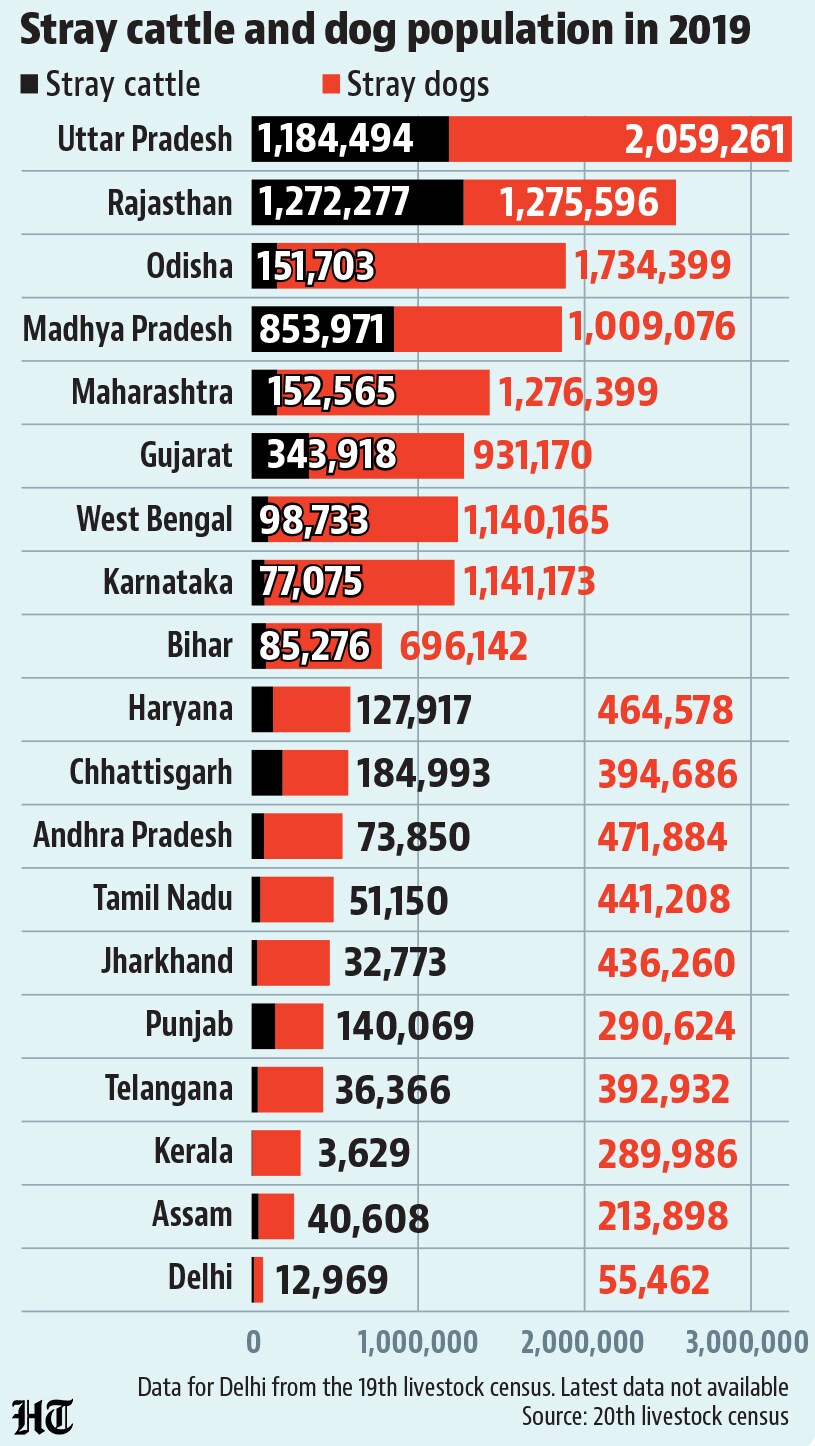
- The root cause of this problem is the huge number of stray animals in IndiaIn India, the problem can be described as “if a stray dog does not bite you, the stray cattle will head-butt you”. This is actually a menace which does not require any statistical proof to anybody who goes around even the most sanitized civic spaces in the country. The numbers only underline the extent of the problem and are perhaps an undercount. Data from the 20th livestock census shows that there were 15.3 million stray dogs and 5 million stray cattle in India. Given that an MCD census in 2016 found 189,000 stray dogs, and the livestock census reports just 55,462 stray dogs in the entire city, the livestock census numbers are perhaps a huge underestimate. While unsterilized stray population is a large reason for this menace, no regulation on owners abandoning animals – from dogs they do not want any more to cattle no longer economically viable or let out for part of the day by illegal dairy farms – is another reason for the rise in this problem. See Chart 2: stray animal data
- But solving the problem requires forcing adequate investment not just sweeping mandatesThe SC’s order is a classic case of the rhetoric not matching the allocation. It has ordered civic authorities to build a shelter for 5000 dogs to begin with, asking for further additions overtime, leaving the fine print of the implementation to civic authorities. “How to do, it is for the authorities to look into it, and if they have to create a force, they shall do it at the earliest. However, this should be the first and foremost exercise to make all localities within city and outskirts free of stray dogs. There should not be any compromise in undertaking this exercise,” the court said. To be sure, the problem is of the making of the same civic authorities, who have dragged their feet over universal sterilisation of strays (forcing animal lovers to step in and fill the gap). As the 2016 census by MCD suggested, Delhi may have hundreds of thousands of stray dogs and the number is likely to be significantly higher in all of NCR. The order is likely to create a dilemma for a civic authority with a mandate to respond to every call for evicting stray dogs but possessing only a fraction of the resources to implement the order. This could very well lead to a different kind of chaos. What could have helped was a more gradualist, resource-tied and widespread approach which also mandated steps to prevent the problem (waste management, abandonment of pets etc.) rather than just post-facto steps of catching dogs.



Unlock a world of Benefits with HT! From insightful newsletters to real-time news alerts and a personalized news feed – it's all here, just a click away! -Login Now!


