E-Paper



Social burden of West Bengal’s regional exceptionalism | Number Theory
Whether the TMC is able to leverage this exceptionalism, as it did in 2019, 2021 and 2024, will be clear when the results are declared on May 4.

 Prefer HTon Google


The 2026 political contest in West Bengal, if the Trinamool Congress (TMC) narrative is to be believed, is also a contest between the state’s regional exceptionalism against a national--largely Hindi--hegemon, namely the Bharatiya Janata Party (BJP). Whether the TMC is able to leverage this exceptionalism, as it did in 2019, 2021 and 2024, will be clear when the results are declared on May 4. What merits closer examination, however, is a less discussed aspect of this exceptionalism--one that appears more regressive than the progressivism often associated with the state: its social contract. This two-part series will examine that dimension in detail. The first part focuses on the social regression embedded in the state’s politics; the second will explore its underlying causes.
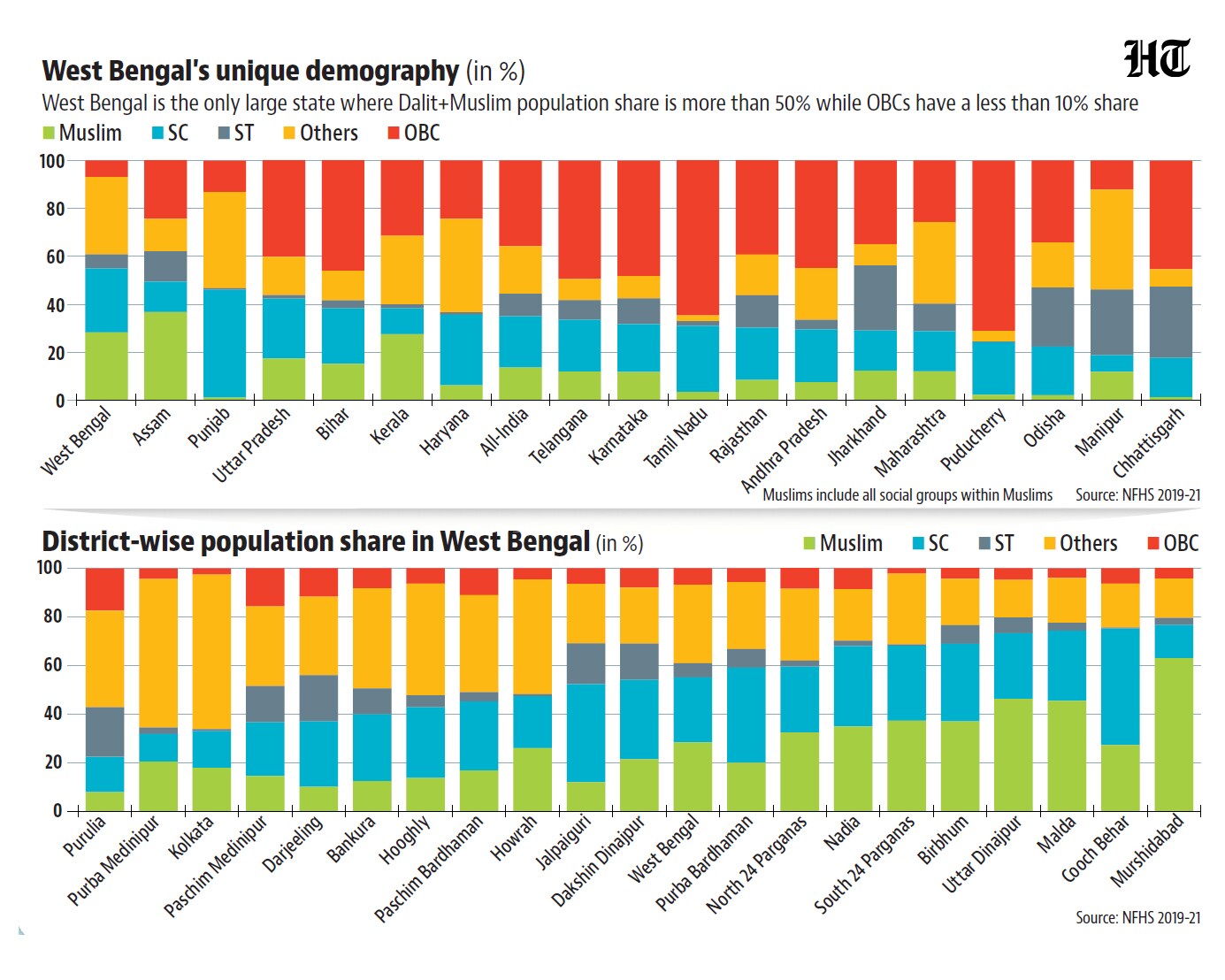
 West Bengal has a very large share of both Dalits and Muslims in its populationThat West Bengal has a large Muslim population is well known and widely analysed in its politics context. These pages have examined the issue in a three-part series in the run-up to the election. Less frequently acknowledged, however, is that the state also has a significant Dalit, or Scheduled Caste (SC), population-- the third largest among major states after Punjab and Tamil Nadu. At the same time, West Bengal has among the lowest shares of Other Backward Classes (OBCs) and a relatively larger share of non-SC-ST-OBC or upper caste Hindus compared to most Indian states. In several districts, the combined population of just Muslims and SCs exceeds 50%.
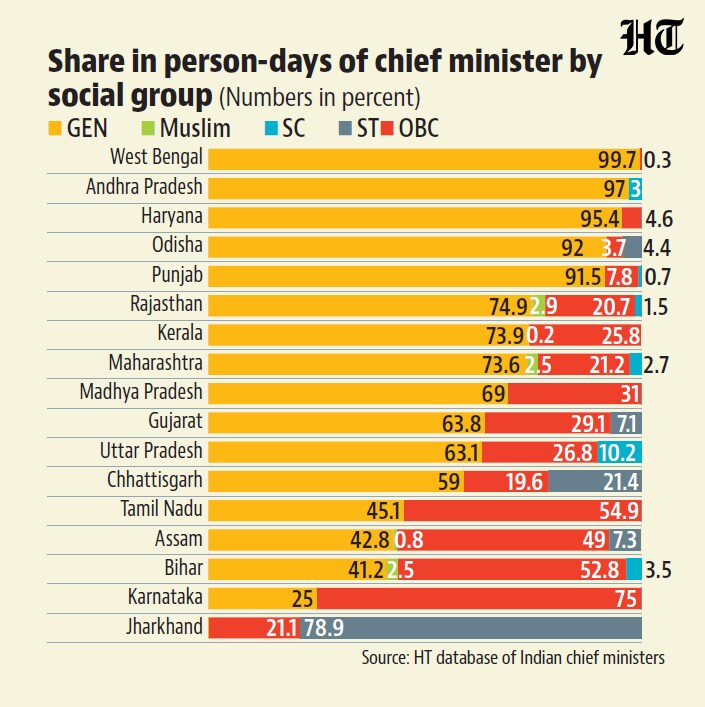
- West Bengal fares the worst in terms of having a non-upper caste chief minister among major statesWhen Mamata Banerjee ended the 34-year rule of the Communist Party of India (Marxist) or CPI(M)-led Left Front in West Bengal in 2011, it marked a political watershed. In on respect, however, things did not change: The chief minister-ship passed from one Brahmin (Buddhedeb Bhattacharya) to another. The transition reflects the entrenched upper caste Hindu dominance in the state’s political leadership. HT’s in-house database of chief ministers in India shows that 95% of West Bengal’s chief ministers have been from upper caste Hindu backgrounds. The only exception was Prafulla Chandra Gosh, an OBC leader who served as chief minister for 90 days. West Bengal is the most upper caste dominated large Indian state in terms of the chief ministers in India. Notably, Suvendu Adhikari, the current leader of the opposition from the BJP and also the most prominent Bengali face of the party in these elections. is also a Brahmin.
- The only thing as entrenched in West Bengal politics as Hindu upper caste dominance is Kolkata dominanceSince independence, the state has had 20 chief ministers (across eight individuals). Seven of these eight leaders have been from Kolkata. The dominance of Kolkata in the state’s political leadership is disproportionate given the fact that it accounts for just 3.75% of the state’s assembly constituencies since 2011, and 7.14% between 1977 and 2011. No other state in India--historically or currently--shows such a concentration of political leadership drawn from its capital city (or one urban center). Among major Indian states, West Bengal is the only one where the chief minister comes from the capital city. Even if one were to compare the chief ministers who have completed at least one full term, West Bengal shows a disproportionate skew in the dominance of the state capital.
- ConclusionWhat explains this social regression in West Bengal’s politics? Is it just the proverbial cultural hold of the “bhadralok” – the socially sanitized moniker for the Bengali term for the educated, socially influential, and upper-caste Bengali middle class that emerged during the British period – or is there a material basis to it? This is a question the second part of this series will answer.