E-Paper



TN, Kerala and West Bengal: The trinity that still eludes the BJP | Number Theory
.

 Prefer HTon Google


The Bharatiya Janata Party (BJP) will win both Tamil Nadu and West Bengal in the elections scheduled for 2026, Home Minister Amit Shah said while speaking at a meeting in Madurai on Monday. The election cycle, which will see Tamil Nadu and West Bengal going to the polls in 2026, will also include Assam and Kerala among the major states. While the BJP has ruled Assam since 2016, Kerala, Tamil Nadu and West Bengal are the only three major states in which the party has not been able to win an assembly election either on its own or in an alliance. That Shah did not include Kerala in his list of claimed victories shows that the BJP is aware of its limited political footprint in the state. What about the states of Tamil Nadu and West Bengal, and the challenge which the BJP is facing there? Here are three charts which explain the state of play vis-à-vis the BJP in these three states.
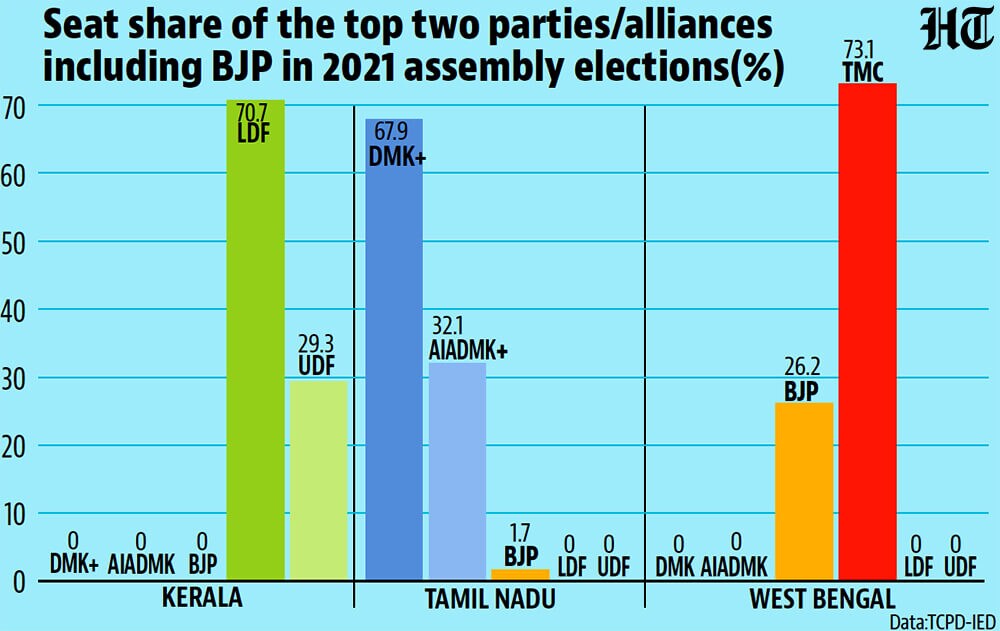
 Principal opposition, junior partner in an opposition alliance and a distant third: BJP’s situation in West Bengal, Tamil Nadu and KeralaThe BJP had a seat share of 26.19%, 1.71% and zero respectively in the 2021 assembly elections, which were held in West Bengal, Tamil Nadu and Kerala. While it recorded its best ever performance in West Bengal, it did better (even if only marginally so ) in Tamil Nadu and Kerala than in previous elections. As things stand , the BJP is the principal opposition party in West Bengal, has course-corrected in Tamil Nadu to resurrect its alliance with the All India Anna Dravida Munnetra Kazhagam (AIADMK) and is still struggling as a distant third in the state of Kerala.
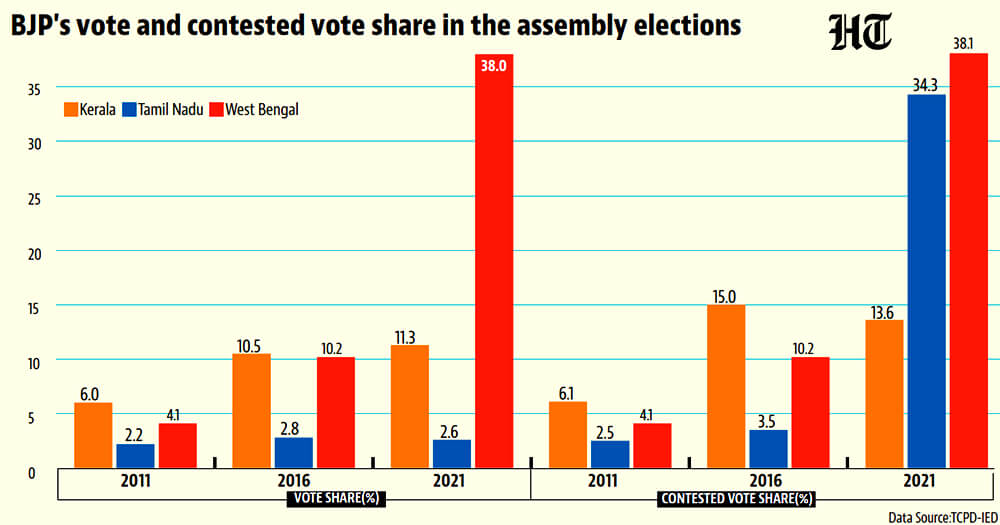
- BJP’s successes and failures in these three states are best described as an ideological coup d’état versus a cul-de-sacThe BJP winning 18 parliamentary constituencies (PCs) in the 2019 Lok Sabha elections in West Bengal was among the most stunning surprises in India’s political history. It had a vote share and seat share of just 16.8% and 4.76% in the 2014 Lok Sabha election in Bengal, which plummeted to just 10.2% and 1.02% in the 2016 assembly elections in the state. Almost all of the BJP’s gains came at the cost of the Communist Party of India (Marxist) or CPI (M) led Left Front which collapsed to a vote share of just 6.7% in 2019 compared to 25.2% in 2014. Such mass desertion from a communist party to a right-wing party made West Bengal a big ideological victory for the BJP. In Tamil Nadu and Kerala, however, it is ideology which has become the bane of BJP’s existence. BJP’s aggressive posturing against Dravidian politics in Tamil Nadu led to its decimation in the 2021 assembly and 2024 Lok Sabha elections. That the BJP has gone back to allying with the AIADMK against the Dravida Munnetra Kazhagam led government shows that it has realized its mistake in waging an ideological battle against the Dravidian parties. Similarly, in Kerala, the BJP has seen its primary national adversary, the Congress, stealing the gains of issues such as the Sabarimala temple entry issue, which should have accrued to the BJP. Unless the Congress-CPI(M) bipolarity ends in Kerala, the BJP has no hope of breaking ground in the state.
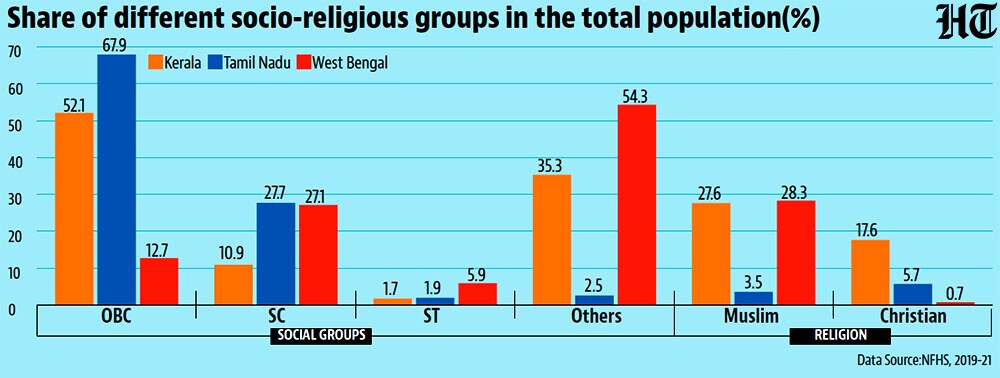
- Demography poses its own challenge to the BJP in all of these statesBJP’s core electoral strategy is about consolidation of Hindu votes in an election. Both West Bengal and Kerala are ill-suited to this kind of a strategy. According to the 2011 census, Muslims accounted for 27.01% of West Bengal’s population. The latest National Family and Health Survey (NFHS) puts this number at 28.3%. The BJP’s best ever vote share performance in West Bengal (40.3% in the 2019 Lok Sabha election), would have involved a consolidation of 70% Hindu votes in the state, assuming Muslims did not vote for the BJP. In any other state, such a consolidation would have led to a landslide victory. Similarly, in Kerala, Hindus have a share of just 54.7% in the state’s population according to the 2011 census. Here, the BJP faces the challenge of weaning most of them away from the CPI (M) while both Christians and Muslims are known to vote for the Congress in bigger numbers. In Tamil Nadu, despite the proportion of Muslims being among the lowest across major Indian states, the key to power lies through OBC consolidation, and these classes are already divided among the two Dravidian parties. BJP’s ideological moorings in the state have often been seen as upper caste which has made it a pariah of sorts in the state. Whether this changes with the renewal of the alliance with the AIADMK and the BJP having an OBC state president remains to be seen.