E-Paper



Why caste struggle is not class struggle in Bihar anymore | Number Theory
.

 Prefer HTon Google


These pages, over the last couple of weeks, have carried detailed statistical analysis of political representation by caste in Bihar — both among all of Bihar’s 3,629 MLAs from 1962-2020 and among the candidates of the two major alliances, namely the National Democratic Alliance (NDA) and Mahagathbandhan (MGB) in these elections. The purpose of these was not to merely count caste or sub-caste among the state’s politicians, but lay the statistical ground for a deeper understanding of the state’s political economy. This three-part series will take this conversation forward by situating Bihar’s political representation by caste in its overall political economy. The first part will explain why Bihar’s caste battles today, unlike in the past, do not capture its class conflict . The second part will highlight how caste competition in politics is essentially a competition between elites, and the third part will show what can actually be a just political economy for the state.
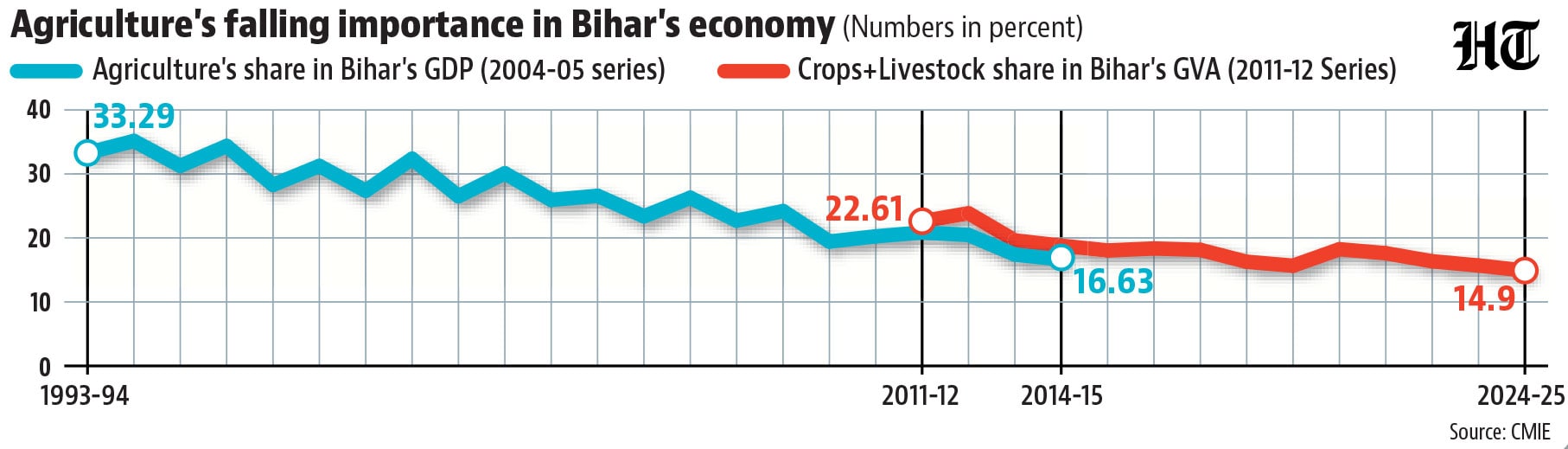
 Bihar’s bloody land struggles are now passé because of the fall in agriculture’s importance…Bihar, not until long ago, saw entrenched conflicts around land which kept large parts of the state on tenterhooks and claimed hundreds of lives across the social divide. This conflict and the associated tensions have dissipated over the past couple of decades. This is also the period Nitish Kumar has been the chief minister of the state. While it is difficult to establish a correlation between Kumar being in office and the easing of caste-based land conflicts in the state, there is at least one piece of hard economic data that can explain why this could have happened. Farm land, which was at the core of these conflicts in the state, is not as important as it used to be a couple of decades ago. Agriculture’s share, as a share of Bihar’s Gross Value Added (GVA), has fallen from one-third to less than 15% during this period.
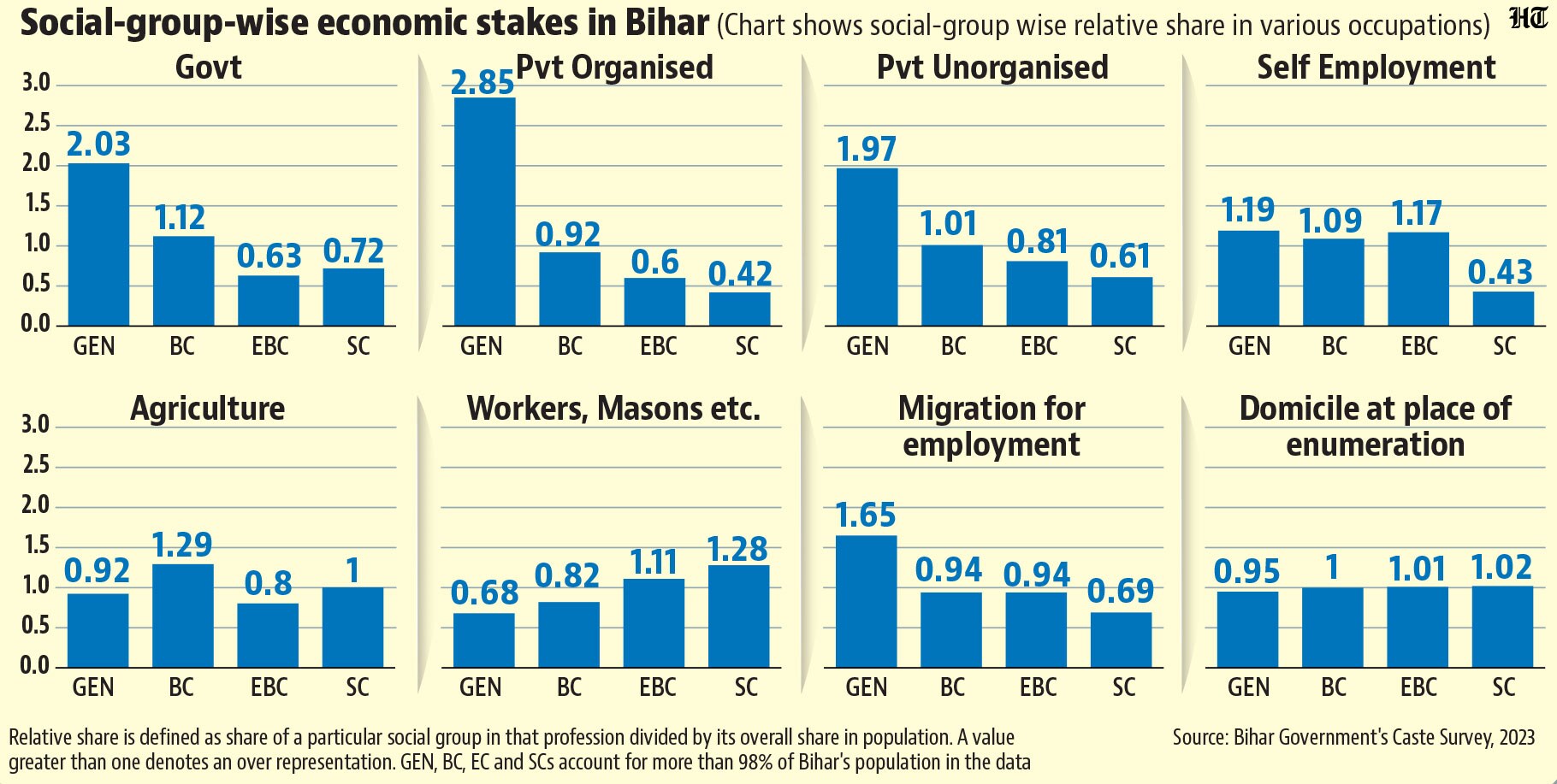
- …And upper castes seem to have migrated the most to better salaried jobs, including those outside BiharOfficial data on employment in India does not distinguish within the larger Other Backward Class (OBC) category. In Bihar, the Backward Class (BC) versus Extremely Backward Class (EBC) category dynamic is very critical to politics. The Government of Bihar’s Caste Survey, which was released in 2023, does give occupational classification at both the broad-social-group level and sub-caste level. The data shows that the non-SC-ST-OBC population (the proverbial upper castes) have a much larger relative share in salaried jobs (both public and private) than other social groups. In fact, their relative share is the highest in organized sector private jobs. BCs, on the other hand, have the highest relative share in farming and SCs lead the ranking in blue-collar jobs such as workers and masons. The short point of these numbers is, upper castes have pivoted away from agriculture which is where they fought pitched battles with the socially oppressed to preserve their entrenched and exploitative dominance until the 1990s. The caste survey data also gives the number of people who have migrated outside Bihar for employment. Once again, upper castes have the highest relative share here, and they are the only broad social group which has a relative share less than one when it comes to those who were staying permanently at the place of enumeration. This means that upper castes have not just left Bihar’s troubled farmlands but also the state itself .
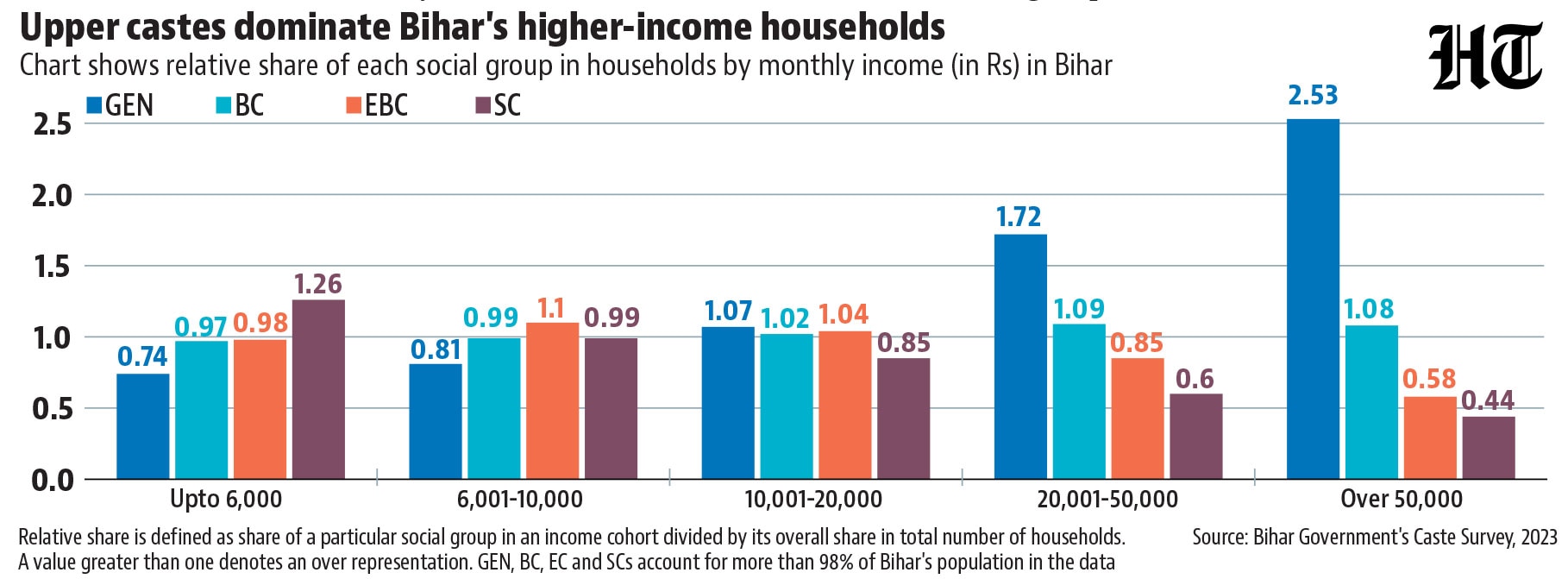
- But upper castes are still the most economically privileged in the stateWhile they are not necessarily invested in perpetuating feudal agrarian relations in Bihar – as is often argued in political rhetoric in the state – upper castes still enjoy significant economic dominance in the state. The best way to look at this is to compare income-wise relative shares of households from each major social group in the state. The 2023 caste survey has classified households into five reported monthly income categories along with a cohort which did not report incomes. Upper castes dominate the highest income category of more than ₹50,000 by a huge distance compared to other social groups. BCs are another remarkable social group on this count because they are equally divided across all income groups in the data.
- How does this overall economic alignment of caste manifest itself in Bihar’s larger political economy?This is what the second and third part of the series will weigh in on.