E-Paper



Youth in labour market: Changing employment trends | Number Theory
.

 Prefer HTon Google


The State of Working India 2026 looks at how India’s growth story has evolved over the years for its youth (15 to 29 year olds) cohort. One of the major metrics of economic transformation is the pace of its structural transformation : how fast have workers moved out of agriculture into manufacturing and services? And, what have been the industries that have employed these workers ? Given different levels of education and aspirations, analytically, one can expect labour market experiences of youth to be very different from that of the older workers. In this piece, we contrast the structural transformation experience for the young and old cohorts.

Given changing aspirations and higher levels of educational attainment, young workers have exited from agriculture at a much faster rate than older (30+) workers. In 1983, nearly similar shares of young and old men were employed in agriculture, about 57%. By 2023, the share of young men had fallen to a quarter whereas about 36% of older men still remained in agriculture. And for young women, this fall has been much sharper vis-a-vis their older counterparts. This faster exit is not surprising -- younger generations rarely aspire for agricultural work, especially given its lower earnings and lack of social prestige.
(Bhargavi Shanigarapu and Rosa Abraham work at the Azim Premji University)
(This is the second of a three-part special data journalism series on India’s young workers and the challenges facing them. The third parts will look at the issue of changing patterns of young men in the labour market.)
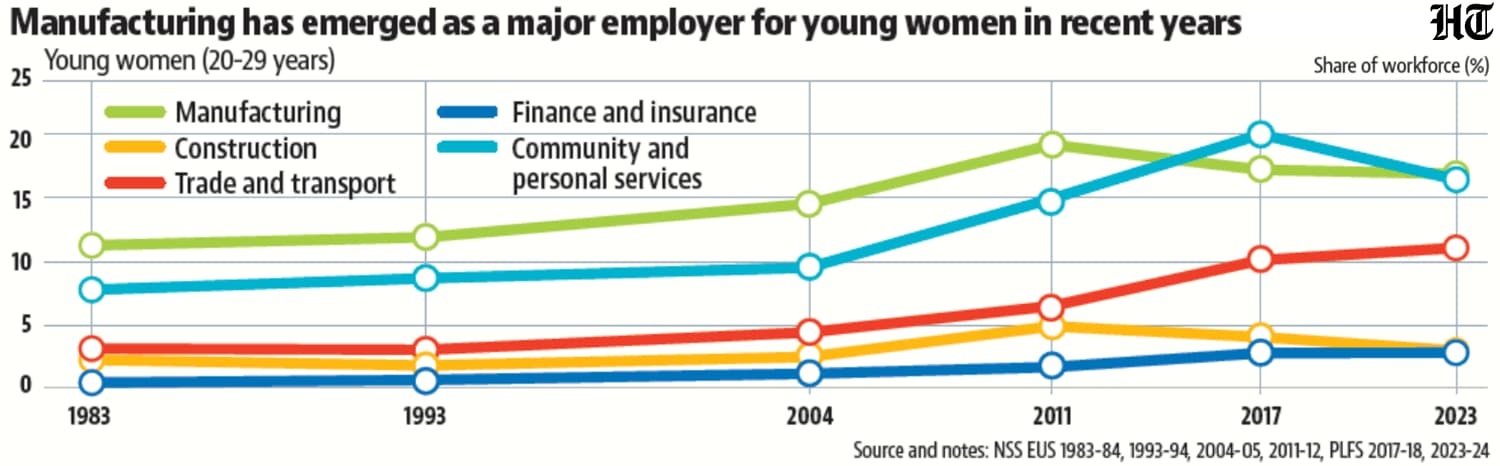
 Where have young workers exiting agriculture moved?If we look at where the young workers have exited from agriculture have moved into, we see sharp gendered variations emerge. First, young men have entered into industries nearly identical to that of the older cohorts, trade and transport, and construction. In contrast, in the case of young women, there are two major differences. The exit from agriculture has been accompanied by a nearly equivalent exit of women from the workforce entirely. And, of the young women who do engage in paid employment, the entry level industries are very different between the younger and older cohort. Manufacturing has emerged as a major employer for younger women, steadily increasing from 12% in 1983 to 20% in 2011, showing a break from traditional gender norms.
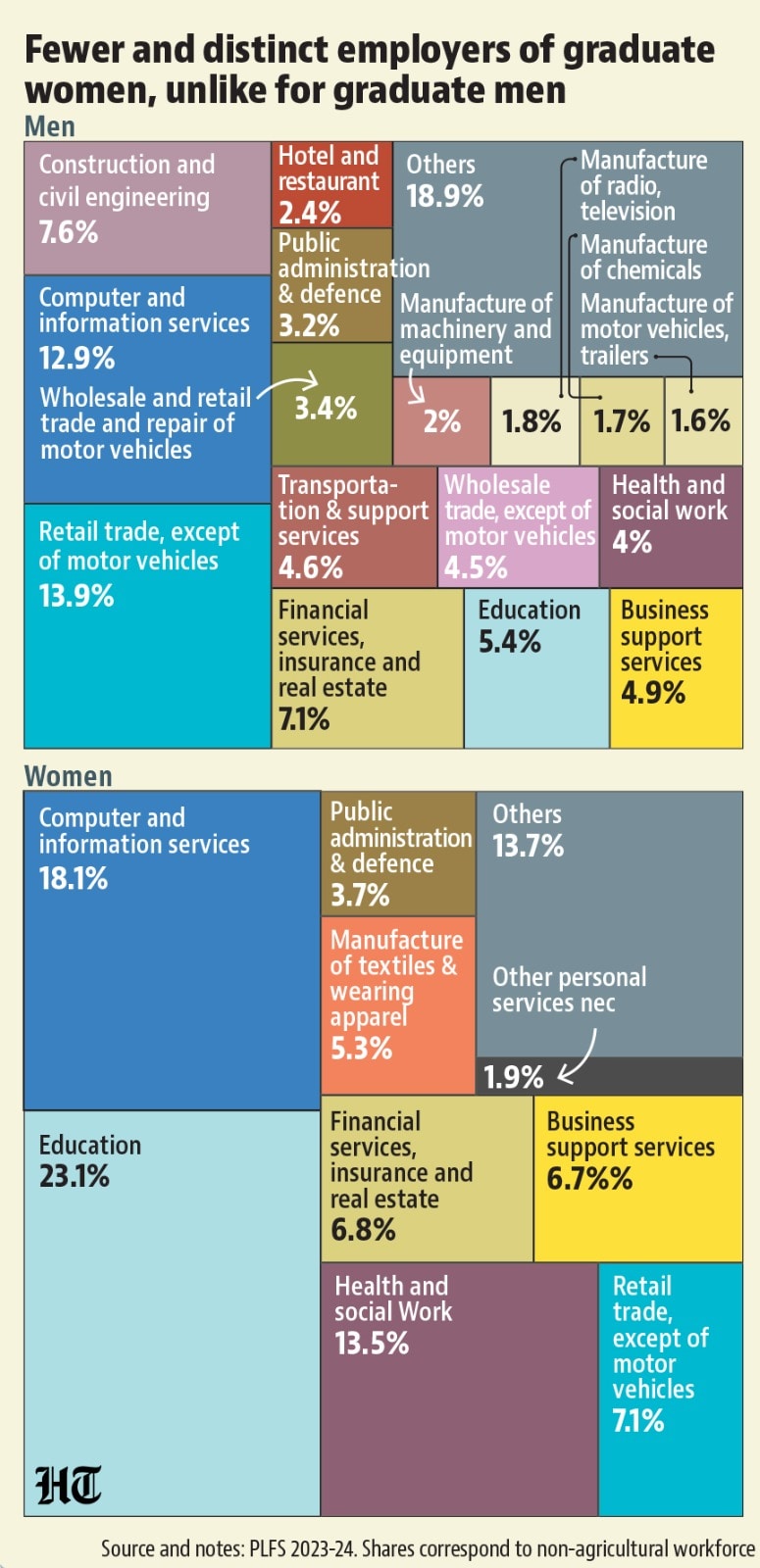
- Contrasting patterns for graduate men and womenBetween young graduate men and women, are major employers the same? Interestingly, employers of graduate men are not very different from employers of non-graduate men. Construction, retail trade and agriculture continue to be the major employers, whether a young man was a graduate or not. Besides, there were a large number of industries that employed graduate men, in small shares. For women, on the other hand, employers of graduate women were not only very distinct from that of non-graduate women, but they were also far more selected. Education and health, traditionally major employers of women, continue to be in 2023. However, the new ‘modern’ services industries, computer and information services, have now emerged as major employers too, as has manufacturing of textiles and apparels. For non-graduate women, major employers are agriculture and personal services, very different from that of graduates. Education, which is expected to sort workers into certain kinds of industries, seems to be doing just that for graduate women, but not for graduate men.
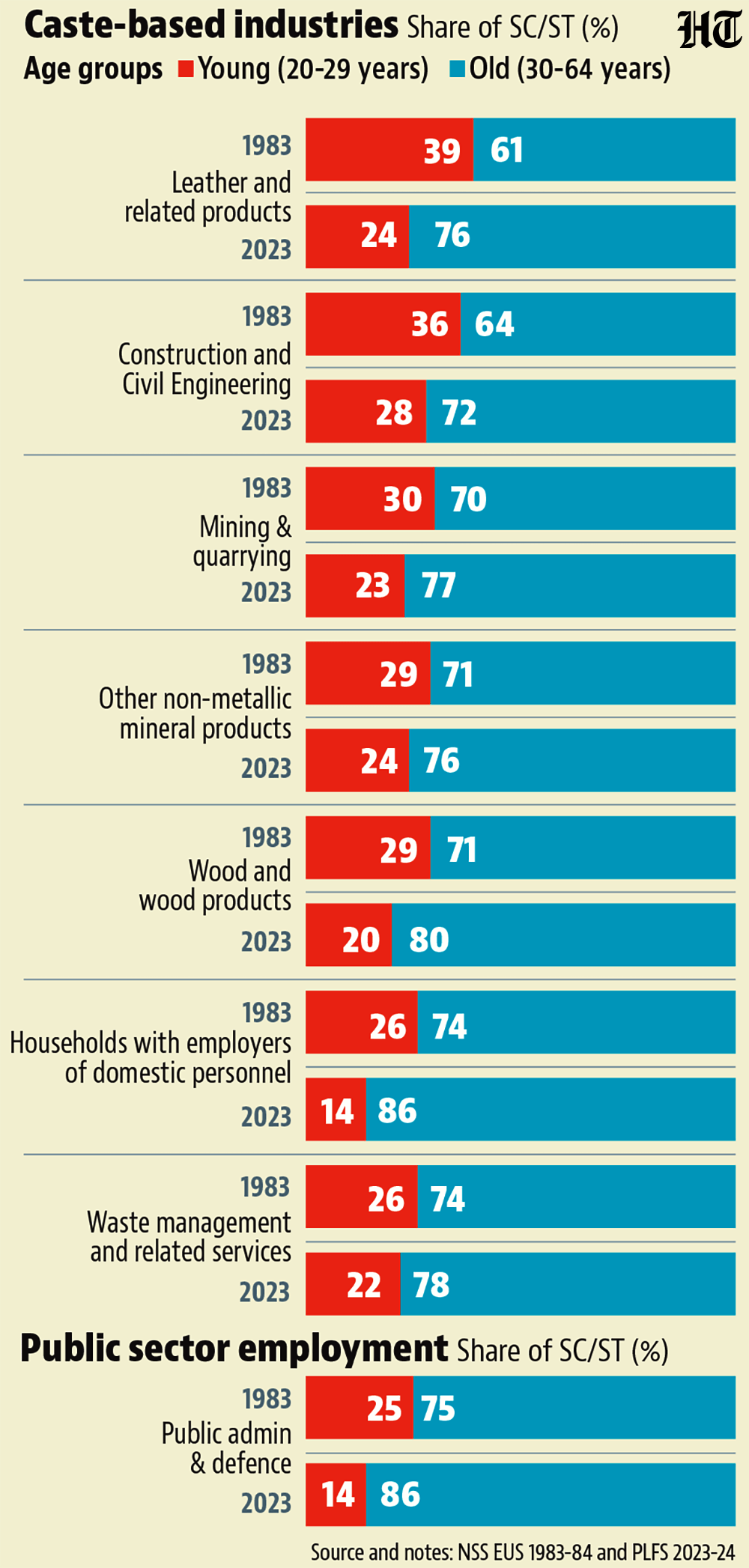
- Weakening of caste and gender-based occupational segregationEntry into the labour market is mediated not just by education, but also social identities, gender, caste, religion. For those industries which are typically associated with SC/ST groups -- leather, construction, mining, waste management etc -- we see how the share of young-old workers have changed over time. Across all industries traditionally dominated by SC/STs, we see a sharp decline in the share of their young workers. Rising educational attainment and the expansion of alternative employment opportunities have enabled greater inter-generational mobility away from traditional caste-based industries. However, while decline in youth representation in traditionally caste-based industries is a welcome development, for public administration, the decline in the share of young SC/ST workers is cause for concern, reflecting the shrinking role of the state and hence of affirmative action as a pathway to decent work for marginalised groups.