
 E-Paper



UP polls: Can inflation, job crisis overpower caste factor in eastern Uttar Pradesh?
Uttar Pradesh assembly election 2022: The government’s claims of providing jobs, of taming inflation and meeting demands for sustenance are vehemently countered by people across castes.

 Prefer HTon Google


Varanasi/Bhadhoi/Mirzapur/Azamgarh: In the litany of complaints against the ruling dispensation, two words are recurrently heard in this eastern part of Uttar Pradesh: mehngai (price rise) and bekaari (unemployment).
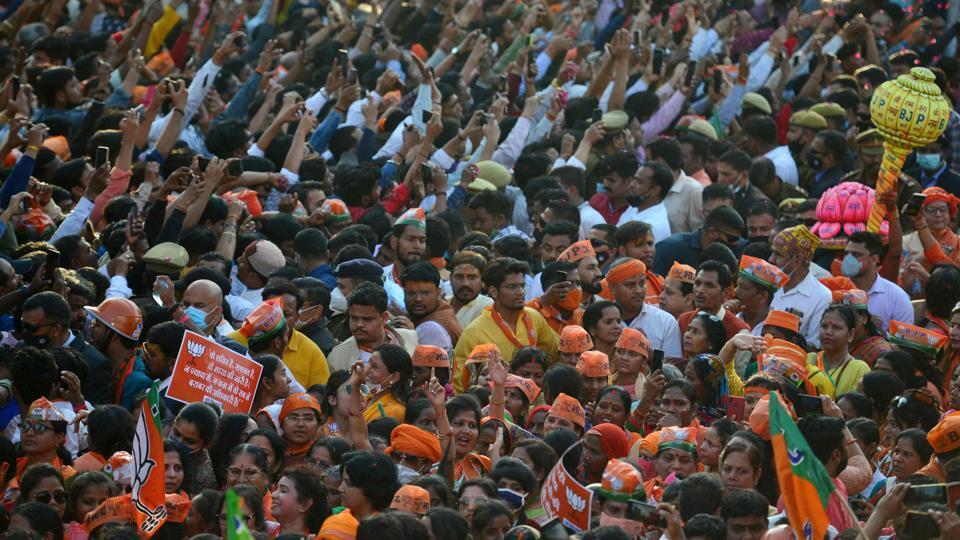
The government’s claims of providing jobs, of taming inflation and meeting demands for sustenance are vehemently countered by people across castes who are demanding a solution to joblessness and soaring costs of all essential items. The BJP had won in all of these three districts in 2017 and is hopeful of retaining its position.
However, even those who assert that they have been supporters of Prime Minister Narendra Modi and will continue to remain ideologically tethered to the ruling Bharatiya Janata Party admit sheepishly that during discussions with friends and neighbours about governance and problems such as price rise, they have to defend the indefensible.
Shift in preference
After getting a diploma in Mechanical Engineering from a government polytechnic in Uttar Pradesh’s Pratapgarh and a BTech from Madan Mohan Malviya Institute of Technology in Gorakhpur, Mata Prasad Patel went on a job hunt. He filled forms for various government jobs and hoped the private sector would offer work. “There was no work,” he says fiddling with his smartphone. The phone has now become a source of earning, even though it’s not enough to meet expenses.
“I joined an online platform, which has headquarters in California. I solve questions for students abroad. I get paid between ₹150-200 for each problem I solve but the monthly earning is not sufficient,” he says. Patel is a resident of village Matuka in Sevapuri district of Varanasi. The area is part of Varanasi rural.
Mata Prasad’s struggle for a job made Vijay, his younger brother, give up studies. “I was in BCom first year. But when I saw how everyone struggled for work, I decided to quit studies and get an early start,” says Vijay who borrowed money to start a poultry farm that just about sustains his family.
No work, no marriage
Lack of jobs in their village and the nearby ones has impacted lives in several ways including not being able to find a match.
“Since most of the people have either low paying jobs or no work, getting married has also become a problem,” says Vijay.
Both brothers are from the Patel caste, counted among the Other Backward Castes (OBC). Their community is counted as the support group of Apna Dal, a BJP ally.
Their anger is not so much against their lawmaker Anupriya Patel, head of Apna Dal, as it is against the sitting legislator Neel Ratan, who is from the party. The brothers say while they like to see Modi as PM, they are not averse to voting for the cycle (the Samajwadi Party’s symbol).
Kishori Devi, who lives next door to the Patel brothers points to the piles of cow dung next to her house. “Who can afford cylinders (LPG gas for cooking); we are back to this (dung, used for cooking). The cylinder is gathering dust somewhere,” she says.
In the neighbouring Lohta village, angry villagers say the local legislator, BJP’s Anil Rajbhar, had won the previous election by a margin of a lakh, but did little to address their concerns. At a tea stall, residents claim though the legislator is also a minister in the state government, there’s little that’s been done to clean up the area or repair roads.
“They paved the road with stones, but water accumulates at various places because of the potholes… and this is the main Varanasi- Bhadhoi road that sees heavy traffic,” said a resident not wishing to be named.
There is talk of supporting a new candidate here as well. The tussle is between two Rajbhars: Anil and Arvind, who is from the Suhaldev Bharatiya Samaj Party, a former ally of the BJP.
Caste in the carpet belt
Caste considerations are taking a back seat in the carpet belt of Bhadhoi and Mirzapur where problems of power cuts, bad roads, poor health infrastructure and a slump in business are concerns for most.
While the minority community is vocal about their preference, the coalition of other backward castes that formed the bulwark of the BJP’s support group in all elections since the 2014 general elections has begun to show signs of fissures.
“Modi ji to theek hai…par baki ka keh nahi sakte,” (Modi is good, but can’t say the same about the rest), says a shop owner in Bhadhoi not wishing to disclose his name. He’s a Kurmi (OBC) who has been a long-time BJP supporter.
What is his grouse? “Most of the people in this area are workers who are now either working for a pittance or have no jobs. They get free ration from the government, but they have little to spend on other things. So, when spending power falls what does a small-time shopkeeper like me get?” he asks. The SP, which had won the seat twice in 2009 (by-poll) and 2012 is hopeful of a favourable outcome here because of the Muslim population.
Opposition warming up to NY-OBC
In Mirzapur too, the caste consolidation claims seem to have come under strain. Many residents here who voted for the BJP say their expectations were high as the people in power promised to usher in big economic reforms. “Migration is the only way to earn a living. People have small land holdings and the labour costs are not high, so they travel across the country. The carpet industries have also cut jobs. Barring the Baniyas in the urban areas, the Muryas and Chaurasias (both OBCs) are now warming up to the SP,” says Sameem Khan, a furniture store owner in Mirzapur.
While the BJP asserts it remains the first choice of the non-Yadav OBCs (NY-OBC),the exit of OBC leaders OP Rajbhar (SBSP), Swami Prasad Maurya and Dara Singh Chauhan who are now with the Samajwadi Party is being read as “jaatiwadi” (caste-based) politics of the state government.
“Thakurwad is prevalent. The OBCs were told they are equal partners in governance but Maurya and Chauhan were not given izzat (respect),” says Naresh Pal, who works at a local carpet factory. Pal, a Chaurasia, says having realised the “value of their vote” the younger generation now demands “barabar ka samman” (equal respect) and political representation.
BJP’s hold over the NY-OBCs, who make up about 35% of the electorate, is also loosening as the other parties are wooing this combination of castes, promising more political representation and freebies.
The SP for instance has given the most tickets to NY-OBC candidates to shed its image of a Yadav-Muslim party and is counting on allies such as the SBSP, Janwadi Party (Socialist) and Apna Dal (K) that are OBC-driven parties to strengthen its position in the Purvanchal region.
The BJP is counting on its allies Apna Dal and Nishad Party to keep the NY-OBCs close. The Kurmis, for instance, that are counted as supporters of Apna Da are between 7-8% the electorate and are present in significant numbers in the eastern belt.
Blaming the Opposition
Union minister of state Arjun Ram Meghwal blames the opposition for “raking up” the issue of price rise. He says the government has been able to contain inflation “in spite of adverse situation”. The adverse situation he refers to is the global pandemic, which led to a slump in the economy.
“The issue in this election is security…people feel if they are safe then they will bear other things,” he says. On the allegations that recruitment has dipped even in the armed forces, Meghwal said, “The SP claims they will advertise posts, but people ask them will only Yadavs be selected.”
The BJP’s attempts to coalesce the OBC votes under the larger ambit of the Hindu vote bank are successful in many parts, but do not have a uniform appeal.
In Azamgarh, a stronghold of the SP, locals are not happy about projecting their region as a hotbed of terror. “There could be one or two cases, but to say Azamgarh is Atankgarh has consequences for us. Our kids get looked at suspiciously,” says Dharampal Yadav, who ferries goods.
Yadav says the BJP has tried its best to polarise the election on religious lines and they keep harping on having fulfilled their promise of constructing the Ram Mandir in Ayodhya, but in Azamgarh the Yadav population is not inclined to shift and only a smaller percentage of NY-OBCs will vote for the party.


