E-Paper



On Hindutva, welfare planks, BJP defeats Samajwadi Party in central UP
Of a total of 89 seats in the region, encompassing the districts of Kanpur, Bundelkhand, Farrukhabad, Hardoi, Unnao, Kannauj, Etawah Fatehpur, Rae Bareli and Lucknow, among others, the BJP won a total of 70 seats, just short of its 2017 tally of 77 seats

 Prefer HTon Google


The popularity of Prime Minister Narendra Modi and chief minister Yogi Adityanath, and a heady mix of welfare and Hindutva enabled the Bharatiya Janata Party (BJP) to stave off the challenge in central Uttar Pradesh by the Samajwadi Party, which put up a fight in areas considered its old bastions but ended up falling short.
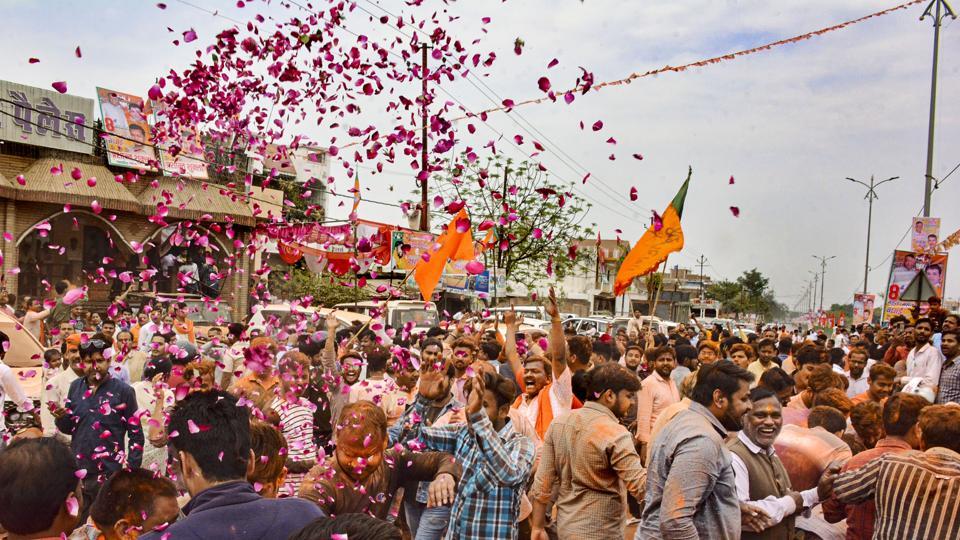
Of a total of 89 seats in the region, encompassing the districts of Kanpur, Bundelkhand, Farrukhabad, Hardoi, Unnao, Kannauj, Etawah Fatehpur, Rae Bareli and Lucknow, among others, the BJP won a total of 70 seats, just short of its 2017 tally of 77 seats. Of the 19 seats that SP won, at least eight were in its old districts of influence of Etawah, Auraiyya and Fatehpur.
“Modi and Yogi both played an important role in this victory. Our studies show that at least 10% of voter who doesn’t care about caste and creed voted because of Modi. This is in line with our finding in 2019 election that 11% people said their vote was decided by Modi factor alone,” said Professor AK Varma of the Centre for the Study of Society and Politics in Kanpur.
Central to the BJP’s pitch in the area were the distribution of free ration, which undercut any public anger over the state government’s management of the Covid outbreak, and the focus on law-and-order, a key facet of Adityanath’s strongman image. “Ek haath mein vikas ki chadi aur doosrey mein bulldozer (the wand of development in one hand, and a bulldozer in the other) connected with a cross section of voters. Improved law-and-order and free ration to the people found substantial resonance in the people and people were unwilling to compromise on security and safety despite other underlying grievances,” said Babulal Tiwary of the Bundelkhand Degree College.
Ramlal Jayan, a Bahujan Samaj Party (BSP) leader from Banda district in Bundelkhand admitted that while his party fought the elections on the ground, much of its vote seems to have shifted to the BJP. “The shifting of the votes allowed the BJP to contest strongly and retain its 2017 numbers,” Jayan said.
Among the prominent winners from the area were SP leader Shivpal Singh Yadav, and the BJP’s two bureaucrats turned politicians Rajeshwar Singh and Asim Arun.
SP leaders from the region said that there was some solace in the fact that the party had achieved its highest ever vote share, and that this was evidence of a committed campaign on the ground. “We raised issues that affected the people directly and offered solutions.”
However, with central Uttar Pradesh home to urban centres such as Lucknow and Kanpur, experts also said that the SP failed to present itself as a viable alternative, and the lack of a clear issue that the campaign centered around.
“The campaign showed an inability from Akhilesh Yadav to define an agenda before the people. The voter wants criticism to be pointed out but needs clear alternatives too. For example, his absence during the Covid crisis was marked while, for all criticism that it faced, the BJP was successful in creating the perception that it cared for people through its welfare web,” Professor Varma said.