
 E-Paper



Poll view: Representation of women poor over the years in Uttar Pradesh
During the 2022 UP assembly poll, the Congress gave 159 tickets to women candidates for the 403-member state assembly, bringing the issue of reservation for women to the fore

 Prefer HTon Google


The Congress’s implementation of its promise to give 40% party tickets to women candidates brought the issue of reservation for women to the fore during the Uttar Pradesh assembly poll as major political parties vied to win the support of women.
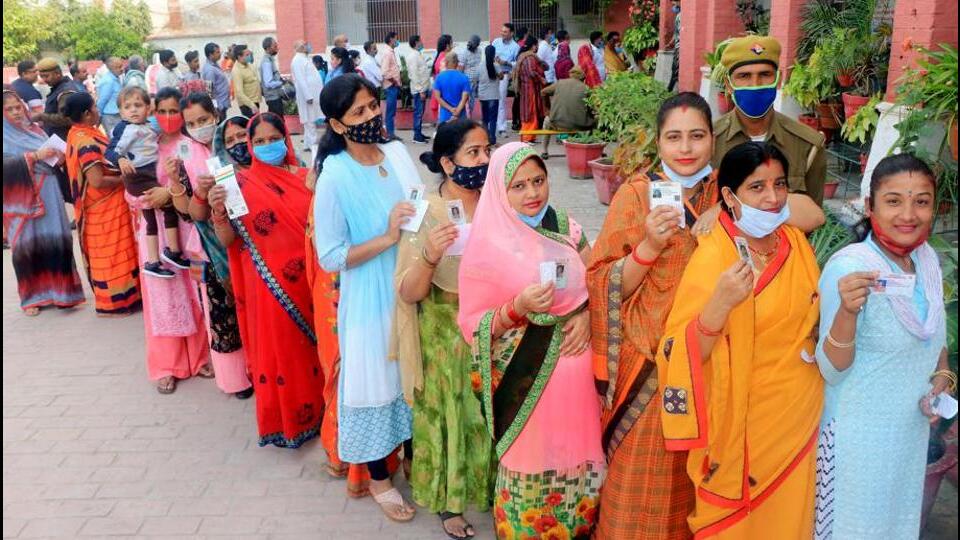
During the 2022 UP assembly poll, the Congress gave 159 tickets to women candidates for the 403-member state assembly.
Uttar Pradesh that has the distinction of sending the first woman Prime Minister the late Indira Gandhi to Parliament and electing women chief ministers like the late Sucheta Kripalani (02/10/1963 to 13/03/1967) and four-term chief minister Mayawati has otherwise failed to give adequate representation to women over the years in the state legislature, Parliament and the council of ministers.
The book, “Uttar Pradesh Vidhan Sabha Mein Mahilaon ka Pratinidhitva evam Mantriparishad Mein sahabhagita (Women’s representation in Uttar Pradesh Vidhan Sabha and their participation in the state cabinet)”, provided statistics about the status of women in the state legislature and the successive ministries portraying a poor picture about representation of women. Chief minister Yogi Adityanath had released the book along with UP assembly speaker Hriday Narayan Dikshit, parliamentary affairs minister Suresh Khanna and others before the announcement of the UP assembly polls.
The book gave details about women’s representation in the state legislature or in successive state governments in Uttar Pradesh. It pointed out that they were not able to get an adequate share in power. Uttar Pradesh elected 11 women MLAs in the first state assembly (1952-1957) while the second state assembly had 39 women members. The 17th state assembly (outgoing) had 44 members. The strength of the 13th state assembly (1996-2002), when Uttaranchal was carved out of Uttar Pradesh (November 9, 2000), was reduced from 425 to 403 members. It had elected 20 women members. One of them resigned soon after getting elected as she was already a member of the Lok Sabha.
The book pointed out that there were only 25 women out of 2,604 candidates who contested the polls for the first state assembly.
In 2017, only 482 women out of 4853 candidates contested the assembly polls and 42 of them won.
With two more women getting elected in by-polls, the strength of women MLAs in the 17th state assembly reached 44.
All this is not about the political parties alone. Women have the least representation as independent legislators in the state. Out of 1462 independent candidates, only 142 were women and none of them won the polls in 2017. Only one independent woman candidate won the poll in the seventh, tenth, 13th and 16th state assemblies, respectively.
A look at women representation’s in the state cabinet also reveals that the number of women ministers has remained low in the state over the years. Uttar Pradesh’s first council of ministers led by Pt. Govind Ballabh Pant did not have a woman member. Dr Sampoornanand, who succeeded GB Pant, also did not have a woman member in his ministry in his first term as chief minister from December 28, 1954 to April 10, 1957. In his second term as chief minister, the Sampoornanand government, however, had a woman deputy minister Prakashvati Sood.
When CB Gupta assumed the office of chief minister (December 7, 1960 to March 14, 1962), he had Sucheta Kripalani as cabinet minister and Prakashvati Sood as deputy minister. The Vir Bahadur Singh-led Congress government (September 24, 1985 to June 24, 1988) had six ministers (16.6% of the strength of ministry) and this was the highest number since independence.
ND Tiwari gave representation to seven women ministers and this was 14.6% of the total strength of the council of ministers. The representation of women was 5.2% during the tenure of the Mayawati government, 3.6% during the Mulayam Singh Yadav government, 2.6% in the Akhilesh Yadav government and 5.5% in the Yogi Adityanath government in Uttar Pradesh. Uttar Pradesh elected six women MPs to the first Lok Sabha. This was 25% of total number of 24 women members. UP sent 11 out of 78 members to the 17th Lok Sabha.
The women’s reservation issue first came into focus in 1992 when the Union government carried out the 73rd and 74th amendments to the Constitution of India to reserve 33% seats in the panchayati raj institutions and urban local bodies. This move triggered a debate for reservation to women in state legislatures and the Lok Sabha. On September 12, 1996, the Union government proposed another amendment to the Constitution, tabling a bill to provide reservation to women in the state assemblies and the Lok Sabha. A 31-member joint committee of both the houses of parliament led by Gita Mukherjee was set up to consider the bill. The committee’s recommendations suggesting certain changes were submitted in both the houses of parliament on December 9, 1996. A proposal to consider the recommendations was moved in the Lok Sabha on May 16, 1997.
Much progress, however, could not be made as the term of 11th Lok Sabha ended soon. The bill was tabled again as the 84th constitution amendment bill in the 12th Lok Sabha on July 13, 1998. The bill could not be pushed further following dissolution of the 12th Lok Sabha on April 26, 1999. The NDA government tabled the bill for the third time as the 85th constitutional amendment bill on December 23, 1999. The UPA government expressed its commitment to women’s reservation and the bill was tabled as the 108th constitutional amendment bill in the Rajya Sabha on May 6, 2008. The bill was referred to a standing committee of parliament on May 8, 2008. The Union cabinet approved the bill on February 25, 2010 and the same was tabled again in the Rajya Sabha on March 8, 2010 and subsequently passed by Parliament on March 9, 2010. The bill, yet to be passed by Lok Sabha and ratified by legislatures of 15 states, provides for reservation for 15 years by rotating the seats every five years.
“The Congress did its best and got the women’s reservation bill passed in the Rajya Sabha. The BJP has been in power for the past seven years and has done nothing. The Congress has at least done a beginning, promising 40% tickets to women candidates,” said Uttar Pradesh Congress Committee vice-president Pankaj Srivastava.
“The Congress is only paying lip service to pushing the cause of women. The Congress should tell how many women have been made office bearers in the party organisation. Besides the issue of women reservation, the BJP has worked with a strategy to increase the number of women in the party organisation and other places,” said Uttar Pradesh BJP vice-president Vijay Pathak.
“Why wait for any legislation to give representation to women? The Congress did not do much when it was in power. If political parties give tickets to the women, they will be able to get better representation. Law is no solution to the issue. Political parties have not made efforts and should come forward to give more tickets to women,” said Professor SK Dwivedi, former head of department, political science, Lucknow University.


