Salakaar could well have been a film. Instead, it is a miniseries of five 30-minute episodes. The 2.5-hour runtime is a relief in the days of 6-hour arcs. I say relief, not because it stays gripping or packs a lot of thrills in a short time, but simply because it does not test your patience too long. Salakaar, like many spy thrillers that have come before it, has its heart in the right place. Everything else is sadly out of order.
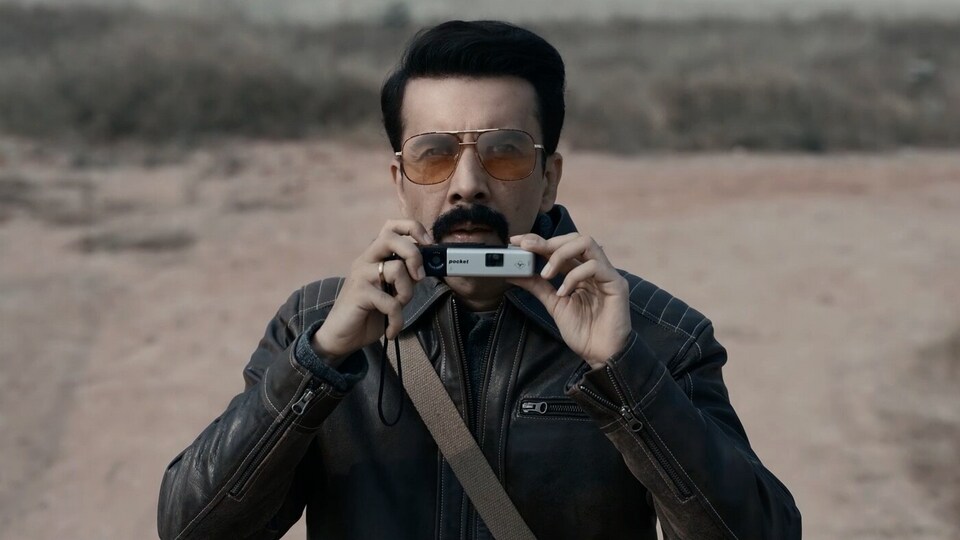
Salakaar review: Naveen Kasturia stars as a fictionalised version of Ajit Doval in the show.
Salakaar traverses two timelines. In 2025, RAW agent Maryam aka Srishti (Mouni Roy) is trying to thwart Pakistani Colonel Ashfaqullah's (Surya Sharma) plans to build a nuclear bomb. Aiding her is the 'salahakar', the National Security Advisor (Purnendu Sharma), who has some history with the Pak colonel. Flashback to 1978, and it is revealed that the NSA was a field operative in Pakistan (Naveen Kasturia as Adhir Dayal), preventing General Zia (Mukesh Rishi) from developing a nuclear reactor.
It is a story that has been told in several films and shows, both previously released (Mission Majnu and Rocket Boys) and upcoming (Saare Jahan Se Acha). The only thing that could have made Salakaar fresh was its treatment. But alas, that is where the show flounders the most. Salakaar never truly grips you. It moves at a quick pace, and the action is relentless. And that engages you somewhat. But the show never allows you to be invested in the characters. The hallmark of streaming is that it has more time than traditional films to flesh out characters, build arcs, and navigate the plot. Salakaar gives all that up for a fast-paced show, and you wonder if this would have been better as a film, with a bigger budget and larger scale, maybe.
Mouni Roy plays a spy embedded in Pakistan in Salakaar.
Salakaar's biggest undoing is its lack of attention to detail. In an age where accuracy and realism are what set shows on OTT apart, Salakaar seems to be a throwback to the dark days of the 80s, when realism was simply a concept in modern art. Colonels drive in vehicles designated for Generals, the High Commission is repeatedly called an Embassy (there is a huge difference), and covert operations are carried out in the open. This is not nitpicking. For a show that promises to show the behind-the-scenes of a true story of India's past, it is a cardinal sin not to even attempt to be accurate and real.
On top of that, Salakaar has the subtlety of a sledgehammer. It oscillates between wanting to be as gritty as Argo and as silly as Kingsman. The spy, who is supposed to fly under the radar, uses buckteeth and comical accents in his cover, completely disregarding the basic principle of blending in. But even as a silly show, Salakaar does not work because it is not self-critical enough to be a parody.
Mukesh Rishi, as General Zia, has an imposing presence on the screen.
Naveen Kasturia, as the young NSA, is one of the show's saving graces. The actor shows that he can do action quite well, and eases into the role very well. Mouni Roy is hardly utilised, relegated to being a damsel in distress being saved by the men, even though she is supposed to be a capable spy herself. The actor tries to bring out her character's vulnerability and badassery with whatever limited she gets. The surprise package is Mukesh Rishi. As a largely over-the-top Zia, he looks menacing and imposes himself on the screen. Salakaar works in parts only because Mukesh Rishi makes the threat of the adversary so real. Surya Sharma and Ashwath Bhatt, two natural actors, are left to be as over as they can, which is a grave mistake on the part of the director Faruk Kabir.
Salakaar is meant to be a tribute to the NSA Ajit Doval, a spymaster in his prime. The show is meant to show the world what he achieved in the field. Everything from Purnendu Sharma's getup to Naveen Kasturiya's fictional name is an homage to him. But tributes are meant to be better. If not well done, they can end up disrespecting what one is trying to glorify. And that is what Salakaar does. The search for India's Argo goes on...
Abhimanyu Mathur is Deputy Editor, Entertainment at Hindustan Times. With almost 15 years of experience in writing about everything from films and TV shows to cricket matches and elections, he inhales and exhales pop culture and news. Currently, he watches movies and TV shows and talks to celebrities for a living, while occasionally writing about them as well.
A journalism graduate of Delhi College of Arts and Commerce, Delhi University, Abhimanyu began his career with Hindustan Times at the age of 20, swapping classrooms for newsrooms at an early age. He began his journey in the early days of digital journalism, later switching to the madness of print journalism.
Work has led him to far off places like Japan and Jordan, as well as to the interiors of Haryana and the Indo-Pak border. He dabbled in city reporting in places like Meerut, Gurgaon, and Delhi, covered the Olympics and Cricket World Cups, before finding his calling in entertainment and lifestyle during the pandemic. A Rotten Tomatoes Certified Film Critic, he is equally at home covering stories on ground as he is interviewing celebrities and studios, and sometimes prefers to shepherd teams in delivering traffic through the day.
Even as his role has evolved from reporter to supervisor over the years, his first love remains writing (and of late, talking on camera). With a good understanding of cinema and its trends, and a keen eye for detail, he continues to spark conversations around showbiz for readers around the world.Read More

 E-Paper