E-Paper



Rapid climate change triggered Asia floods
The study also found that rapid urbanisation and widespread deforestation contributed to turning the extreme rains into a disaster.

 Prefer HTon Google


New Delhi : Deadly floods and landslides that killed over 1,600 people across Sri Lanka, Malaysia, and Thailand became more intense due to climate change, a rapid analysis by World Weather Attribution said on Thursday.
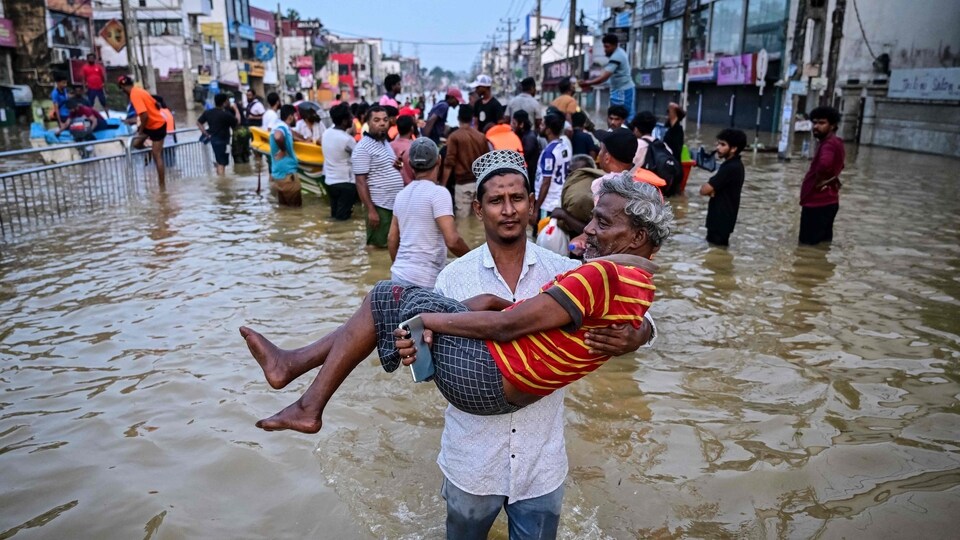
The study also found that rapid urbanisation and widespread deforestation contributed to turning the extreme rains into a disaster. The probability of a rainfall episode over the Malacca Strait as intense as the one triggered by Cyclone Senyar is about 1.4%, equivalent to a one-in-seventy years event. For Cyclone Ditwah, the chance of a similar rain event over Sri Lanka is about 3.3%, corresponding to a one-in-thirty years event.
“The combination of heavy monsoon rains and climate change is a deadly mix,” said Sarah Kew, climate researcher at the Royal Netherlands Meteorological Institute, and lead author of the study. “Monsoon rains are normal in this part of the world. What is not normal is the growing intensity of these storms and how they are affecting millions of people and claiming hundreds of lives,” she said.
For the Malacca Strait region, the increase in extreme rainfall associated with rising global mean surface temperature is estimated at about 9% to 50%. Over Sri Lanka, the trends are even stronger; heavy five day precipitation events, such as those associated with Cyclonic Storm Ditwah, are now about 28% to 160% more intense due to the warming to date, the analysis has said.
Natural climate patterns such as La Niña and the Indian Ocean Dipole also contributed to the observed rainfall over the Malacca Strait. Sea surface temperatures over the North Indian Ocean were 0.2 degree C higher than the historical 1991-2020 average, providing heat and moisture to the storms. Without fossil fuel warming, temperatures would have been about 1 degree C cooler than the historical average, researchers said.
“Cyclones like Ditwah have become an alarming new reality for Sri Lanka and the wider South and Southeast Asian region, bringing unprecedented rainfall, widespread loss of life, massive disruption to economic activities, and unrecoverable damage to the environment. Preliminary assessments place total economic losses in Sri Lanka alone between USD 6-7 billion, nearly 3-5% of the national GDP. This should be an unequivocal eye-opener to the scale of future climate-driven extremes the country and the region must prepare for,” said Lalith Rajapakse, professor in the department of civil engineering at the University of Moratuwa.
The influence of climate change on tropical cyclones is rather complex. However, while both regions were hit by tropical cyclones, the impacts mainly stem from the associated heavy rainfall rather than the high winds, researchers explained.
HT reported on December 1 that two extremely rare cyclones in November devastated parts of Sri Lanka, Indonesia, Malaysia and Thailand. While meteorologists are taken aback by the unusual location of their genesis, climate scientists are seeing a clear global warming signature.