E-Paper



Weather Bee | How unusual are forest fires in March and April?
The recent surge in forest fires in Uttarakhand has been attributed to unusually dry weather since winter. However, this phenomenon isn't unique to this year.

 Prefer HTon Google


The number and extent of forest fires in Uttarakhand raised alarm bells in the past week. The reason cited for this by experts is an expected one: unusually dry weather continuing since winter. While this explains the current disaster in Uttarakhand, it does not mean that things are radically different in other years when the weather is not unusually dry. Here is why.
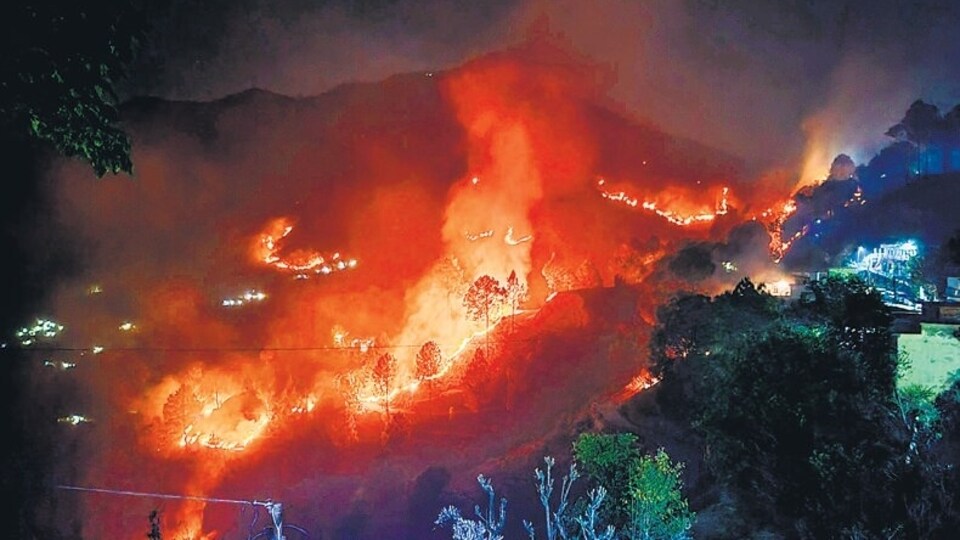
The Suomi-NPP satellite, operated by the US National Oceanic and Atmospheric Administration, makes roughly two passes over India every day and the VIIRS instrument aboard it counts the number of active fires it detects. To be sure, the instrument only detects if an area with a resolution of 375 meters per pixel has any active fires. However, this allows one to get a reasonably approximate number of active fires.
How do we know the fires detected by VIIRS are forest fires? The fire detection algorithm of VIIRS (or other such satellite instruments) does not by itself classify fires by their location. However, we know that March-April fires are likely to be forest fires because the Forest Survey of India (FSI) uses satellite data in combination with forest maps to ascertain the number of forest fires. FSI numbers on forest fires are usually close to the overall fires detected in these months by satellite instruments.
An analysis of fires detected over India by the VIIRS instrument since 2012 shows that a large number of active fires recorded in April is a regular phenomenon. In fact, the monthly average for the 2013-2023 period (the instrument became active only in the middle of January 2012) shows that April accounts for around 23% of annual fires. To put this number in context, this is much higher than the average proportion of annual fires detected in October (6.6%) and November (12%), when stubble burning is the reason active fires are detected. To be sure, this analysis shows that April is not the only month when a large number of active fires are detected. March has a similarly higher share.
So, why is there a spike in forest fires in March and April? While drier-than-usual weather may have made the spike bigger this year in Uttarakhand, March and April are two of the driest months on the calendar even if they follow normal patterns. The 1961-2010 average (it is considered a benchmark for rain in India) for different months shows that March and April are the fourth and sixth driest months of the year. To be sure, these ranks on their own hide the fact that the only months drier than March or April are the months from November to February, the coolest period on the calendar. This means that March and April provide the perfect weather conditions for forest fires: dry and hot.
These historical trends in usual monthly fires and weather establish that a large number of fires are expected in March and April. This does not mean that they cannot be prevented. Any fire takes place when three things come together: fuel, oxygen, and ignition. While ignition can happen naturally, man-made factors are also responsible for it. The latter can definitely be prevented with proactive measures. Moreover, given the pressures on the natural environment with an expanding and rapidly urbanising population, containing fires is not an option to be exercised in dire circumstances. It is necessary to contain fires immediately. Authorities such as forest departments can definitely be proactive in putting out fires as soon as they break out. Such disasters will continue to be dictated by weather patterns, which are getting harder to predict in a rapidly changing climate.
Abhishek Jha, HT’s senior data journalist, analyses one big weather trend in the context of the ongoing climate crisis every week, using weather data from ground and satellite observations spanning decades.