
 E-Paper



Building quant skills for modern finance: IIM Ahmedabad's Advanced Programme in Quantitative Finance and Risk Management
Derivatives pricing. Risk management. Machine learning in finance. These are the skills modern quants need. Build your expertise with IIM Ahmedabad.

 Prefer HTon Google


Research-Backed Choices
Every product we recommend is chosen through a combination of Primary Research and Secondary Research.
Do you know how the price of a complex derivative is actually worked out? Or what goes into measuring risk across portfolios when markets turn volatile? Much of this happens through quantitative models that are built and applied behind the scenes. The domain of “quants”, professionals who use mathematics, computing, and programming to price products, manage risk, and decode market movements.
Their role has grown significantly as global markets become more complex. From high-frequency trading to risk analytics, quantitative finance now sits at the centre of how modern financial systems operate.
The scale of the opportunity
The numbers tell the story. According to the Bank for International Settlements (BIS), global over-the-counter (OTC) derivatives markets stood at over US$700 trillion in notional value in 2025, while exchange-traded derivatives continue to grow. These figures reflect not just market size, but the deepening reliance on structured instruments to navigate uncertainty.
India has emerged as a key hub in this ecosystem. As global banks such as Goldman Sachs, JPMorgan, and Deutsche Bank expand their operations, the demand for professionals with strong mathematical, analytical, and programming skills has grown steadily, with much of the pricing and risk management work now handled by India-based teams.
"Many American and European banks employ Indian professionals with strong mathematical and programming skills to support risk management and option pricing," says Prof. Vineet Virmani, Faculty Co-Chair of IIM Ahmedabad's Advanced Programme in Quantitative Finance and Risk Management (APQFRM). “As more skilled professionals become available, more such roles are expected to come here.”

What the role actually demands
Quant roles today span front-office trading desks, middle-office modelling, and strategy functions, along with back-office risk and regulatory teams. What ties them together is the need for a combination of finance, mathematics, and programming knowledge, not deep expertise in just one domain.
“Financial institutions are increasingly relying on structured models to support pricing and risk-related functions," says Prof. Virmani. “This has made the role of quants more central to how these activities are carried out."
This is also where many professionals hit a wall. Familiarity with financial markets is common, but the ability to work fluently with quantitative models is rare. APQFRM is designed to bridge that gap.
What the programme covers
The curriculum is designed using three integrated modules. It begins with mathematical and financial foundations, moves into derivatives pricing, including Black-Scholes and its extensions, and then into advanced risk management: market risk, credit risk, and regulatory frameworks such as Basel norms.
"It covers the building blocks of mathematics and derivative pricing, followed by advanced topics in risk management," says Prof. Anirban Banerjee, Faculty Co-Chair, noting that machine learning techniques are integrated throughout the programme to reflect real-world usage.
Programming is embedded across the curriculum; participants work with code as a practical tool for implementing models, not as an end in itself. Python is the primary language used and AI tools are formally integrated to help participants explore numerical problems and interpret model behaviour more effectively. "AI tools are very quickly able to come up with numerical examples and real-time applications," says Prof. Virmani, something that has meaningfully changed how quantitative work is done in practice.

Learning alongside industry peers
The programme attracts working professionals from banking, analytics, and technical domains, some of whom are already in quantitative roles, while others are looking to move into them.
"We had participants working in banks within domains such as risk management, quantitative finance, and derivative pricing, alongside individuals who were relatively new and looking to enter these roles,” says Prof. Banerjee. That mix, he notes, makes for peer learning grounded in real industry contexts rather than theory alone.

Programme structure
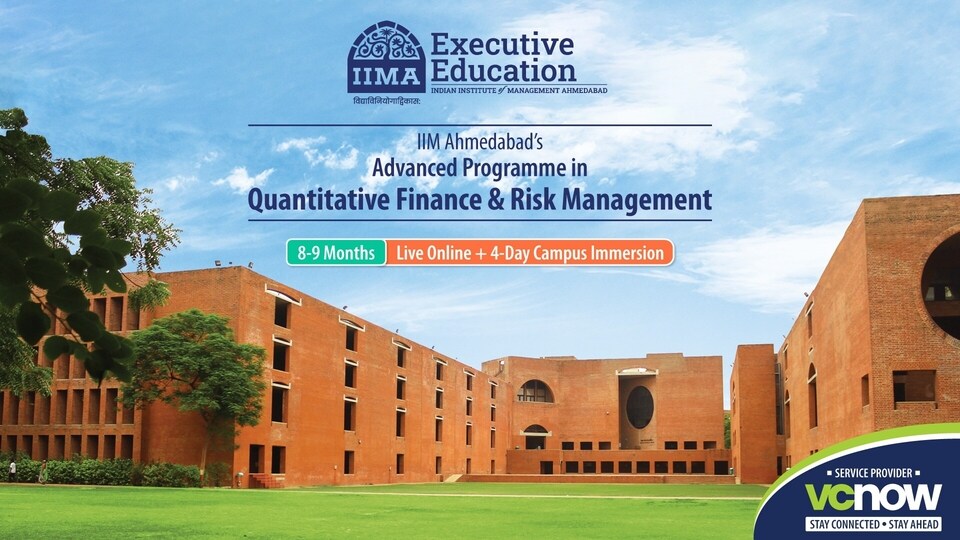
APQFRM runs for over eight to nine months in a blended format, with live online sessions facilitated by the service provider, VCnow, and campus modules at IIM Ahmedabad. Participants engage through lectures, case discussions, assignments, and group projects, along with presentations during the campus immersion period.
The structure is designed for working professionals to build this capability without stepping away from their careers.
The Quant mindset
Quantitative finance is not just about building models; it is about knowing how to use them. As mathematician and quant practitioner Paul Wilmott puts it, “Quants are there to make sense of risk and uncertainty using mathematics.” That means going beyond technical execution to interpreting outcomes, connecting mathematical results with market behaviour, and making informed decisions under uncertainty.
For professionals seeking to develop this capability, the Advanced Programme in Quantitative Finance and Risk Management at IIM Ahmedabad provides a structured path that connects models, markets, and risk in a way that is both rigorous and grounded in practice.
For more details and enrolment in Batch 2, visit the programme’s website.
Disclaimer: This article is part of Hindustan Times' paid consumer connect initiative. The content, created based on inputs by VC Now, is for informational purposes only.


