
 E-Paper



IIM Calcutta’s Advanced Programme in Strategic Leadership Communication: Reframing the language of leadership
Build leadership impact by using communication as a strategic tool to influence, engage and achieve outcomes with a programme designed for senior professionals.

 Prefer HTon Google


Research-Backed Choices
Every product we recommend is chosen through a combination of Primary Research and Secondary Research.
For most senior leaders, the hardest part of the job is no longer deciding what to do. It is to get complex organizations to move, align, commit, change course and act in the face of uncertainty. Strategies fail less often because they are wrong and more often because they are misunderstood, contested, or never truly owned. In boardrooms and leadership teams, outcomes are increasingly shaped not by authority or intent, but by how decisions are framed, how trade-offs are argued, how dissent is handled and how meaning is constructed across stakeholders.
Communication has quietly become the operating system of leadership. Not as performance or polish, but as decision architecture, the way leaders design understanding, sequence choices, build coalitions and convert direction into coordinated action.
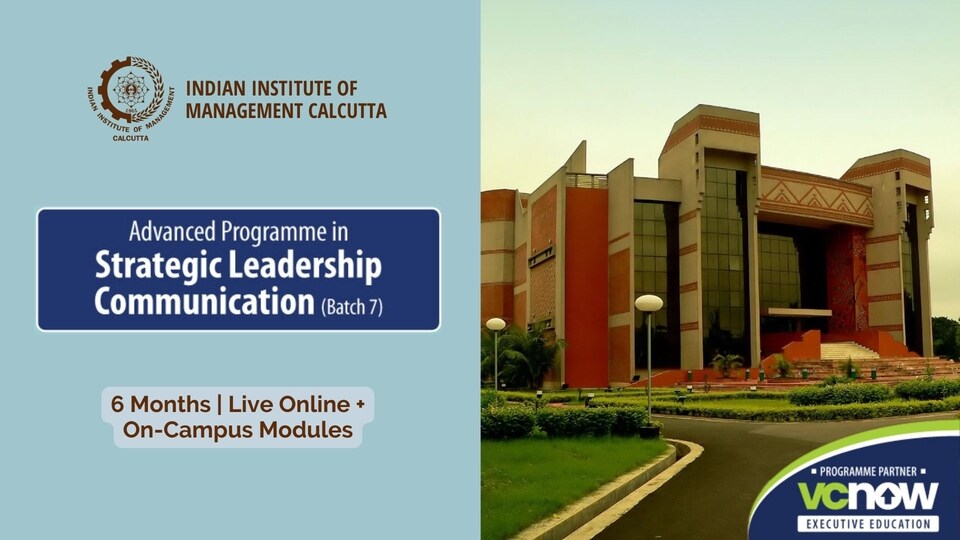
This is the context in which the Advanced Programme in Strategic Leadership Communication (APSLC) at IIM Calcutta takes shape. Designed for senior professionals (5+ years of experience) and delivered in association with the programme partner VCnow, the six-month programme does not treat communication as expression. It treats it as infrastructure, a strategic system that leaders use to influence outcomes across complexity, conflict, data, digital channels and increasingly, AI-shaped environments.
Apply multidisciplinary frameworks to leadership communication
Experienced leaders communicate all the time. But experience often breeds intuition rather than structure. One of the most consistent shifts participants describe is moving from instinctive messaging to deliberate design.
Batch 4 participant, Sam B., Co-Founder, Creator Engine, a creative media professional with over 14 years of experience across post-production for brands like Netflix and Disney+ Hotstar, puts it simply: “What changed for me was learning to break communication down into frameworks. Instead of relying on instinct, I now have a structure I can apply, whether it’s conflict in a team, public speaking, or feedback conversations.” He points to the programme’s heavy use of cases and applied work as the turning point: “I had never seen communication pulled apart this way and rebuilt into something you can actually use, again and again.”
That architectural approach runs through the programme’s multidisciplinary curriculum, drawing on behavioural economics, law, psychology, humanities, marketing, corporate communication, analytics and digital media. Participants learn to view communication not as a single act, but as a system: context, stakeholders, incentives, timing, medium, narrative, evidence and follow-through. The result is repeatability, being able to construct influence deliberately rather than hope it emerges.

Design leadership influence through communication
Senior leaders rarely struggle to be heard. They struggle to shape decisions, especially when interests diverge; uncertainty is high, or authority is diffusing. Here, persuasion is not about rhetoric; it is about architecture: how choices are presented, how trade-offs are surfaced and how coalitions are built.
Ganesh Pai, who runs a consulting firm (Finnosights Consulting LLP) and brings 18 years of corporate experience, frames his biggest takeaway from the programme around alignment. “The real shift for me was learning to align every message with the stakeholder’s perspective, purpose and business outcome. Communication stops being about delivery and starts being about design.” He describes the programme as giving him “a new toolkit and a new lens”, one that he now applies both personally and at the firm level.
This is where ideas like behavioural economics and advocacy frameworks become practical leadership tools. Participants work on how to construct arguments, how to sequence conversations and how to build support before decisions are even formally tabled.
Build credibility through narrative and data
In complex organizations, data is abundant and attention is scarce. Leaders are expected to be rigorous and persuasive at the same time, to move between evidence and meaning without losing either. The programme’s focus on narrative, storytelling and data-driven communication reflects a simple reality: facts do not travel on their own. They need structure, context and relevance to decision-makers.
Participants work on building contemporary leadership narratives, how to connect strategy to reality, how to present data as a case for action and how to maintain credibility when the message is difficult. This includes studying great communicators, dissecting arguments and practicing how to make complex ideas legible without diluting them.
Batch 4 Participant, Kranti Khanolkar Sety, Senior President & Group Head - Human Resources (People & Culture) at Svatantra Microfin Pvt. Ltd., captures the shift succinctly: “When you communicate, there are many things you’re unaware of, especially how your audience is actually hearing you. The frameworks helped me move from speaking to designing how messages land.”

Navigate conflict and dissent as a leader
If influence is the architecture of movement, conflict is the stress test. Modern leaders operate across functions, cultures and competing priorities. Disagreement is not a failure mode; it is the terrain. The question is whether it becomes destructive friction or productive progress.
APSLC treats conflict, negotiation and dissent as core leadership work, not as interpersonal side quests. Participants learn to structure difficult conversations, argue positions with credibility and keep decisions moving even when consensus is impossible. The focus is on process as much as on outcome: how to surface differences, how to preserve relationships and how to close decisions without eroding trust.
Another participant, Deepak Ranjan, Product Head at JSW Steel, reflects the shift as a move from instinct to intent. The programme, he says, helped him “sharpen my negotiation and argumentation, learn to nudge more deliberately and become more effective in cross-cultural corporate environments,” capabilities that matter most when leaders are working through disagreement rather than around it.
This is where the programme’s legal and negotiation frameworks intersect with organizational realities. Leaders practice advocacy, rebuttal and resolution in high-stakes contexts because, in real organizations, strategy is often decided in rooms where interests collide rather than align.

Lead through digital and AI-shaped communication
Leadership communication no longer lives in a single room or a single medium. It is fragmented across platforms, accelerated by digital channels and increasingly shaped by generative technologies. The programme’s attention to digital communication, analytics and AI reflects a pragmatic question: how does leadership influence change when messages are mediated, remixed and sometimes automated?
Participants explore how visual communication, transmedia storytelling and analytics shape perception and how tools like generative AI alter both speed and scale. The point is not novelty. It is governance: understanding how to maintain clarity, coherence and ethical influence in environments where messages travel faster than meaning.
Treat communication as a leadership discipline
What ties these strands together is a single premise: leadership communication is not a collection of techniques. It is a discipline that sits at the intersection of strategy, psychology, data, culture and technology. The programme’s pedagogy, modern curriculum and executive-friendly structure, faculty-led live online sessions and two campus immersions at IIM Calcutta reflect that ambition.
For participants, the outcome is not just improved delivery. It is a different way of thinking about leadership communication itself. As Ganesh Pai notes, “This programme doesn’t just change how you communicate. It changes how you think about decisions, stakeholders and outcomes.”
And that may be the most important shift APSLC seeks to make, from seeing communication as an act to treating it as the architecture of leadership itself.
For details and enrollment in batch 7, visit the programme website.
This article is part of Hindustan Times' paid consumer connect initiative. The content, created based on inputs by VC Now, is for informational purposes only.


