
 E-Paper



Convocation 2025: Manav Rachna Students Step Forward in India’s Amrit Kaal
At Manav Rachna's convocation, Union Minister J.P. Nadda urged graduates to embrace their future roles in shaping India's transformation.

 Prefer HTon Google


India’s aspiration to reach developed-nation status by 2047 is often discussed in terms of long-term planning and institutional growth. But at the Joint Convocation of Manav Rachna University and Manav Rachna International Institute of Research and Studies, the focus was on the country’s current phase of transformation and the role of the Class of 2025 in contributing to that progress.
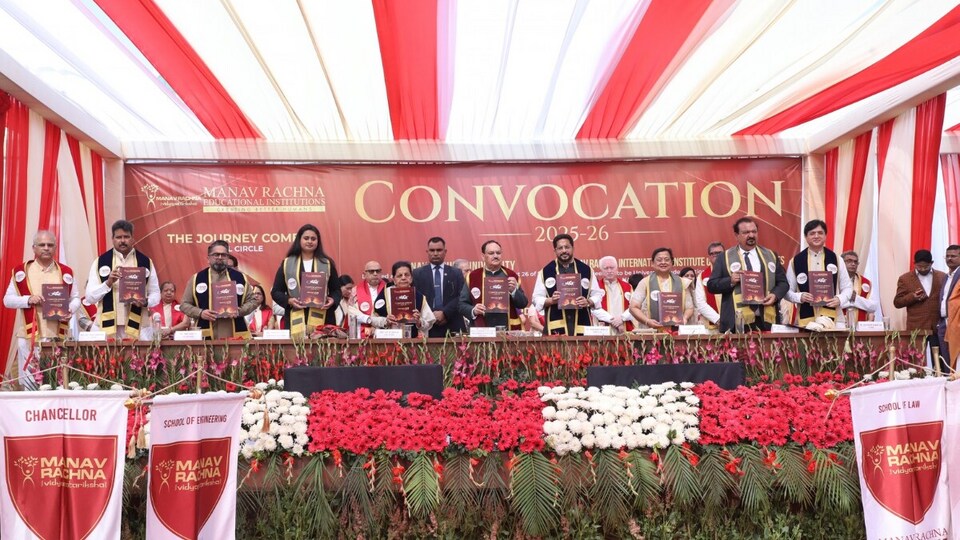
Addressing 2,150 graduates, Union Minister for Health and Family Welfare and Chemicals and Fertilisers, J. P. Nadda, emphasised that the coming decades will belong to those entering professional life now. “The next 25 years belong to you. This is a great opportunity, but also a great responsibility,” he said, particularly in sectors that directly influence quality of life and institutional strength.
The Years Ahead
For the generation graduating today, the future represents a long horizon within which careers, research and enterprises will develop. The transformation of healthcare, science, technology and industry will depend not only on policy direction but on skilled professionals capable of execution and innovation.
In his address, Nadda referenced measurable shifts in public health indicators over the past decade: institutional deliveries rising from 78 percent to 89 percent; maternal and infant mortality declining at rates nearly three times faster than the global average; tuberculosis and malaria reduction outperforming global trends even as detection improved. Out-of-pocket healthcare expenditure has fallen from 62 percent to 39.4 percent, expanding access through important initiatives. These figures form part of the environment into which today’s graduates are entering, one where systems are evolving and demand technical expertise and ethical leadership.
He also noted the expansion of higher education capacity over the past eleven years, with the number of AIIMS increasing from six to twenty-three; IITs to thirty-three; IIMs to over twenty institutions built to global standards. Such developments expand access and research capability. However, institutions alone do not determine outcomes. Graduates do.
“Change will not come on its own,” he said. “You must lead this change.”
From Education to Application
Convocation marks academic completion but more significantly, it marks transition. At Manav Rachna, the Chief Guest reflected on the institution’s name, observing that education must extend beyond knowledge acquisition to the shaping of individuals grounded in values and social awareness.
Dr. Prashant Bhalla, President of Manav Rachna Educational Institutions, described the ceremony as a public acknowledgment that graduates are ready to accept greater responsibility. The transition from campus to professional life, he noted, requires resilience, clarity and ethical judgment.
Dr. Amit Bhalla, Vice President of Manav Rachna Educational Institutions, reinforced that graduation signals the beginning of continuous learning. In a rapidly changing professional landscape, adaptability, discipline and principled action remain essential.
Achievement and Responsibility
The conferral of honorary doctorates on leaders from diplomacy, medicine, governance and the judiciary reinforced the institution’s emphasis on service and impact.
H.E. Dr Ian Borg, Deputy Prime Minister and Minister for Foreign Affairs and Tourism of Malta, was recognised for contributions to global diplomacy. Shreyasi Singh, Minister of Sports and Information Technology in the Government of Bihar, who is also an alumna of Manav Rachna, Olympian, Commonwealth Games Gold Medalist and an Arjuna Awardee, was honoured for excellence in sports and leadership in youth and public life. Justice Gita Mittal, former Chief Justice of the High Court of Jammu and Kashmir, was recognised for strengthening jurisprudence and access to justice. Dr. Anil Kumar J. Nayak, National President of the Indian Medical Association, was acknowledged for advancing medical practice and education.
Each career represented a reminder that influence carries obligation.
A Transfer of Trust
There were first-generation graduates, doctoral researchers, families and faculty members marking a collective milestone. Convocation represents a transfer of trust: from institution to graduate, from structured learning to independent action.
The coming decades will demand innovation aligned with sustainability, competitiveness balanced by ethics, and ambition supported by discipline. Universities prepare students for that complexity; graduates must navigate it.
The Class of 2025 leaves campus with qualifications in hand. What follows will be defined not by rhetoric, but by application: in laboratories, boardrooms, clinics, courtrooms and classrooms.
The work ahead is not abstract. It begins with individual choices, sustained effort and responsible leadership.


