
 E-Paper



Robotics with a Soul: Inside Vidyashilp University’s Hands-on Learning Approach
Vidyashilp University in Bengaluru pioneers early innovation via its VURA framework, giving students lifetime ownership of impactful, long-term projects.

 Prefer HTon Google


In an Indian higher education system traditionally defined by delayed exposure to real-world problem-solving, one university in Bengaluru is quietly building a new norm — where innovation begins not at the end of a degree, but from day one.
A Model With Global Parallels - Such long-term, student-owned innovation ecosystems are rare in Indian academia but have become a benchmark in some global universities. At Yale, the First-Year Summer Research Fellowship enables students to join labs and research groups in their very first year. At Princeton, students participate in the Scholars Institute Fellows Program which anchors them in real-world research throughout their undergraduate life. Harvard’s Innovation Labs and the multi-year engineering capstones at MIT similarly foster continuity, mentorship, and early immersion.
Vidyashilp’s VURA framework echoes these structures — marking what could be the beginning of India’s own version of early-start, mission-oriented undergraduate research and innovation. Unlike most models where student projects are short-term or evaluation-driven, Vidyashilp has designed a system where learners inherit, evolve, and scale existing innovations — building a culture of long-term ownership.
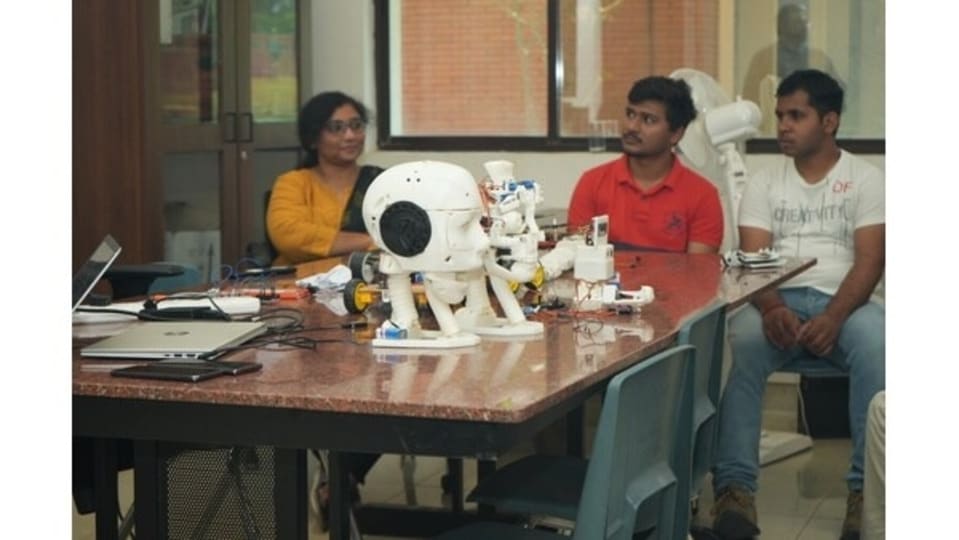
At the heart of this approach lies VURA — Vidyashilp University Robotic Automation — a homegrown learning platform that now supports multiple socially relevant robotics projects. Since its inception in 2021, VURA has evolved into a springboard for several ambitious student-led innovations. The most prominent among them is MEERA — Mindful Empathetic Enduring Robotic Assistance — a humanoid designed to support caregiving in elder care and patient recovery.
“We wanted to create something that doesn't just work, but understands,” said a third-year student on the MEERA team. “That meant teaching the robot to read human emotion, respond with empathy, and assist with real-time tasks.” MEERA is now equipped with a robotic arm, voice-enabled interface, and AI-powered emotional detection — and is scheduled for a physical rollout by the end of July 2025.
Other student innovations under the VURA framework include:
- ISWAR – A Wadget Recognition Robot Automation system for assistive tech use cases.
- LARA – A prototype for Legal Assistant Robot Automation, simulating legal reasoning and case analysis.
These projects are notable not just for their complexity, but for their continuity. MEERA, for instance, began with a first-year design workshop and is now being built across cohorts — each student group advancing the work done by the previous.
“Our professors don’t just guide us,” a student noted. “They sit with us late into the evening — they’re part of the process. It’s more like a collaboration than a class.”
This continuity — where projects evolve semester to semester, not disappear — is what makes the Vidyashilp model unique.
Beyond Engineering: A Broader Pedagogic Vision
Vidyashilp’s emphasis on innovation is not limited to its School of Computational and Data Sciences. With its Design Your Own Degree model and early research cluster formations, the university encourages students from law, psychology, economics, and design to co-create across disciplines. Several of the robotics prototypes integrate insights from behavioural science, ethics, and law — revealing how real-world innovation is inherently interdisciplinary.
“Innovation isn’t just about technology,” says a senior faculty member. “It’s about asking better questions. That means exposing students early to the complexity of human needs.”
This broader vision is supported by faculty who contribute to national education policy consultations, civic tech projects, and cross-sector partnerships. Yet the core remains student-centric — creating learning environments where students are not just knowledge consumers but knowledge producers.
The Stakes — and the Signals
With the higher education sector in India undergoing tectonic shifts — from NEP 2020’s emphasis on flexibility to growing expectations from employers — institutions like Vidyashilp University represent the change of globalisation of education with Indian context, adapting the spirit of international models: trust early, mentor deeply, and build for real life.
“We’re not just building robots,” said a student researcher. “We’re learning how to build things that matter.”
As India inches towards a future shaped by automation, ageing populations, and ethical dilemmas in AI, the relevance of institutions that can blend technology with empathy — and students with purpose — will only grow.
For now, the MEERA robot is nearly ready. But the larger project at Vidyashilp — to turn classrooms into studios of impact — has already begun.
Note to readers: This article is part of HT's paid consumer connect initiative and is independently created by the brand. HT assumes no editorial responsibility for the content, including its accuracy, completeness, or any errors or omissions. Readers are advised to verify all information independently.
Want to get your story featured as above? click here!


