
Sign in

Drone mapping detects unauthorised sand mining in the Aravallis

A team of Gurugram forest, wildlife and technical officials spotted trucks laden with sand leaving Sakatpur and Tikli villages in the Aravallis.

Published on: Jun 17, 2018, 10:54:33 IST
Hindustan Times, Gurugram | By , Gurugram
Share
Share via
  • facebook
  • twitter
  • linkedin
  • whatsapp
Copy link
  • copy link

The Gurugram forest department on Saturday completed the drone mapping of two villages in the first phase to check encroachment or illegal activities in the Aravallis.
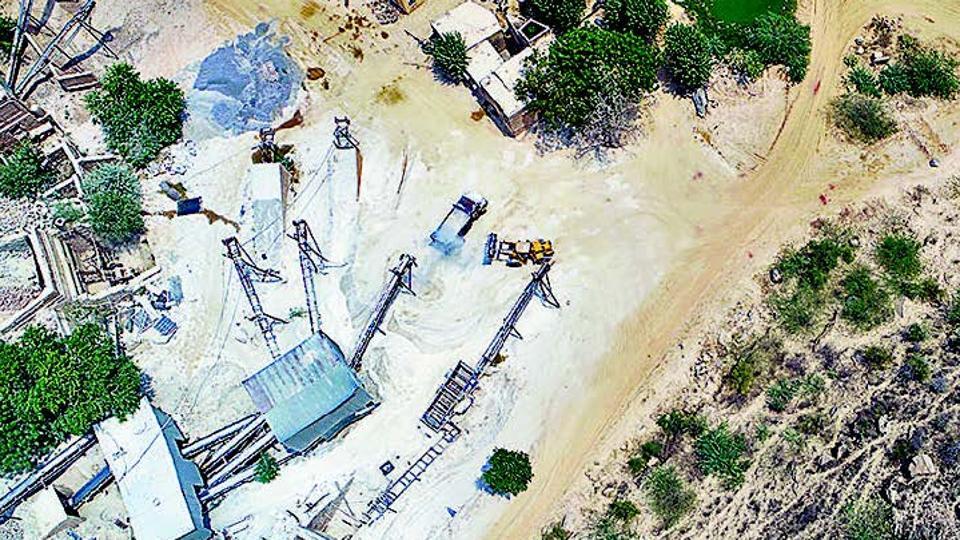
The first phase of drone mapping began in the Aravallis on Friday. (HT Photo)

During the mapping process, which started on Friday morning, a team of forest, wildlife and technical officials, detected illegal sand mining in Sakatpur and Tikli villages.

Trucks, laden with sand, were spotted leaving these villages on Saturday morning, a forest official said. Before the mapping teams could get hold of the sand miners, they drove away, the official added.

“The mining surveillance system enables us to get a satellite view of quarrying sites and any illegal activity taking place in the Aravallis. We have formed teams to keep vigil, especially during the night. If any person is found to be indulging in any illegal activity, strict action will be taken. We can also file a criminal case as the recordings from the drones will be used as evidence against them,” Vinod Kumar, additional principal chief conservator of forest, Gurugram, said.

The officials have also decided to set up more teams to check the low line area where there is an urgent need to build more water pits for the local wildlife. A low line area is referred to as one where there is a scarcity of water and the pits need to be filled in time, so that animals don’t stray into civilian areas in search of water, Kumar said.

After the mapping was completed at 4pm on Saturday, a list of more than 10 natural pits that need attention was prepared. The department has also started constructing new water-holes in the Aravallis and the work will get over by the end of July, an official said.

Besides Tikli and Sakatpur, Raisina, Gairatpur Bas and Roj Ka Gujjar will also be mapped. The mapping process for five villages will take nearly a month, after which the officials will analyse the data and a report will be sent to the forest minister.

Third eye on the Aravallis
DRONE SURVEY WILL HELP IN
  • High-resolution mapping of the forested terrain
  • Making 3D models of the forest and wildlife
  • Gathering information on the terrain and vegetation
  • Gathering data on the state of the forest
  • Tracking encroachments, if any
  • Gathering details on the local wildlife in a bid to enable officials to draw up a forest management plan
  • Helping develop decision support systems
  • Capturing pictures and videos, which are better than satellite images, and can be used for making a 3D model of the area
  • Taking high quality images of the terrain
DRONE SURVEILLANCE WILL HELP IN
  • Giving officials more clarity on the distribution of vegetation and wildlife in the area
  • Tracking traps laid by poachers, if any
  • Determining the extent of water scarcity
  • Tracking water pits
  • Mounting rescue operations
WHAT THE DRONE CAPTURED
  • On Saturday, the drone captured images of unauthorised sand mining in two villages of the Aravallis
  • Two trucks, laden with sand, were seen leaving these villages
  • The drone took images of unauthorised construction work in the Herbal park
KNOW THE DRONES
  • They can fly up to a height of 250 metres at a speed of more than 60 metres per hour.
  • Both are equipped with night-vision cameras
  • They are fitted with thermal and high-definition cameras

The two villages were selected in the first phase, as these have massive forest cover which is rich in wildlife.

According to the officials, the department is hopeful that the mapping will eventually help bring down incidents of man-animal conflict in these villages, as the animals will get sufficient water in their habitat and won’t need to stray into villages.

“Drone mapping is a great tool to assess the forest cover, water points and land use changes in high-resolution images. The mapping of Tikli will help us plan the layout of the proposed herbal garden. While survey mapping of Sakatpur will provide us an excellent 3D model of the Aravallis and help us determine its land use. It is an effective tool in identifying unauthorised construction in the prohibited forest area,” Kumar said.

In May, the department had bought two drones for monitoring wildlife, mapping forests and spotting and preventing non-forest activities in the Aravallis.

They were bought after green activists raised concerns over rising environmental violations in the Aravallis. In the last six months, nine cases of tree felling and illegal construction have been reported in the Aravallis.

Last month, following a petition seeking directions to ban construction in the Aravallis , the Punjab and Haryana High Court sent notices to the Union ministry of environment, forest and climate change and the Haryana government for violating the provisions of the Aravalli notification as well as several Supreme Court orders.

Officials said rampant tree felling has been taking place in the Aravallis for the last six months and with the help of drones, those indulging in such illegal activities will be caught red-handed.

The drones are fitted with thermal and high-definition cameras and are also equipped with nightvision cameras. They can fly up to a height 250 metres at a speed of more than 60 metres per hour.

  • Leena Dhankhar
    ABOUT THE AUTHOR
    Leena Dhankhar

    Leena Dhankhar is Senior Editor and Bureau Chief, Gurugram, at Hindustan Times, where she has spent over 17 years chronicling the transformation of one of India's fastest-growing urban regions. From starting her career as a crime reporter to leading the Gurugram bureau, her journalism has been defined by investigative reporting, in-depth storytelling and an unwavering focus on public interest. Over nearly two decades, she has reported extensively across crime, politics, civic governance, elections, real estate, environment, courts, sports, education and entertainment, covering Gurugram, Faridabad, Nuh and Palwal. Her reporting has exposed several major scams and systemic failures, including insurance frauds, waste management irregularities, illegal arms manufacturing units in Nuh, illegal mining in the Aravallis, organised crime networks and governance lapses affecting millions of residents. Known for her investigative work and exclusive stories, Leena has reported on high-impact national issues, including the Nicaragua charter flight carrying Indian migrants that was turned back amid allegations of human trafficking, exposing the growing network of illegal immigration rackets. Her work has also focused on gang wars, prison administration, juvenile crime, women and child protection systems, the functioning of the Juvenile Justice Board and Child Welfare Committee, and environmental challenges such as pollution, waterlogging and deteriorating civic infrastructure. Beyond hard news, Leena has extensively documented Haryana's rich heritage, forests and wildlife, bringing attention to the state's historical landmarks, biodiversity, conservation efforts and ecological challenges through immersive reportage and feature writing. Her journalism has consistently gone beyond breaking news. She has documented Gurugram's rapid urbanisation through long-form narratives and enterprise reporting on issues ranging from pothole-ridden roads, flooding and waste management to the changing social fabric of India's Millennium City. She also writes widely read feature columns, including The Outsider, Changemaker, and Concern for Gurugram, profiling people, places and ideas shaping the city's identity. Leena is the author of Gurugram School Murder, published by Juggernaut Books, a deeply reported account of one of India's most high-profile school murder investigations. She is currently working on her second book, an investigative work exploring some of India's most significant scams and fraud investigations. Beyond print journalism, she has expanded her storytelling through public speaking and digital media. She is a TEDx speaker and has produced podcasts exploring Gurugram's transformation, civic challenges and untold stories. Her work reflects a commitment to narrative journalism that combines rigorous reporting with compelling storytelling. A law graduate with an MBA in Human Resources, Leena brings a multidisciplinary perspective to her reporting, particularly on governance, public policy and legal affairs. She has travelled extensively across India to pursue investigative assignments, often reporting from remote locations and conflict-prone areas in search of stories that matter.Read More