
 E-Paper



Meet the man who tells tales of Farrukhnagar, the historically-rich Haryana town
Raj Kanwar Gupta, the 79-year-old retired school teacher, is a resident of Farrukhnagar in Harayana. He is the go-to person for anyone and everyone who takes the slightest interest in the town’s history.

 Prefer HTon Google


If you were to visit the heritage sites in the historically-rich town of Farrukhnagar, an old man with a fringe of grey hair around his balding scalp, a slightly hunched back, and a slow gait might catch your attention. For the past ten years, 79-year-old Raj Kanwar Gupta, a retired school teacher, visits these monuments almost daily. A heritage enthusiast, Gupta is the go-to person for anyone and everyone who takes the slightest interest in the history of the octagonally enclosed town of Farrukhnagar. Peppered with historical structures such as the Shish Mahal and Dilli Darwaja that go back at least 300 years, Farrukhnagar is an important contributor to the pool of heritage sites within the ambit of Gurugram district.
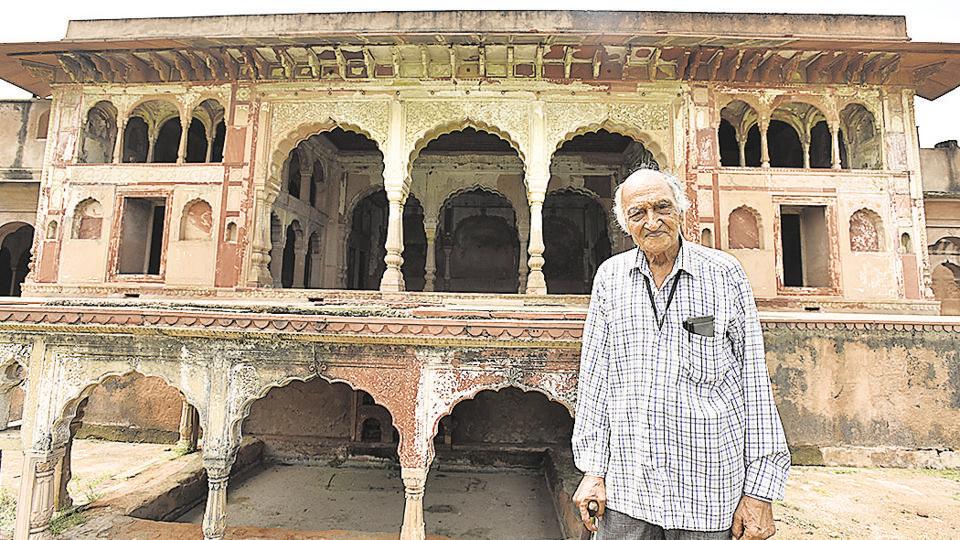
Gupta, for all practical purposes, can easily qualify as the heritage man of Farrukhnagar. He is the one person people can bank on for getting the doors of the Shish Mahal opened. Schools and universities often approach him to act as a guide for tourists visiting the area. Armed with a personal diary and a stick for support, Gupta is a walking repository of the town’s history.
“Around 300 years ago, the land around Farrukhnagar used to be rich in salt. A place without any electricity, roads or facilities was naturally producing salt back in those days,” Gupta enthusiastically tells visitors.
Gupta is not a qualified historian but grew up listening to the stories of the kings and queens that once lived. His childhood years of growing amid these monuments fuelled a sense of inquisitiveness in him. Later on, a chance encounter with a heritage experts’ team gave him an opportunity to get associated with the heritage body Indian National Trust for Art and Cultural Heritage.
“Around ten years ago, there was an event here to mark the renovation of the Dilli Gate. A team of experts was visiting the area. I went up to them and enquired if I could get involved in preserving the history of my land. Seeing my enthusiasm, they readily said yes. I filled the form, made a small payment, and today I am a lifelong member of the heritage body, INTACH,” Gupta said.
Heritage experts also swear by his name. Parul Munjal, associate professor, Sushant School of Art and Architecture, said that Gupta played the role of a universal host for Farrukhnagar. “He is always inviting people to explore the region and makes lifelong connections with them. The stories about Farrukhnagar’s salt manufacturing history and so many others are essentially alive because of him. He is a valuable asset to Farrukhnagar,” Munjal added.
Gupta taught art and crafts to children in class 6-10 in the government senior secondary school for 20 years before retiring in 1995. Retirement from service, however, didn’t deter him from doing what he loves most — teaching. “I always had an interest in history and teaching. Sharing knowledge with others excites me even today. It brings me great joy to know that people have fond recollections about me whenever they talk about Farrukhnagar. Even after retirement, I have made myself available to serve the people,” Gupta said.
Gupta runs a small shop near the Shish Mahal where he has preserved memorabilia associated with the town’s history. Old maps, photographs, and paintings adorn the walls of his shop where he spends a few hours daily.
Alluding to his old age, Gupta says that he has few years of service left. “I don’t have much time left now but I will continue to do whatever little I can do. People may not remember me once I die but, at least, they would think of me when they want to know about the history of this town. I want the stories of Farrukhnagar to outlive me,” he said.
Earlier last month, Hindustan Times had done a story outlining the poor state of heritage structures in Farrukhnagar. Damaged by the vagaries of time and human apathy, remnants of history in the town are gradually perishing. In such a scenario, Gupta’s role as a chronicler of the town’s lore assumes significance. For many first-time visitors, Gupta is the one ensuring that their visit doesn’t turn out to be a dampener. He is the one people bank on for getting the doors of Shish Mahal opened, which otherwise remains locked by the caretaker from the Department of Archaeology and Museums.
“The caretakers hardly know anything. They simply call me and ask me to come whenever there are visitors. I don’t mind since I want people to keep coming back here. I am always ready to serve people and share whatever little I can,” Gupta said.


