
 E-Paper



Tobacco kills half its users: Tips on quitting smoking


France has announced plans to introduce plain packaging of cigarettes as part of tough anti-smoking laws. Tobacco use in India is higher than France (31%), with 34.6% adults here using some form of tobacco. India too has introduced graphic warnings on tobacco packages, but how effective are they?
France announced plans to introduce plain packaging of cigarettes as part of tough anti-smoking laws aimed to lower smoking in the country where people love their tobacco almost as much as their wine -- 31% adults smoke in France.
Also read: Why quitting smoking is harder for some
Plain packaging will result in all cigarette and tobacco packages looking exactly the same. They will be of the same size and colour with the brand name written in small, standardised lettering under a graphic health warning, which is a grim reminder of the many horrible ways in which tobacco will slowly and surely kill its users.
No logos or brand advertising will be allowed on the packs, which will also put an end to tobacco industry's surrogate advertising using symbols and associations, such as the Marlboro Man, Joe Camel and Benson & Hedges' signature ampersand, among others. France is also banning smoking in cars with children under the age of 12, smoking in areas frequented by children, and advertising for electronic cigarettes.
Also read: Why passive smoking is worse than smoking
France’s Health Minister Marisol Touraine said her anti-smoking plan, to be introduced in stages over two years, aims to bring down the number of smokers by 10% by 2019 and make children born today the country's first ‘non-smoking’ generation in 20 years.
With 31% of adults smoking daily, France has among the highest smoking rates in Europe, compared to 14% in the UK and 24% in Germany. UK, Ireland and New Zealand, too, are planning to ban branded cigarette packages.
Smoking down, Down Under
The tobacco industry is predictably outraged and insists that plain-packaging makes no difference to smoking rates. Some companies claim it has actually pushed up cigarette smuggling and sale of cheaper, contraband cigarettes.
Data from Australia, which became the the first country in the world to introduce plain packaging in 2012, proves them wrong. Australia recorded its sharpest ever fall in tobacco use, with daily smoking rate plunging from 15.1% to 12.8% between 2010 and 2013, shows data from National Drugs Strategy Household Survey released earlier this year.

The real reason tobacco companies are worried is that plain-packaging hits them where it hurts most -- it keeps new smokers away.
Australia found tough packaging measures and advertising bans resulted in children delaying starting smoking, with the age of initiation -- when children first smoke their full cigarette and get hooked to smoking -- going up from 14.2 years to 15.9 years in 2013.
Also read: For pretty lips quit smoking
Even better was the news that 95% 12-17 year olds had never smoked and the proportion of 18–24 year olds who had never smoked rose from 72% to 77% between 2010 and 2013. With only 3.7% of adults in homes with children reporting smoking indoors in 2013, down from 31% in 1995, far fewer children were being exposed to secondhand smoke.
India's chewing challenge
Tobacco use in India is higher than France, with 34.6% adults in India using some form of tobacco. Roughly one in seven adults (14%) smoke, with far more men (24.3%) smoking than women (2.9%), found data from the Global Adult Tobacco Survey 2010, the most comprehensible survey yet on tobacco use in India.
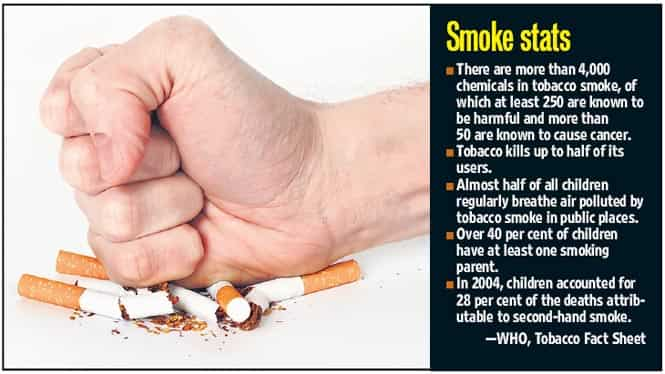
Tobacco is the only legal product that kills if used as directed, killing one person every six seconds, says World Health Organisation (WHO).
One million of the world's 6 million tobacco deaths occur in India, with up to half of current users eventually dying of one of a tobacco-related disease, such as cancers, lung disease, heart disease and stroke, among others.

India has introduced graphic warnings on tobacco packages, banned smoking in public places, sale of smokeless products containing tobacco and nicotine, and restricted tobacco use in popular media, but more needs to be done to prevent addiction among the young.
Increasing the age of buying tobacco from 18 years will have little effect in a country where children manufacture and sell tobacco products in the informal sector.
Also read: People who work longer smoke more, finds research
What work better are plain packaging with graphic warnings, raising taxes, advertising bans that include online and surrogate advertising, and offering cessation services to people who want to quit use. Introducing taxes that increases tobacco prices by 10%, for example, lowers use by about 5% in low- and middle-income countries, says the WHO.
Given India's quasi-federal structure, how effectively states implement the law remains crucial. But it's up to the Centre have adopt tobacco-control measures to give the states the tools to save lives.

Catch your daily dose of Fashion, Taylor Swift, Health, Festivals, Travel, Relationship, Recipe and all the other Latest Lifestyle News on Hindustan Times Website and APPs.


