
 E-Paper



An obscure Chinese company just listed in Shanghai: It’s a story about AI and your eye-watering gadget bill
An AI-fuelled memory shortage has sent gadget prices soaring. CXMT’s 470% debut surge is a bet it isn't ending soon.

 Prefer HTon Google


ChangXin Memory Technologies (CXMT) listed on Shanghai’s STAR Market on Monday, in what was Asia’s biggest initial public offering (IPO) of 2026.
The Hefei-based company raised 57.9 billion yuan (roughly $8.6 billion), pricing shares at 8.66 yuan apiece. Shares surged 470% within minutes of trading opening, changing hands at 49.50 yuan and briefly making CXMT the most valuable company on China’s stock market — a market capitalisation of 3.3 trillion yuan ($487.31 billion), sharply up from the roughly $85.5 billion valuation implied during the IPO process, even as global tech stocks have been through a recent selloff.
Most in India have likely not heard of CXMT. Fewer still know it makes DRAM — the memory chips packed into every phone, laptop and server on the planet. But the reason this listing matters has nothing to do with the company’s name, and everything to do with why your last gadget upgrade cost more than it used to.
Why memory got scarce
Every AI query — a chatbot response, an image generation, a model being trained — runs through data centre servers that need to move enormous volumes of data in and out of processors at speed. That job falls to memory chips, mainly DRAM (dynamic random-access memory), the chip’s working memory, which holds data actively in use but forgets everything the moment power is cut. NAND flash, the other memory type in the mix, is long-term storage — the same technology behind a phone’s storage capacity, which retains data even when switched off.
As AI infrastructure scaled through 2025 and into 2026, demand for both types exploded. Building a new memory fab (fabrication plant) takes years and billions of dollars, so supply could not follow. Chipmakers did not run out of capacity, though — they redirected it. Samsung, SK Hynix and Micron, who together dominate the world’s DRAM supply, found it more profitable to sell High-Bandwidth Memory (HBM). These are specialised, vertically stacked form of DRAM built for AI accelerators such as Nvidia’s chips — and server-grade memory to data centre operators than ordinary LPDDR (low-power DDR), the DRAM variant built for battery-run devices like phones.
Analysts at intelligence and research firm TrendForce have documented suppliers explicitly prioritising “higher-priced, higher-margin server applications” over consumer-grade production — memory did not disappear, it was reallocated to the highest bidder.
What the numbers show
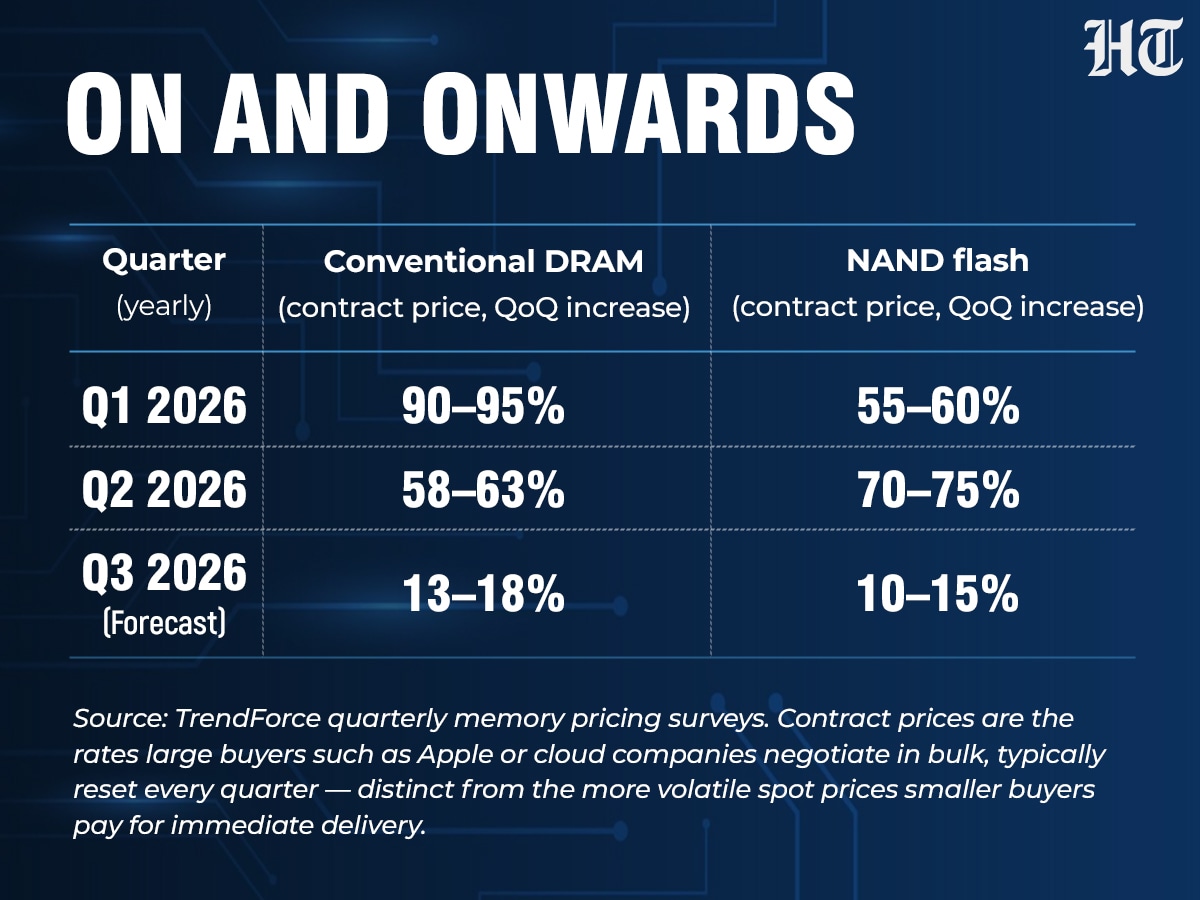
Gartner has projected a 130% year-on-year rise in DRAM prices for 2026 as a whole.
Why CXMT’s listing matters
CXMT is the world’s fourth-largest DRAM maker, with roughly 7.7% of global market share in 2025 — some distance behind Samsung, SK Hynix and Micron, but state-backed and expanding fast. Its listing on the STAR Market — Shanghai’s Nasdaq-equivalent board for tech and science listings, created in 2019 so high-growth Chinese firms could list domestically rather than in Hong Kong or the US — sold A-shares: stock in a mainland Chinese company traded on a mainland exchange, largely restricted to domestic investors. That is why this is described as China’s biggest domestic semiconductor listing since SMIC’s 2020 debut, rather than a global one.
The scale of investor appetite is itself a signal. Retail demand was reported at close to 244 times the shares on offer; institutional bidding topped 500 times. That is a bet that the memory shortage has years left in it, not quarters — CXMT is investing in wafers (the silicon discs chips are etched from) at increasingly advanced process nodes, a reference to the size of the transistor circuitry etched onto each chip, with smaller numbers denoting costlier, more advanced technology.
Some analysts caution the opposite could happen: if CXMT’s new capacity comes online faster than expected, it could ease the very shortage its valuation depends on, potentially unsettling Samsung, SK Hynix and Micron’s pricing power in the process.
There is a nearer-term wrinkle too. Large IPOs in China can trigger what traders call a “cash-drain” effect — investors selling existing stock holdings to free up money to bid for hot new shares, briefly pulling liquidity out of the wider market.
The listing also sits inside the wider US-China chip rivalry. Beijing has spent years trying to cut its dependence on foreign chips, a push that has intensified as the US and its allies have tightened export controls on advanced semiconductors and manufacturing equipment. It’s also what makes CXMT’s debut, in part, a test of whether China can build a competitive domestic producer in a sector still dominated by foreign firms. That same rivalry works against CXMT too: US export restrictions limit its access to advanced chipmaking tools from suppliers such as Dutch lithography maker ASML, making it harder to close the technology gap with its rivals, particularly in HBMs. The US department of defense designated CXMT a “Chinese Military Company” last month, and a US interagency committee had approved adding CXMT to the commerce department’s entity list — a trade blacklist — though that step has not yet been implemented.
Where this lands on your gadget shelf
You can already see it in shop prices. Apple raised prices globally on Mac, iPad and accessories by close to 20%, citing the rising cost of unified memory and storage directly. Microsoft raised Xbox console prices by $100–150 and dropped its highest-capacity storage tier. Dell, HP, Lenovo and Asus have each raised prices or trimmed memory specifications on their machines. Samsung is reported to have raised the LPDDR chip prices it charges Apple by roughly 80% versus a year earlier; SK Hynix’s increase to Apple was said to be closer to 100%.
India felt Apple’s revision more sharply than most markets — the MacBook Pro M5 rose by up to ₹70,000 and iPad Air pricing climbed as much as 42%, with import duty and GST layered on top of the base hike.
None of it traces back to a single company running short of chips. It traces back to a structural shift in where the world’s memory supply goes — and CXMT's listing on Monday is the market placing a very large bet on how long that shift lasts.


