
 E-Paper





Prerna Madan leads the explainers and immersives team at Hindustan Times, bringing more than eight years of editorial experience across India's three largest English-language newsrooms — Hindustan Times, The Times of India and The Indian Express. Her career spans the full range of modern news journalism: digital-first production, print news desks covering metro, national, and front-page, and editorial decision-making at the planning and commissioning stage. From managing coverage of Assembly elections and the Union Budget to steering the reporting, editing and production of in-depth reporting into the Delhi-NCR’s pressing issues, Prerna has honed journalistic storytelling that spans genres, topics and formats. Running through her current work is a facility for complexity — translating consequential, difficult material in the fields of policy, science, environment and politics into rigorous, accessible journalism that sets out to answer two critical questions: why it matters, and what happens now. Prerna holds a degree in English Literature from the University of Delhi and a postgraduate diploma from the Indian Institute of Mass Communication.
The out-of-this-world plan to run AI from orbit, and the down-to-earth physics in its way
SpaceX aims to begin launching first of a million Starmind satellites in 2027, creating an orbital alternative to some Earth-based AI computing.



The US Federal Communications Commission (FCC) on Wednesday cleared SpaceX to launch up to 1 million satellites that would work as data centres in orbit, an ambitious plan that depends on powering AI chips with sunlight and cooling them in a vacuum.
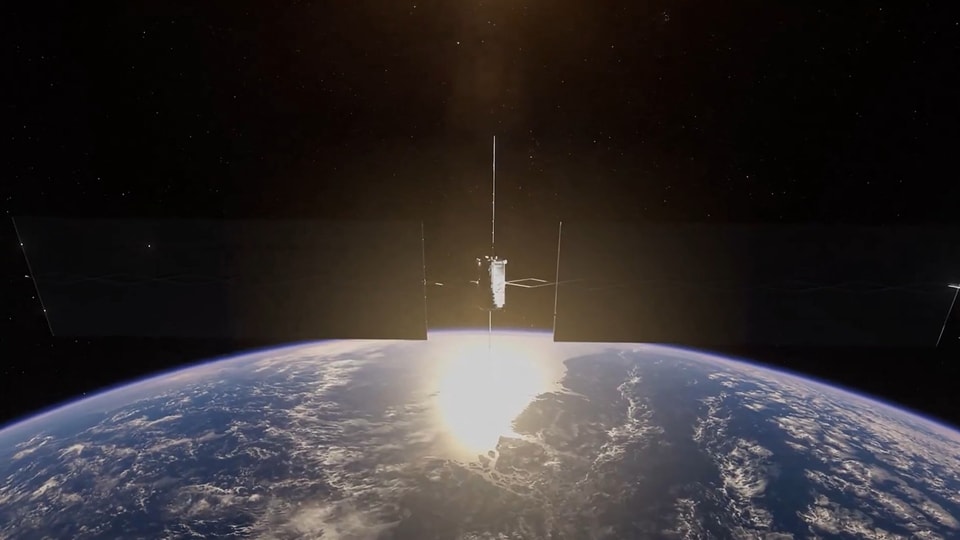
The scale of Starmind, as SpaceX has named the planned constellation, would dwarf everything currently in orbit. About 17,000 satellites are in space today, just 1.7% of the scale being planned. The FCC gave SpaceX until 2040 to launch all of Starmind, with the first satellite due to be working by November 25, 2033.
The regulator did not judge whether such a network can actually work. Some public comments, its order said, sought to put the government's judgment of the business in place of the company's. “We decline to do so,” the FCC said.
The answer depends on physics more than on the licence. Sunlight is plentiful in orbit, which is why SpaceX wants to put computers there. The harder problems are shedding the heat that AI chips would produce in a vacuum, and protecting the chips from radiation. SpaceX has to solve both before Starmind can really work as a data centre.
SpaceX’s filings also reveal the size of its ambition. “Our goal over time is to launch 100 gigawatts of compute to space each year,” the company told US securities regulators ahead of its stock market listing. According to the International Energy Agency (IEA), a large AI data centre on Earth has a capacity of 100 megawatts or more. SpaceX’s goal is the equivalent of about 1,000 of them launched into orbit every year.
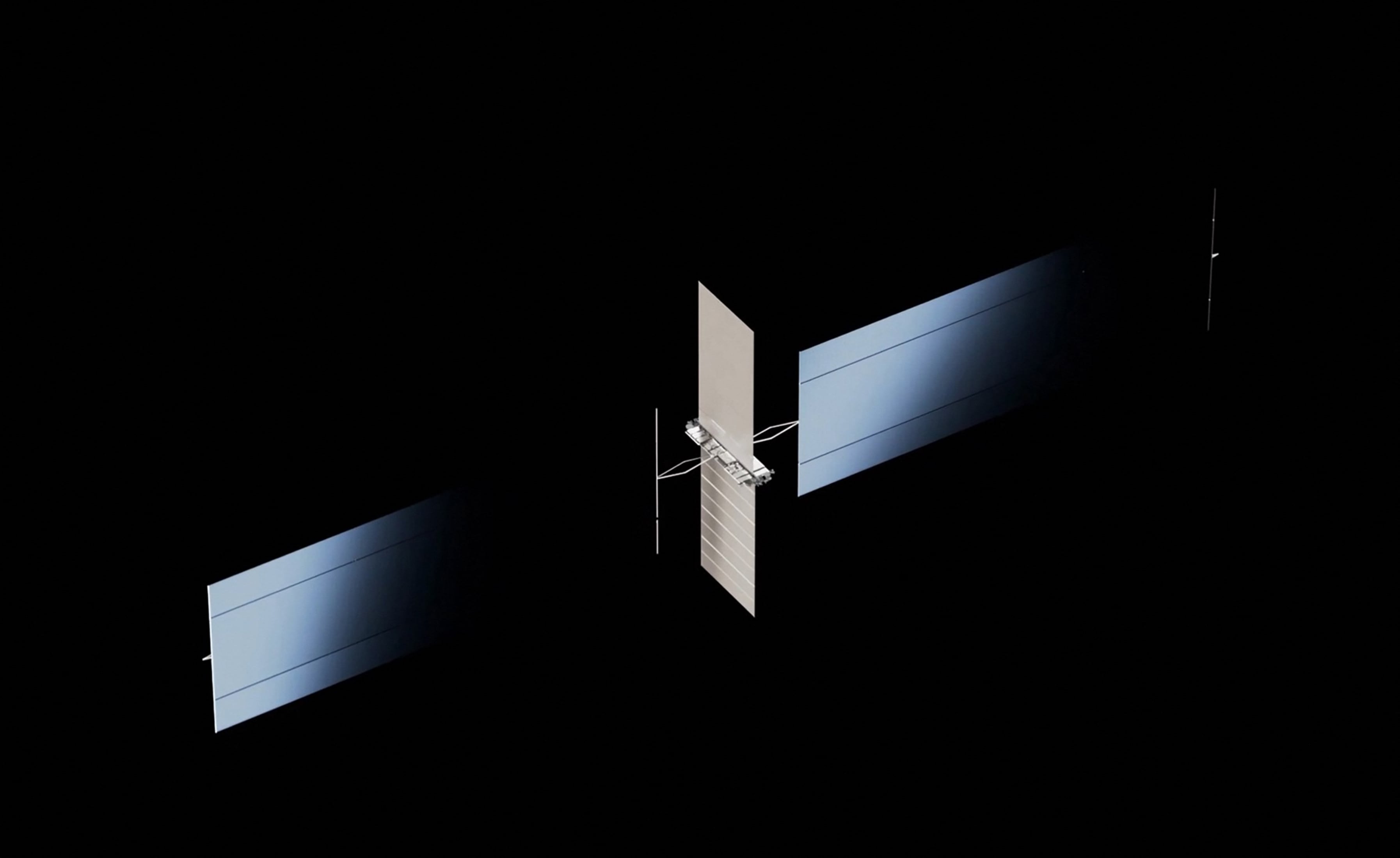
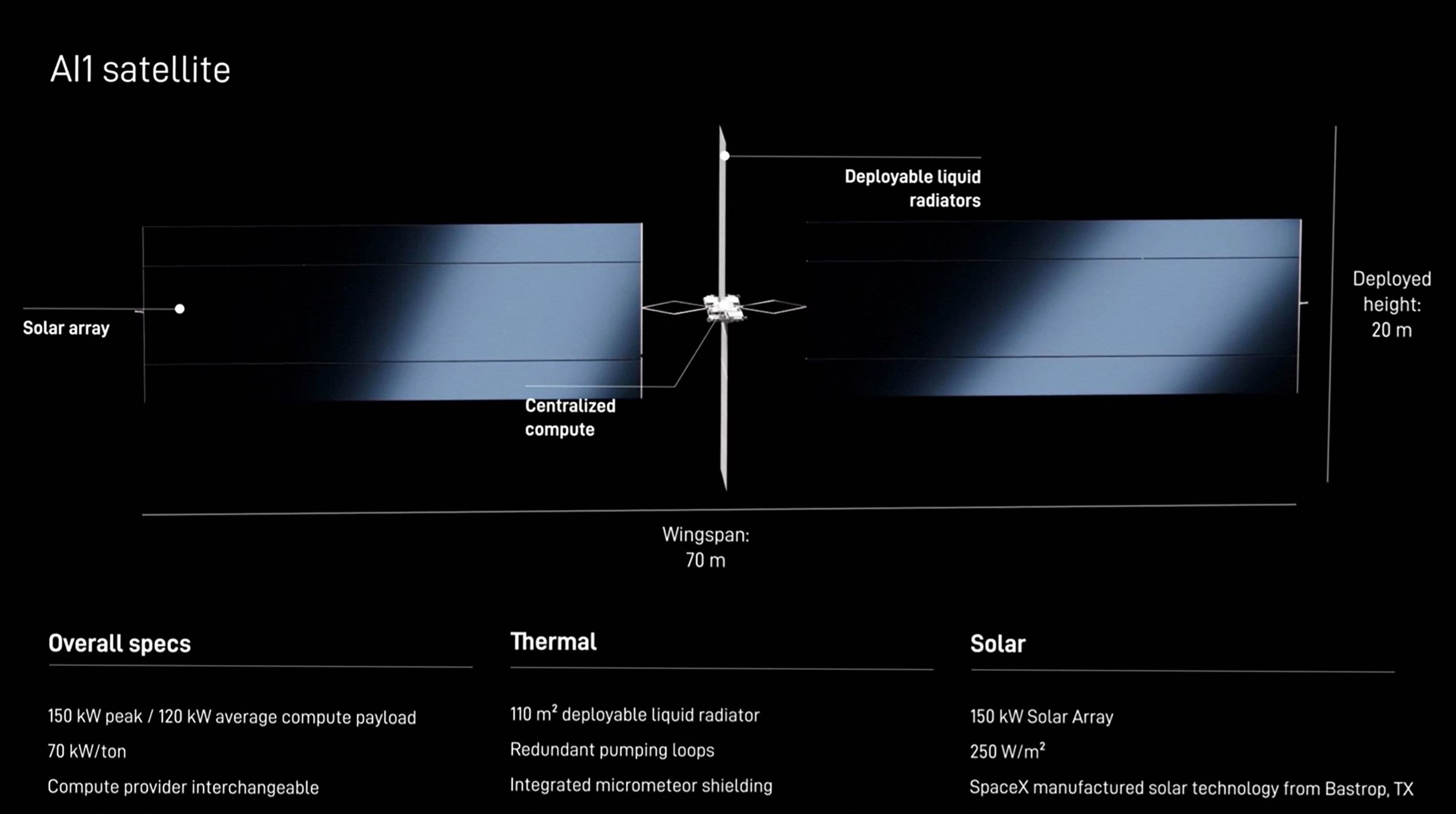
The first Starmind satellite, which SpaceX calls AI1, is designed to run about 120 kilowatts of computing on average, its official website says. So far, companies have only tested single chips in orbit.
Why put a data centre in orbit
SpaceX's case for orbit is about electricity. AI depends on data centres, buildings full of computers that need massive amounts of power. Supporters of orbital data centres argue that capturing the sun's energy in space would ease pressure on power grids and cut demand for the water used to cool those buildings.
SpaceX made the same case for Starmind. "By directly harnessing near-constant solar power with little operating or maintenance costs, these satellites will achieve transformative cost and energy efficiency,” it told the FCC while applying for the licence.
Getting that near-constant sunlight depends on the choice of orbit. SpaceX chose its orbits to “maximise the time during which these satellites can generate solar power", its application to FCC said. Three of Starmind's six orbital bands are sun-synchronous orbits. A satellite in one travels from pole to pole and passes over any given place at the same local time on every trip, according to Nasa.
A satellite in such an orbit can capture solar energy continuously, at eight times the efficiency of a panel on the ground, AFP reported.
Shedding heat
The chips that run on that sunlight give off heat, and getting rid of it is one of the key problems. Data centres on Earth use water to cool their chips. Space is cold, but it is also a vacuum, which traps heat inside objects much as a thermos does.
Nasa’s guide to small spacecraft says heat in a vacuum travels only by radiation and conduction. To be released from a satellite, heat must be radiated from dedicated surfaces called radiators. For a sense of the size involved, the International Space Station (ISS) sheds 70kW of heat through six radiator arrays, each made of eight panels. A single AI1 satellite would have to get rid of the heat from about 120kW of computing, roughly 1.7 times what the stations’ whole system is designed to handle.
SpaceX’s website says heat “radiates freely into the vacuum of space”.
Adam Becker, an astrophysicist and author, told AP there are “basic physical limits” to radiating that heat out. Many smaller satellites could together carry the material needed, he said, but that would be expensive and difficult.
The American Astronomical Society had raised a second problem in its petition to the FCC against such a licence. It argued that the satellites’ wasted heat could raise the infrared glow of the sky and threaten research. The FCC said that was outside the scope of the licence.
Members of the public have also questioned how the satellites would manage their heat, and whether orbital data centres would be less efficient than those on the ground. The FCC treated those doubts as outside its mandate.
Radiation and chips
The ability of the computer chips aboard orbital data centres to withstand high radiation in space is among the technical challenges yet to be resolved.
Most electronic parts are built for use on the ground and are vulnerable in space, according to a Nasa technical bulletin. A single energetic particle, such as a cosmic ray or a proton, can change the state of a chip. Nasa said this was a single-event upset. In computer memory, it can show up as a bit that flips for no apparent reason. A worse strike can destroy a component instantly.
Damage can also build up over time, as radiation deposits energy in a chip's materials. Nasa says shielding and radiation-hardened parts have limited serious damage on its missions.
For Starmind's chips, SpaceX has turned to Nvidia, the US chipmaker. Nvidia said in August that the first Starmind satellites will use a version of its Vera Rubin NVL72, a rack-scale system that is like a cabinet of linked processors built and sold as one machine. Nvidia sells the same kind of hardware for data centres on Earth, and the two companies are adapting it for orbit.
The announcement did not say how the chips would be protected from radiation. SpaceX’s Starmind website does not mention radiation either.
Also read: The rocket science behind Tesla's flying Roadster, and the air thrusters that SpaceX helped build
Back to Earth
Whatever the chips compute then has to reach users on Earth. In theory, Starmind satellites will pass their results by laser to Starlink satellites already in orbit, which will relay them to Earth. Radio is a backup, for use only if the lasers fail, the FCC order said.
Competing networks plan to send data straight to and from Earth by laser, AFP reported.
Launch, repair and replace
All of this hardware also has to reach orbit, and be replaced as it wears out. SpaceX is counting heavily on cheaper launches from Starship, its next-generation reusable rocket, which is still under development, Reuters reported. Its filings say the 100-gigawatt goal would need thousands of launches a year, carrying about a million tonnes to orbit annually.
The company flies its own rockets, which have completed hundreds of missions.
SpaceX told the FCC it would test new satellites in low orbits before raising them higher. Retired satellites, it said, will be steered to re-enter the atmosphere over the ocean, and each of them is designed to burn up completely.
Putting a million satellites in orbit also raises the risk of crashes, Becker warned. “You could end up with a cascading set of space junk collisions,” he told AP. Such crashes could create “a cloud of debris” in low Earth orbit, home to many weather and telecommunication satellites, he said.
Whether SpaceX will launch anything close to a million is disputed.
Amazon Leo, Amazon’s satellite unit and a SpaceX rival, along with others have criticised the plan, suggesting that the Elon Musk-led company was unlikely to deploy all the satellites and could take centuries to do so.
Brendan Carr, the FCC chairman appointed by US President Donald Trump, rejected that stand in March. “Amazon should focus on getting Amazon's house in order with their own launches and their own satellite constellation, rather than worrying about other people that are actually out there launching satellites at the pace and cadence that SpaceX is,” he said.
Also read: With AI, scientists may solve their hardest problems faster than they can understand why
All the plans
Two single-chip tests have been carried out by companies competing with SpaceX. Starcloud, a US startup, operated a GPU, the type of chip used for AI, aboard a satellite in late 2025. Google, which is pursuing its own project under the codename Suncatcher, did the same in October. Blue Origin, Amazon founder Jeff Bezos’s rocket company, has applied to the FCC for a constellation it calls Project Sunrise.
Becker called the prospect of launching a million satellites to create data centres “a fantasy”, adding: “It's not going to happen.”
In August, Musk promised to launch the first satellite in the fourth quarter of 2027, with a ramp-up in 2028. That is six years ahead of the FCC’s deadline.
Currently, though, SpaceX is far from its goal. AI1 delivers 70kW of computing per ton of satellite, according to the company. The 100-gigawatt goal assumes 100kW per ton. Every ton of satellite would have to carry about 40% more computing than AI1 does at the moment.
ABOUT THE AUTHOR
Prakriti Deb is a journalist at Hindustan Times Digital, where she is part of the US Desk. She works on stories related to American politics, crime, sports, entertainment and weather. She particularly enjoys covering political developments that have global ripples. Through her work, she aims to break down complex events in a way that feels simple and understandable. Before joining the Hindustan Times, she worked with The Indian Express Digital, where she covered world affairs. She holds a postgraduate degree in Mass Communication with a specialisation in Journalism, along with a bachelor’s degree in English Literature. Outside the newsroom, Prakriti enjoys travelling and stepping out of her comfort zone. She finds her sense of being through storytelling in all its forms, including conversations, painting, theatre, dance and photography. She appreciates discussions that challenge her perspective and help her see the world a little differently.


