Union health minister JP Nadda reviewed Delhi's swine flu surge with state officials on Friday, as the city's tally for the year touched 1,777 confirmed H1N1 cases and Delhi health minister Pankaj Kumar Singh said hospitals had been placed on alert.
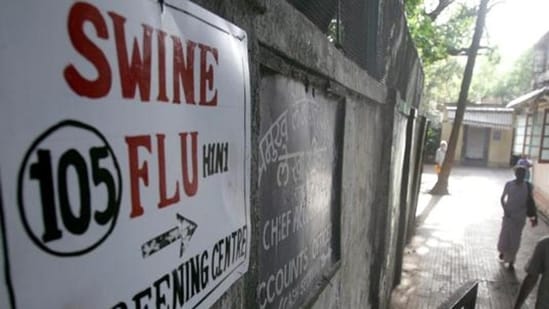
Hours earlier, Aam Aadmi Party's Delhi president Saurabh Bharadwaj described the outbreak as "alarmingly high" and "spreading like corona", saying in a post on X that "once a family member gets it, almost everyone gets sick in turn".
Studies on H1N1 show that transmission dynamics of this virus are less explosive than Sars-CoV-2, which causes Covid-19. Its clinical course is typically mild, and its circulation and vaccination over the years is likely to have built some immunity among populations.
Where the virus came from
The H1N1 virus was first identified in Mexico in early 2009. Writing in Science in July 2009, researchers mapped the virus's genetic makeup and found that it was a patchwork — its genes had, over the previous decades, been circulating separately in pigs in North America, Europe and Asia, in birds, and in humans, before mixing together in a form that had never before been seen in a virus infecting people.
{{/usCountry}}The H1N1 virus was first identified in Mexico in early 2009. Writing in Science in July 2009, researchers mapped the virus's genetic makeup and found that it was a patchwork — its genes had, over the previous decades, been circulating separately in pigs in North America, Europe and Asia, in birds, and in humans, before mixing together in a form that had never before been seen in a virus infecting people.
{{/usCountry}}The name 'swine flu' stuck because most of the virus's eight gene segments were traced to influenza viruses that had been circulating in pig populations for years. Public health agencies later moved away from the label, and the World Health Organization began referring to it as "influenza A(H1N1) 2009", because the virus was spreading directly between people and had no link to pork consumption or contact with pigs.
The WHO declared a pandemic on June 11, 2009, and formally ended the pandemic phase on August 10, 2010. Since then, the virus — designated influenza A(H1N1)pdm09 — has been absorbed into the pool of seasonal influenza A subtypes that circulate globally each year, alongside H3N2 and the B/Victoria lineage of influenza B.
A 2012 study in The Lancet Infectious Diseases estimated that the pandemic strain caused roughly 284,500 respiratory and cardiovascular deaths worldwide in its first twelve months of circulation.
Also read: Why H1N1 cases are rising in Delhi and how to protect yourself?
Transmission: the R0 question
Epidemiologists measure how easily a virus spreads using a figure called R0 — the average number of new people that one infected person will pass the virus on to, in a population where nobody is yet immune.
A 2014 systematic review published in BMC Infectious Diseases by Matthew Biggerstaff and co-authors at the US Centers for Disease Control and Prevention pooled 78 R0 estimates from 57 studies of the 2009 pandemic.
Across those studies, the typical estimate was 1.46, with most falling between 1.30 and 1.70. For seasonal influenza in ordinary years, the same review reported a median R0 of 1.28.
In plain terms, each person infected with the pandemic strain, on average, went on to infect between one and two others. For ordinary seasonal flu, that number is about 1.3. Both are well short of the threshold at which an outbreak doubles its case count in a matter of days.
A June 2009 Science paper by Christophe Fraser and the WHO Rapid Pandemic Assessment Collaboration, working with Mexican outbreak data, had placed the R0 at 1.4 to 1.6.
For ancestral Sars-CoV-2, the R0 is higher.
A 2020 review in The Lancet Infectious Diseases by Eskild Petersen and co-authors placed the Covid R0 at 2.5, with a range of 1.8 to 3.6. Later Omicron subvariants pushed the effective reproduction number higher, with some published estimates approaching 10 in fully susceptible settings.
Two features of influenza nonetheless make it seem as if the outbreaks spread faster. The first is the serial interval — the gap between one person developing symptoms and the person they infect developing symptoms.
For influenza, this typically runs at around three days. For ancestral Sars-CoV-2, it was closer to 5.2 days, according to a 2021 systematic review in BMC Infectious Diseases. A shorter serial interval means each generation of transmission moves through the population faster, so even a lower R0 can produce a steep local rise in cases.
The second is behavioural. Household transmission of influenza is efficient, particularly among school-age children.
Also read: Ludhiana sees fresh swine flu case; surveillance up
Influenza A(H1N1) spreads mainly through respiratory droplets — the small bursts of moisture that people release when they cough, sneeze or talk — and which can be inhaled by anyone within roughly a metre or two, according to WHO and CDC guidance.
Smaller aerosol particles can carry the virus over slightly longer distances indoors, particularly in poorly ventilated rooms, though droplet spread remains the dominant route. Contaminated surfaces play a smaller role: the virus can survive on hard non-porous surfaces such as door handles and phones for up to 24 hours, and a person who touches such a surface and then touches their nose, mouth or eyes can catch the infection. This is why the standard advice — covering coughs and sneezes, washing hands, ventilating rooms — is largely the same as it was for Covid-19.
Symptoms, and when to see a doctor
H1N1 typically shows up as an unpleasant bout of seasonal flu. Common symptoms, according to Britain's National Health Service (NHS) and the US CDC, include fever, chills, dry cough, sore throat, headache, muscle and joint aches, fatigue, and a runny or blocked nose.
Some patients develop nausea, vomiting or diarrhoea — gastrointestinal symptoms that are more common with H1N1 than with the older seasonal strains.
GC Khilnani, chairperson of the PSRI Institute of Pulmonary, Critical Care and Sleep Medicine in Delhi, had told HT that most current patients have mild symptoms such as sore throat, chest pain and runny nose, but a subset, typically the elderly or those with underlying illnesses, may require hospitalisation. In few cases, ventilator support may be needed too.
Patients should approach doctors or a hospital if they experience breathing difficulty, chest pain, persistent high fever, confusion, bluish lips, or a return of fever after an initial recovery.
High-risk groups include people aged over 65, pregnant women, children under five, and anyone with cardiac, pulmonary, renal, hepatic or metabolic disease, or on immunosuppression.
The antiviral oseltamivir, sold under the brand name Tamiflu, remains the front-line treatment. Its clinical benefit is greatest when started within 48 hours of symptom onset, according to WHO and CDC treatment guidance. In India, oseltamivir is on the essential medicines list and is stocked at government hospitals and larger private facilities.
Also read: Maharashtra reports 303 H1N1 cases; 40 logged in PMC
H1N1 in India
India has recorded seasonal H1N1 activity every year since the 2009 pandemic, with the National Centre for Disease Control's Integrated Disease Surveillance Programme (IDSP) tracking outbreaks through both sentinel sites and state-level reports.
The larger surges have not been predictable, with the gap between big outbreak years ranging from two to five. India recorded elevated case counts in 2010, 2015, 2017, 2019, 2022 and 2024.
NCDC's historical data shows that in 2010, the first post-pandemic year, 20,604 laboratory-confirmed cases and 1,763 deaths were recorded, a case fatality of about 8.5%. By 2024, 20,414 cases were counted officially, and 347 deaths recorded, a case fatality closer to 1.7%.
Delhi has seen three major outbreak years since 2015 — 4,307 cases that year followed by 3,627 in 2019 and 3,151 in 2024. At least 12 deaths were recorded in 2015 and 31 in the 2019 wave. In 2024, and so far in 2026, Delhi has recorded zero H1N1 deaths despite substantial case counts.
This decline in fatalities could be because of two possible reasons – a build-up in population immunity and improved clinical management. This means exposure to H1N1 and the rollout of the annual flu vaccine, which now includes protection against the pandemic strain, are likely to have lent some degree of protection against future infections and/or serious illness.
Clinical practice may have caught up too, with timely use of oseltamivir, better critical-care protocols, and wider access to ventilatory support.
To be sure, India's surveillance system relies heavily on symptomatic patients turning up at hospitals, and testing intensity rising and falling with public and political attention.