
 E-Paper



Brics+: Coherence in the time of scepticism
This article is authored by BBL Madhukar, chairman, FORE School of Management, Co-Chairman & director general, Brics Chamber of Commerce & Industry, New Delhi.

 Prefer HTon Google


Towards the dawn of the new millennium, the rise of the Global South ushered in a new geo political order. Initially coined as BRIC by Jim O’Neill of Goldman Sachs in 2001 to depict the rise of emerging markets for guiding global investment plans, the bloc has gained substantial geo political stance with advancing years. Henceforth, it has consolidated its legitimacy as a vehement voice of the Global South, along with G20, in the aftermath of the West-induced financial crisis of 2008.
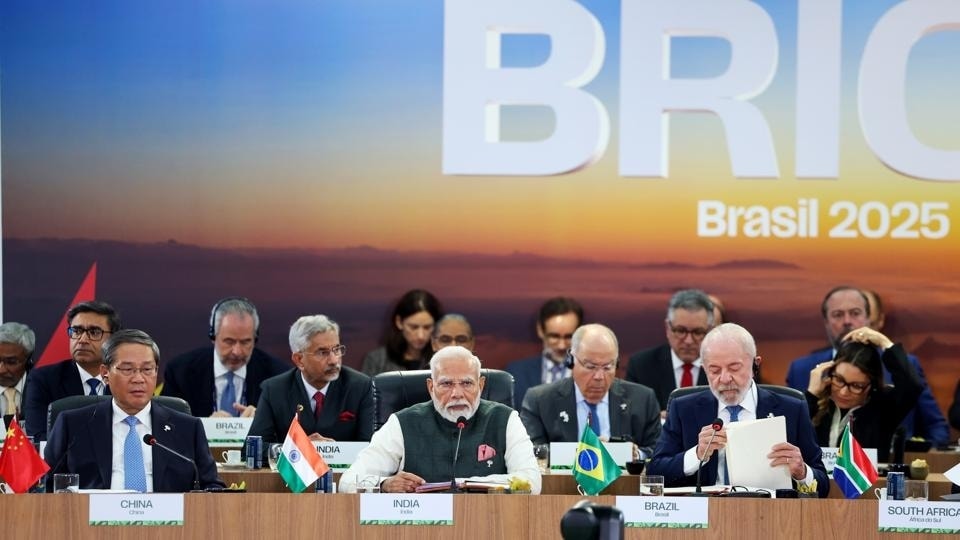
The Brics grouping held its first submit in 2009 as Bric in Russia. It included South Africa in 2010 to be later known as Brics, and now have expanded its membership to ten countries, and invited other ten countries as partners. BRICS+ represents nearly 50% of the global population, around 40% of the global GDP and nearly 26% of world trade. Brics, initially seen as an economic grouping of emerging market economies, later mutated to form a strategic geo-political forum advocating multilateralism, democracy, inclusion and representation in international institutions. Marking the 17th year of the summit in Brazil, this July, the bloc with its divergent political ideologies, objectives and economic sizes has stood together and strong against scepticism and opinions with regard to its imminent collapse. It’s not just the West which has been trying to write off Brics, but also many national scholars of repute who see little or nothing substantial in the summit- level declarations of the group. So, what could be the underpinnings?
History has been replete with innumerable examples of how diverse individuals and groups with collective action and strategic perseverance achieved their legitimate rights against greater might. Hence, it is no secret as to why some prominent Global South nations chose a forum to express their national interest and concerns in a world of hegemonic pressures. Apparently, with the failing of great power governance (GPG) to manage regional conflicts and mitigate other global crisis issues, Brics, since its inception, has been relentlessly advocating making global institutions like UNSC, IMF and World Bank more inclusive and representative. Prime Minister Modi remarked that when two thirds of humanity lack representation in these global institutions, it is their effectiveness and credibility which becomes questionable. Brics has acknowledged the significance of these institutions’ hold on global good governance, and hence reiterated the need for their urgent reforms to salvage the international order.
The Brazil 2025 BRICS summit was held with the theme of Strengthening Global South Cooperation for More Inclusive and Sustainable Governance. Some of the main highlights of the Rio Declaration has been the Brics leaders’ Framework Declaration on Climate Finance, Brics leaders’ Statement on the Global Governance of Artificial Intelligence (AI) and Brics Partnership for the Elimination of Socially Determined Diseases. These statements have found consensus and is believed to have widened the understanding of the delegates to formulate future policies in a coherent direction.
One of the interesting developments have been the proposal to mobilise $300 billion annually by 2035 for climate-related investments for developing countries. Amusingly, it juxtaposes the missed targets of the climate finance mechanism sponsored by the developed world. For the first time, Artificial Intelligence (AI) was discussed as one of the main agendas in Brics. With less than five years at hand, the potential of AI in driving inclusive and sustainable growth as per the UN SDGs 2030 was received with rave appreciation. Another laudable highlight was the issue of socially determined diseases, which occur as a result of poverty and inequitable access to resources. The summit, hence addressed the need for collaborating on building resilient health systems and financing universal health coverage for its elimination.
While reforming IMF and World Bank, it is imperative that WTO also needs a significant reshaping. Trade policies cannot be effective or sustainable if they are in contrast with monetary policies. The BRICS declaration also emphasised the need for rules based, open, transparent, consensus based multilateral trading system with WTO as its core and with special and differential treatment (S& DT) for developing countries.
Brics+ is not a conventional grouping of countries as it is spread across four different continents with varied governance systems, economic composition, growth rates and population. However, most of them share a history of colonialism and deprivation while sharing a common aspiration to grow and rise with dignity and sovereignty on the global stage. As a growing collective, it would stand as a force against unilateralism and unfair governance. It is proposed that India would give new form and flair to Brics in 2026 by reconstructing it. India, an assertive and persistent advocate of democracy and inclusion can take Brics+ to a next level of leadership without antagonising friends in the Global North.
This article is authored by BBL Madhukar, chairman, FORE School of Management, Co-Chairman & director general, Brics Chamber of Commerce & Industry, New Delhi.


