
 E-Paper



Finnish president makes a mark with a State visit to India
This article is authored by Rajiv Bhatia, Distinguished Fellow, Gateway House and former ambassador, New Delhi.

 Prefer HTon Google


Amid the fast-changing geopolitical landscape, European Union (EU) member States seem to have rediscovered the value of close cooperation with India, an Asian power with greater ambitions. India, too, finds that growth in partnership with the EU and the UK is a source of strategic comfort. Both sides are propelled to deeper mutual policy proximity by the pressures generated by Trump 2.0.
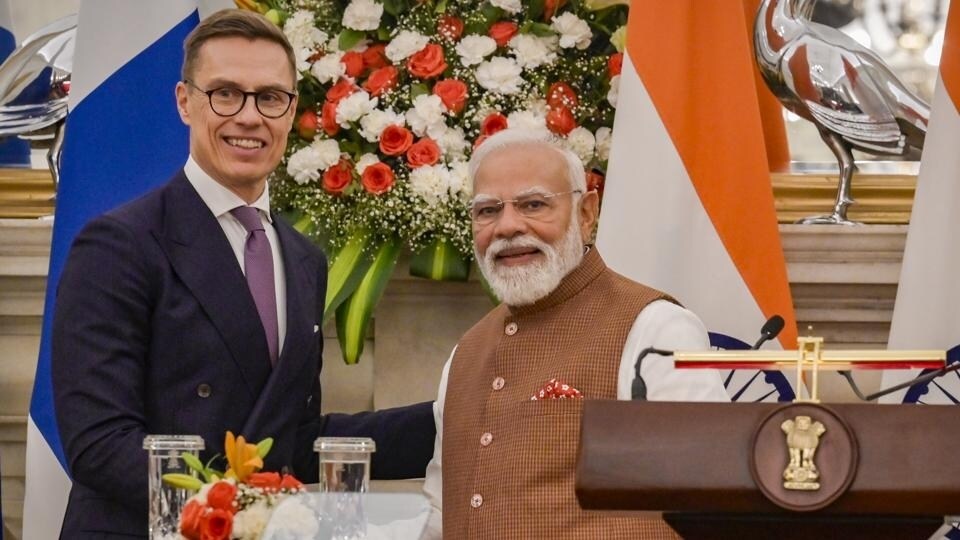
The visit of Alexander Stubb, President of Finland, to India (March 4–7) was rated as significant for several reasons. It was a State visit laden with elaborate protocol; he was the chief guest at the Raisina Dialogue, the flagship platform for global interaction created by the ministry of external affairs (MEA) and the Observer Research Foundation (ORF), and it produced concrete outcomes for bilateral partnership. Observers also noted that it was a rare instance of both the prime minister and the president of Finland visiting India within a brief period.
Despite its small population of five million and limited geographic size (65th in the world), Finland is an advanced industrial economy with a per capita income of over $54,000. It stands among the front-ranking nations in technology, particularly AI and telecommunications. Its delegation, led by Prime Minister (PM) Petteri Orpo, played an active role at the AI Impact Summit hosted by India. International awareness of Finland's importance increased tremendously after the outbreak of the Russia-Ukraine war. Helsinki abandoned its traditional neutrality and consciously chose to join NATO as a full member in April 2023.
The Indian establishment, participants in the Raisina Dialogue, as well as national and international media, had an opportunity to gain a first-hand glimpse of Finland’s worldview as President Stubb delivered the inaugural address on March 5, with PM Narendra Modi and others listening. He rejected the notion that the liberal world order was dead. “The fact that the rules are broken,” he insisted, “does not make all the system null and void any more than someone getting caught for speeding makes speeding limits irrelevant.” He conceded, however, that the world order was changing; the global balance of power had shifted; and the Western-dominated world may be replaced by one shaped by the Global South and a country such as India. He generously depicted India “as a major power.”
Stubb strongly articulated his refusal to believe that “the future will only belong to two great powers.” Asserting that this should not be allowed, he called for a multipolar order and for reform in the UN, WTO, and Bretton Woods institutions. An advocate of a dignified foreign policy, he underlined the need to create an atmosphere of dialogue and engagement with one another on an equal footing and with respect.
With such an enlightened outlook, the Finnish President held fruitful discussions with the Indian side. The two governments readily agreed to elevate bilateral relations to “Strategic Partnership in Digitalisation and Sustainability.” Their joint statement establishes a cross-sectoral working group on digitalisation to produce concrete, substantial actions. AI-related domains and space tech may be accorded priority. As regards sustainability, the focus on cooperation will be on such fields as ocean energy solutions, biofuels, smart grids, and green hydrogen. A joint working group on sustainability will drive future dialogue and the crafting of cooperation schemes. Finland, according to experts, has globally recognized expertise in clean technology and renewable energy, which are priorities for India.
Concerning multilateral cooperation, Finland’s clear support for upholding a rules-based international order and for India’s permanent membership of the reformed UN Security Council must have been music to the host’s ears. In line with the EU policy approach, Finland aligned itself with India in promoting “a free, open, peaceful and prosperous Indo-Pacific.” A brief reference to the United Nations Convention on the Law of the Sea (UNCLOS) was a joint coded signal sent to China. India also welcomed Finland’s decision to join the Indo-Pacific Oceans Initiative, which is still awaiting a real takeoff. An agreement was also reached on strengthening cooperation in Arctic-related areas. Besides, Finland expressed support for India’s fight against terrorism, including cross-border terrorism.
However, there were specific areas of difference too, such as the West Asian conflict and the Russia-Ukraine war. Both issues were discussed, but divergences in their perspectives were evident in the joint statement's little mention of them.
Three MOUs were signed, including one on migration and mobility. Among the eight announcements made at the conclusion of the presidential visit were the resolve to double bilateral trade (currently at $3 billion) by 2030, in line with the conclusion of the historic India-EU Free Trade Agreement (FTA); creation of a joint task force on 6G; and greater connectivity of the startup ecosystems through the India-Finland Startup Corridor. About 33,000 Indians are in Finland, most of them young professionals working in the IT sector. New opportunities are likely to be created for them. The two sides also agreed to co-host a World Circular Economy Forum in India in 2026 and to establish a consular dialogue between the two foreign ministries. After completing his programme in Delhi, the president visited Mumbai, met the chief minister, and addressed a business event and students at Bombay University.
PM Modi mentioned that Nokia's mobile phones and telecom networks “connected millions of people across India,” adding that the president’s visit and the new partnership would provide “momentum and new energy to our cooperation across several high-technology sectors,” including telecommunications and quantum computing. While briefing the media, a senior MEA official observed that the visit, with its focus on three Ts – Trade, Technology, and Talent – was “very substantive and productive.”
Overall, it was a notable visit during which the shared goal was to deepen and expand practical bilateral cooperation, while expanding the contours of mutual strategic understanding on global developments and issues. Its real significance lies in confirmation that India and Europe remain on the same page geopolitically, despite certain differences in their global outlooks.
This article is authored by Rajiv Bhatia, Distinguished Fellow, Gateway House and former ambassador, New Delhi.


