
 E-Paper



US warships close in as Trump pressures Tehran
This article is authored by Prabhu Dayal, former ambassador, New Delhi.

 Prefer HTon Google


The US decision to deploy the USS Gerald R. Ford to join the USS Abraham Lincoln represents a significant military build-up aimed at pressuring Iran amid escalating regional tensions. The move aims to secure maritime routes, deter Iranian aggression, and provide maximum leverage in ongoing, high-stakes nuclear negotiations.
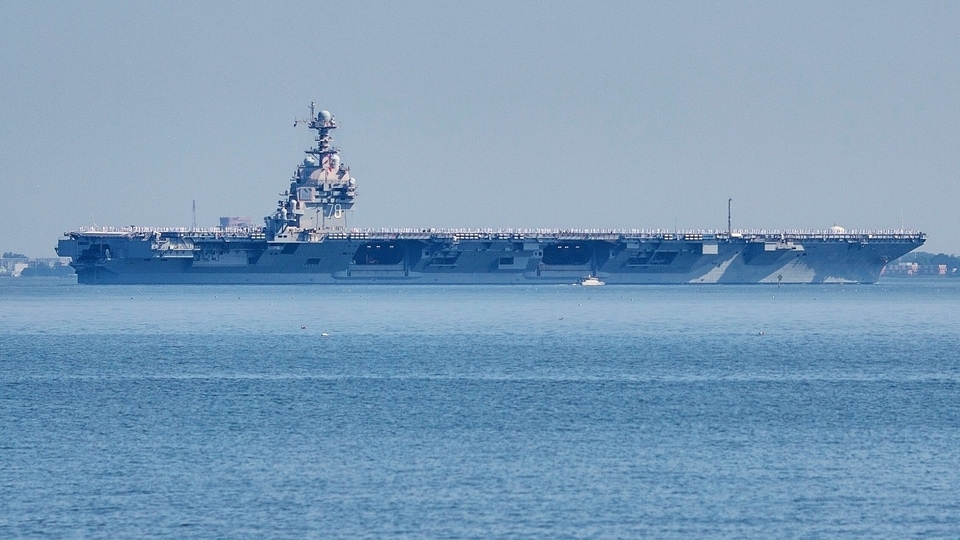
The deployment of the Ford—the world's largest aircraft carrier—significantly increases US air, naval, and missile capabilities in the region, allowing for potentially weeks-long military operations if ordered. The combined fleets bring over 150 advanced aircraft, hundreds of Tomahawk missiles, and sophisticated Aegis-equipped missile defences to the region. Operating from the sea allows the US to maintain strike capabilities without needing permission to use the airspace or territory of regional allies like the UAE, which has publicly restricted such use. The presence of two carriers enables the US to conduct sustained, multi-week military campaigns if necessary, rather than isolated strikes.
The Gerald R. Ford is being redirected from a long-term deployment in the Caribbean. The move reflects preparation for a sustained, multi-week military campaign rather than just a single strike, indicating the serious nature of the current standoff. The situation remains critical, and the next few weeks will determine if this massive show of force leads to a diplomatic breakthrough or direct conflict.
The build-up follows large-scale anti-government protests in Iran and a violent crackdown by authorities. The deployment coincides with President Trump's recent comments floating the idea that a "shift in power" in Tehran would be the "best thing that could happen". Despite his comments, Trump has repeatedly said that his preference is a diplomatic agreement. He recently told Israeli Prime Minister Netanyahu that nuclear talks with Tehran must continue. While Trump has used the term "regime change," Vice President JD Vance recently stated that the US is not actively pursuing it. Similarly, secretary of state Marco Rubio has noted that ousting the current leadership would be "far more complex" than previous efforts in other countries.
The deployment of the US fleets has significant geopolitical implications. It serves to project American power and strongly reassures regional allies, particularly Israel, as tensions rise regarding Iran’s nuclear programme and missile capabilities. This shift from mere containment to potential regime change has heightened regional fears of a full-scale war. While framed as "defensive," the deployment is viewed as increasing the risk of a wider regional war if a "small mistake" occurs.
The significance of this deployment lies in the fact that it is part of a deliberate, reinforced strategy to pressure Tehran to accept a new nuclear deal, with President Trump warning of "traumatic" consequences if negotiations fail. The deployment is a "peace through strength" tactic aimed at pressuring Iran during ongoing nuclear talks in Oman. President Trump has stated that the fleet is a "just in case" measure if diplomacy fails, warning of "very traumatic" consequences if a deal is not reached quickly. It also signals a rapid response capability. The presence of two carrier strike groups (USS Ford and USS Lincoln) provides massive, immediate air and missile strike capabilities (including F-35C fighters and Tomahawk missiles) to act against Iranian targets if ordered. The build-up is designed to deter Iran and its regional proxies from attacking US forces or commercial shipping, especially after recent incidents, including the shooting down of an Iranian drone by US forces.
The increased naval presence is also heavily focused on ensuring the freedom of navigation through the Strait of Hormuz, a critical choke point for global oil, which Iran has threatened to block. The carriers serve to prevent attacks on commercial shipping that have previously disrupted up to 12% of global trade through the region. The dual-carrier presence provides a formidable deterrent against potential Iranian attempts to block the Strait of Hormuz, a critical chokepoint for 20% of global oil trade. This aims to prevent a spike in global energy prices, which analysts warn could exceed $150 per barrel if conflict erupts.
The deployment of the USS Gerald R. Ford to the Persian Gulf comes a week after the indirect talks between the US and Iran, held in Muscat, Oman on February 6, 2026, and which were described by both sides as "positive" and "constructive". Iranian foreign minister Abbas Araghchi called the talks a "good start," and President Trump described them as "very good". However, there remained fundamental policy differences between the two sides. Iran flatly refused to end uranium enrichment or move its fuel offshore, which was a core US demand. Moreover, Washington pushed for a broader agreement that includes Iran’s ballistic missile programme and its support for regional proxies, while Iran maintained that talks should only focus on the nuclear issue. A second round of high-level nuclear negotiations between the US and Iran is scheduled for February 17 in Geneva, though reports indicate that an official date remains subject to final confirmation.
As things stand, the Trump administration has focused on exerting maximum pressure to force a new nuclear deal, aiming to contain Iran rather than engage in a total, resource-draining war. A direct war could be costly, unpredictable, and potentially lock the US into another long-term West Asia engagement. Despite the preference for diplomacy, US military officials have prepared for potential sustained operations against Iran if ordered, indicating readiness for escalation. A full-scale war could lead to the closure of the Strait of Hormuz and trigger retaliatory strikes on US bases in the region, including in Kuwait, Qatar, and Bahrain. The situation remains high-stakes, with both sides manoeuvering to avoid full-scale conflict while being prepared for it.
Summing up, against the above background, the future of US-Iran talks is currently at a critical and volatile crossroads, defined by a dual-track strategy of tentative diplomacy and intense military posturing. President Trump has coupled diplomatic outreach with the deployment of a "large armada" to the region, threatening "bad things" if a deal is not reached. On the other side, hardline factions in Tehran, including the IRGC and powerful clerics, have publicly dismissed the talks as a "political game," and Supreme Leader Ali Khamenei remains deeply sceptical of US intentions. Despite efforts to avoid full war, the region remains volatile and a "durable peace" appears difficult to achieve. On balance, it appears that both sides may eventually settle for a "temporary de-escalation", as neither side currently seeks a full-scale regional war.
This article is authored by Prabhu Dayal, former ambassador, New Delhi.


