
 E-Paper



When pitches in India are Judged, while pitches elsewhere are excused
This article is authored by Shishir Priyadarshi, president, Chintan Research Foundation, New Delhi, and Aman Kumar Singh, head, Chairman’s Office, Adani Group.

 Prefer HTon Google


To any avid follower of cricket, there appears to be an unspoken rule in global commentary. When a Test match in India finishes in two or three days, the pitch is swiftly put on trial. Elsewhere, the same outcome is treated as a benign anomaly, with the burden of failure placed on the batsmen rather than the pitch. This asymmetry is rarely acknowledged, yet it shapes the narrative around Indian conditions far more than evidence ever does.
To be clear, India is not above reproach. There have been occasions when pitches here have been under-prepared or have tilted too sharply towards bowlers. Acknowledging this is necessary if the debate is to be credible. But acknowledging this is very different from accepting the disproportionate, moralising scrutiny that Indian pitches attract compared to similar surfaces elsewhere.
That imbalance — not criticism per se — is what makes the debate troubling.
The recent fourth Ashes Test, which finished in barely two days on Australian soil, once again exposed how selectively outrage is deployed in international cricket discourse.
It is a broadly accepted principle of Test cricket that home conditions reflect a host nation’s strengths. No one expects Australia to flatten the Gabba, England to remove grass at Headingley, or South Africa to lower bounce at Centurion. These conditions are celebrated as part of cricket’s diversity and competitive character.
Yet when Indian pitches favour spin — historically, Idia’s greatest strength — criticism surfaces almost automatically, often infused with moral judgement. The implication is not merely that the contest was demanding, but that it was somehow illegitimate.
Sunil Gavaskar has long pointed out this inconsistency, arguing that there must be “one yardstick for pitches across the world.” Seam-friendly tracks are applauded as “sporting,” while turning tracks are condemned as “doctored.” That distinction reveals less about cricketing values and more about entrenched biases.
The Indore Test of the 2023 Border-Gavaskar Trophy was hardly the first flashpoint. After the match ended in just over two days, Australia captain Pat Cummins described the surface as “not ideal for Test cricket.” Former England captain Michael Vaughan went further, arguing that such pitches “damage the format.”
Similar reactions have followed the 2021 pink-ball Test in Ahmedabad, which finished inside two days after England collapsed against spin. That match prompted calls for sanctions and a “poor” pitch rating, even though teams struggled equally.
What is striking is how often outrage correlates with outcome. When visiting teams lose in India, the pitch becomes the story. When they win, the narrative changes. New Zealand and South Africa both secured Test victories in India on turning tracks in recent years, and those matches passed without controversy or accusations of unfairness. The silence then was revealing.
As Gavaskar has noted, technical failure against spin is rarely framed as a batting deficiency in the same way struggles against pace are elsewhere.
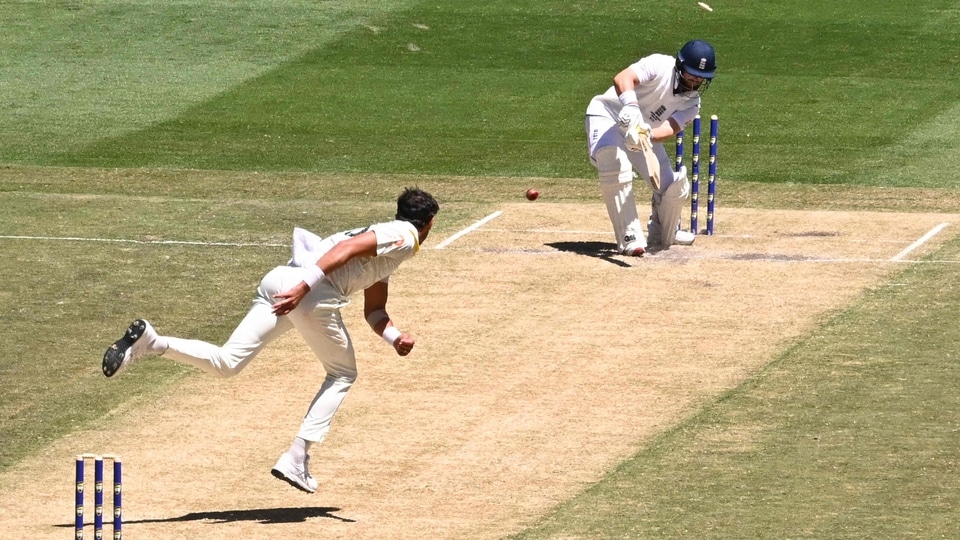
Contrast this with the reaction to the recently concluded fourth Ashes Test, which ended in two days on a seaming Australian pitch. Thirty-six wickets fell on a surface offering extravagant movement from the very first session. Batting became an exercise in survival.
England captain Ben Stokes did concede that “a Boxing Day Test finishing in less than two days is not ideal.” But the tone was notably restrained. There were no allegations of intent, no suggestions that Australia was undermining Test cricket, and no calls for punitive ratings. That silence is instructive.
After the Indore Test, former Australian wicketkeeper Ian Healy had gone beyond critique, declaring: “India just don’t want five-day Test matches.” It was an accusation about motive, not merely conditions. Yet after a marquee Ashes Test collapsed just as quickly on Australian soil, such moral outrage was conspicuously absent.
At the heart of this double standard lies an uncomfortable truth: Spin-dominated cricket is still viewed by sections of the western cricket establishment as less legitimate than pace-dominated cricket.
When a ball seams violently on a green top, it is described as “testing.” When a ball turns sharply in India, it becomes “excessive.” The same outcome — batters struggling and matches ending early — is judged differently depending on geography and bowling style.
This is not really about match duration. Tests in South Africa and New Zealand have ended in under three days without triggering moral panic. But when spin is the decisive factor, particularly in the subcontinent, curators are quickly cast as villains.
This is not an argument for defending poor surfaces anywhere. If pitches — whether in India, Australia, or England — produce randomness rather than a genuine contest of skill, they deserve scrutiny. But scrutiny must be consistent, not selective.
If two-day Tests are said to damage the format, that concern must apply universally. If intent is questioned in India, it must also be questioned elsewhere. Anything less is not analysis; it is bias.
There is also a final truth Indians must confront. We attach disproportionate importance to what Western media and former players say about our cricket. Every column in London or Melbourne is dissected endlessly at home. But those commentators in western media rarely pause to examine what Indian newspapers write about their cricketing biases? Unlikely.
Respect in international cricket is not secured through validation; it is asserted through performance and self-belief.
Test cricket deserves honesty; Indian pitches deserve fairness; and hypocrisy deserves to be called out.
This article is authored by Shishir Priyadarshi, president, Chintan Research Foundation, New Delhi, and Aman Kumar Singh, head, Chairman’s Office, Adani Group.


