
 E-Paper



Statehood or not: Kejriwal will be evaluated on his ability to fulfil promises
A demand for full statehood is fine but Delhi’s chief ministerial designate Arvind Kejriwal will have to work closely with the BJP led Centre to deliver on his 70-odd promises. People in the capital will evaluate Kejriwal on his ability to implement his developmental agenda and getting statehood will be incremental gain.


A demand for full statehood is fine but Delhi’s chief ministerial designate Arvind Kejriwal will have to work closely with the BJP led Centre to deliver on his 70-odd promises. People in the capital will evaluate Kejriwal on his ability to implement his developmental agenda and getting statehood will be incremental gain.
It would not be prudent to believe that the Centre will accede to Kejriwal’s statehood demand as it has jurisdictional and security complexities which has been debated by legal experts since Independence. And the uniform conclusion had been that the national capital should not get the status similar to other states when it comes to control over land and police.
The issue was debated in the Constituent Assembly and the majority view was Delhi should be a Union Territory under direct control of the Central government. The assembly had studied status of the national capitals of three federal countries – United States, Canada and Australia --- and found them to be under control of the Federal government. And that was the reason the Constituent Assembly decided that Delhi should be a Union Territory with Lieutenant Governor as Centre’s nominee.
The issue was also deliberated by the State Reorganisation Commission constituted in 1953 to define state boundaries and it upheld the view of the Constituent Assembly. The latest to examine the issue was the Sarkaria Commission, which in 1989 recommended an assembly with limited powers for Delhi but kept land and law and order with the Central government.
The commission had said that granting full statehood to Delhi would mean loss in revenue assured by the Central government for development of the city. If Delhi gets full statehood, the Centre will be obliged to provide only 10% of the total funding as per Gadgil-Mukherjee formula. As of now, half of the Delhi’s gross budgetary support comes from Central government as it is a Union Territory.
Why so much brouhaha over statehood by the Delhi leaders? The answer is simple. Statehood will give power to the political class to play a role in transfer of police officers and allocation of land like in other states, a cause for corruption there.
If statehood was so crucial governance in all other states would have been much better than in Delhi.
Former Delhi legislative assembly secretary SK Sharma believes granting full statehood to Delhi is not feasible in present circumstances and it will not improve the lives of people. “Yes, it will give power to the political class and they would be better-off,” he said.
For a common Delhi resident, who voted emphatically for Aam Aadmi Party, statehood is not relevant. They did not vote for Kejriwal to get statehood. They have voted for him to usher in a new developmental spectre which could be difficult without a cordial relationship with the Centre.
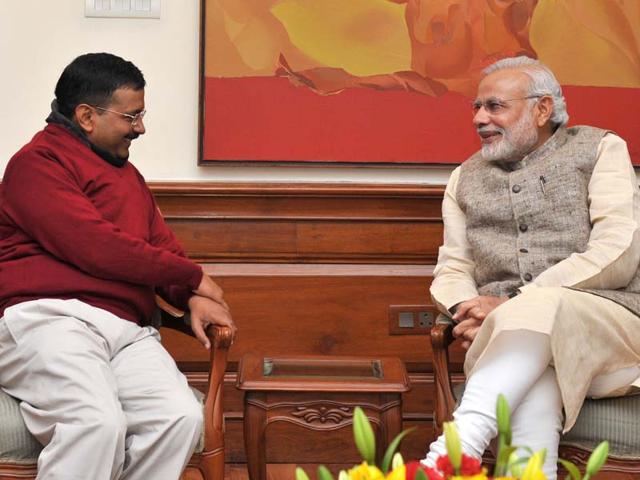
Kejriwal had started on the correct note by meeting Prime Minister Narendra Modi and other senior functionaries of the Central government who could ensure that his promises are delivered rather than being confrontationist as was the case in 2013.
Time will tell what comes into play --- cooperative federalism or party politics!


