
 E-Paper



Texture hunting is blowing up online, but what does it even mean?
The trend that turns urban surfaces into keepsakes is reshaping everything from journaling to design, and reconnecting travellers with the textures of place.

 Prefer HTon Google


If you are someone who is chronically online, you might have been told to disconnect from screens and go outside to experience the real world by “touching grass”. And now you can do that while making it a fulfilling activity. Texture hunting, the pastime activity of pressing non-toxic clay or a kneadable eraser against walls, manhole covers, locks and metal signs to lift a print into your notebook, has quietly turned into a travel micro-trend.
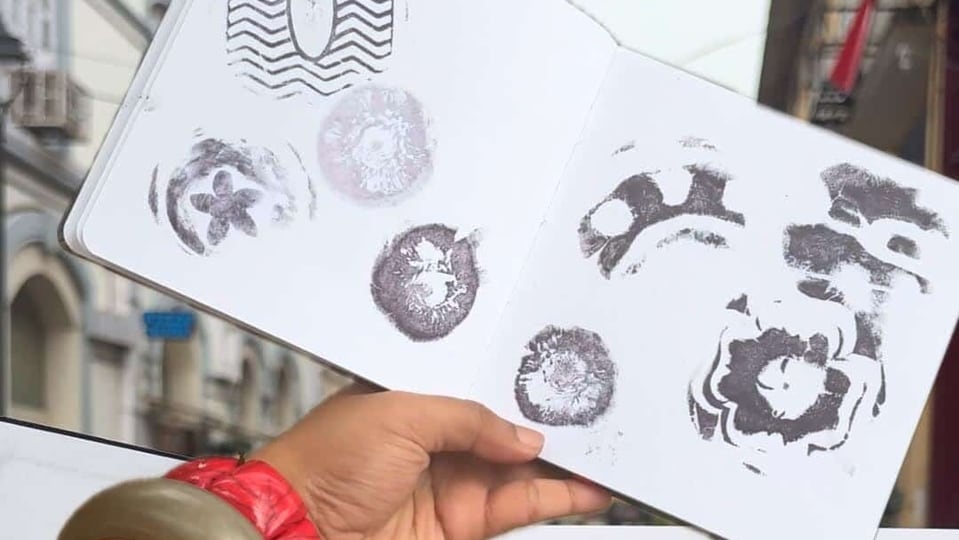
The trend went viral when creator @readinglolita shared a reel tracing textures and making prints during her trip to Barcelona with friends, earning over 5.9 million views.
In an era where “touching grass” has been repurposed from an online rebuke into a call for mindful presence, fingerprinting the world’s surfaces becomes a slow activity that makes you map the tactile personality of a place for memories or before it fades with time
What is the trend?
Texture hunting is simple: kneadable eraser or non-toxic clay pressed on found surfaces, then inked and stamped into a journal. It’s a scavenger hunt for patterns like the cracked paint of an old shopfront, the embossed letters on a railway gate, the saucer-sized rosette at a heritage cafe. Practitioners call it everything from texture hunting to texture stamping; to them, it’s a practice of noticing. As Erica Dias (@reynasgrey) explains, “I’ve always liked the idea of collecting souvenirs and journaling… I saw a reel, searched the hashtag texture hunting, and realised no one in Bombay was doing it at the time. So why not?”
What you need
The kit is intentionally low-fi: a kneadable eraser or non-toxic clay (safer for surfaces), a portable ink pad, and a journal. Erica’s advice is practical: “Use a kneadable eraser or clay that’s non-toxic… sometimes the clay can stain or damage a surface if it’s not the right kind.” Keep the clay small for delicate details, she favours locks and small architectural flourishes, and bring patience.
How does it help your travel?
Texture hunting reframes travel from a checklist to a living-in-the-moment practice. Instead of ticking monuments, you learn the details of a neighbourhood. Erica found that South Bombay’s “texture personality” - fonts, manhole covers, street patterns - told a story she’d walked past for years without noticing. The hunt forces slow walking, prolonged looking and, crucially, touching different surfaces. For travellers, that means a richer archive of places that’s portable, personal and impossible to replicate unless you are there in person.
How people are using it in journaling
Junk-journalers and notebook collectors have grafted texture stamps into their spreads as proof of place. While not everything you stamp will look good on the go, since some textures look better in the field than on paper — and that imperfection is part of the aesthetic: “Don’t focus on getting the prettiest stamp. Be okay with owning whatever happens once you start," adds Erica.
How is it evolving
Designers are mining these tactile archives for authenticity. Texture lifts bring elements and grit into menus, album artwork, brand collateral and editorial layouts. Graphic designers across countries have texture hunted the texture of walls to even imprinting signs for new fonts. Akhoury Abhishek, Director at Pause Design says textures are one of his favourite secret weapons in design: “A soft paper grain, a rough concrete wall, a smudge of ink. Each one adds mood, history and a bit of beautiful imperfection. Used intelligently, textures give a project soul, originality and a sense that it exists in the real world, not just on screen. Collecting textures and building up a personal library should be a constant pursuit of the thoughtful designer.” In a digital age of clean vectors, stamped textures give a handcrafted edge.
Texture hunting as therapy and testimony
For art therapist Emily Sharp from Copenhagen, who has gone viral for texture-hunting across Denmark and Greece, the practice is a tactile form of grounding that supports wellbeing. “When you press your palm to a wall and lift a pattern, you’re naming the place with your body,” she says. “It’s small, sensorimotor work that calms the nervous system and stitches memory to matter.” That double function, therapeutic and documentary, explains why the trend has spread among creatives, therapists and travellers who want souvenirs with use value.


