
 E-Paper



11 states told to increase testing, create more containment zones
The states have also been told to review death rates by hospitals and come up with a strategy to stop late admission in hospitals and non-adherence to the National Clinical Management Protocol.


The Centre on Friday told 11 states that are seeing a surge in Covid-19 cases to continuously increase testing to bring down positivity rate to 5% or less, ensure that 70% of the tests are the accurate RT-PCR ones, and create more containment zones as parts of an elaborate emergency action plan, at a meeting chaired by cabinet secretary Rajiv Gauba.
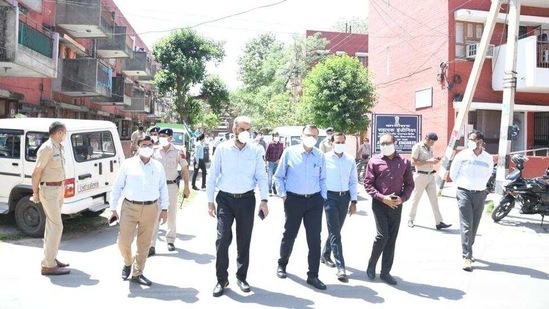
The states have also been told to review death rates by hospitals and come up with a strategy to stop late admission in hospitals and non-adherence to the National Clinical Management Protocol. The union government also wants district-wise action plans with a “focus on mapping of cases, reviewing of ward/block wise indicators” and 24X7 Emergency Operations Centre. The government has also advised strict imposition of penalties on defaulters.
The meeting concluded that the situation is particularly worrying in Maharashtra, Punjab, and Chattisgarh. It also recommended five “tools”: “vaccination, enhanced testing, strict containment, prompt contact tracing, and enforcement of Covid appropriate behaviour.”
The meeting, attended by state chief secretaries and director generals of police, senior officials from the health ministry, ICMR, NCDC, and Niti Aayog came against the backdrop of a surge in cases across India. On Friday, India recorded 89,030 cases, the highest since September 19, 2020, according to HT’s dashboard.
Maharashtra was told to take up “immediate and high effective measures” to contain active cases and the death toll through a strict clinical management protocol that was shared earlier with all states.
In the meeting, union home secretary Ajay Bhalla expressed anguish and observed that even amidst the rapid surge of Covid cases, none of the states/ UTs have shown “commensurate increase in enforcement of containment activities” . Dr V. K. Paul, member Niti Ayog, emphasized that the states follow a protocol for sharing clinical and epidemiological data for detailed study of mutant strains of virus.
Several experts are of the view that these so-called variants of concern or VOCs are behind the surge, especially in states such as Maharashtra and Punjab.
The 11 states and union territories that attended the meeting were: Maharashtra, Punjab, Karnataka, Kerala, Chhattisgarh, Chandigarh, Gujarat, Madhya Pradesh, Tamil Nadu, Delhi and Haryana. Together, the 11, described by Gauba as “states of grave concern” accounted for 90% of Covid cases and 90.5% of deaths in the past 14 days (as on March 31). Some of them have also crossed their early reported peaks in last year.
After a detailed and comprehensive review, Gauba told the states that waiting time for test results has to be reduced and Rapid Antigen Tests (RAT) should be used for screening in densely populated areas and places where new cluster of cases are emerging.
The cabinet secretary also added that “all symptomatic RAT negatives be mandatorily subjected to RT-PCR tests,” according to an official release. Last month, Prime Minister Narendra Modi too, emphasized on RT-PCR tests over RAT during his meeting with the chief ministers. RT-PCR tests are the gold standard of testing and considered very accurate. Rapid Antigen Tests throw up a lot of false negatives -- identifying infected people as uninfected.
The states have been also asked to ensure effective and prompt isolation of the affected in institutional facilities and daily monitoring of patients isolated at home, and the immediate transfer, if required of isolated people who test positive.
Emphasizing contact tracing, Gauba and other union secretaries insisted that at least 25 close contacts should be traced for each infected person and that this be done within 72 hours of the person testing positive.
The centre has also reiterated the need to define containment zones and micro containment zones to break the chain of transmission.
The 11 states and union territories were told to increase the number of isolation beds, oxygen beds, ventilators/ICU beds and planned oxygen supply.


